The Golden Tamaracks

From the bridge on Route 30, facing Simon Pond, across from Raquette Pond and Tupper River.

It was a mustard-and-rust-colored couple of fall days through the northern Adirondacks, driving Keene Valley and Lake Placid, returning via Blue Mountain Lake and Speculator. The white trunks of broken-topped birches climbed up the side of Route 73/9N along the rocky AuSable River.  Rain had been heavy the previous week, so High Falls Gorge rushed amber with hemlock tannin’d water, reminding me of Tahquamenon Falls in Michigan’s Upper Peninsula, colored also by swamp trees. I piloted my car next to flowing mountain ridges covered with smoky smears, indicating trees whose leaves had already fallen; but then there were these spires of gold, stands of trees matted in green by the pines and balsam firs around and behind them.

The instant these particular trees sparkled at me from a distance, I was entranced; they seemed like perfect Christmas trees, but colored flaxen and lit from within. What were they?

Tamaracks, I was told. What a poetic name for a tree, an Algonquian name I learned later, the only deciduous conifer–a tree that seasonally loses its needles, with a color change first from bright green to yellow.

Tamarack. Here was a plant I’d heard mentioned as part of the name of a place–Tamarack Lodge, Tamarack Inn–but never observed live. Didn’t know they were the source of turpentine, or another moniker for a Larch.  I’d even seen the outlines of them on wood signs, just thought it was Plain Ol’ Woods, or Evergreens. And here they aren’t ever-green at all.

Ecstatic with their discovery, I spent my day searching for a wonderful picture to take of the Golden Tamaracks. My travel companion told me they show up in patches here and there, but warned they would not be seen when we headed south, out of the spruce flats of the Adirondack Park.  I spied them here and there, but the roadside shoulder was too narrow to park on, or shadows marred their brilliance. Some half-way passable photos were taken at a quick muddy pullover, but electric lines disfigured the oh-so-unforgettable vista I craved in my viewfinder. I comforted myself with more common rust colored beech leaves and the sparse quaking aspen foliage.

Beech leaves, which will stay on the trees all winter, dabbing the snowy landscape with splashes of brown.

Finally, at the end of the day, heading back to the main road from a side trip up Route 8 in Wells, we came upon a single glorious glowing larch, lit by the sunset beyond it, a calendar-perfect shot backed by the curves of the mountains. And yet…I was tired from the fresh air of the day, the five hundred snaps already taken, watching river otters and walking out to Oxbow Marsh at The Wild Center in Tupper Lake.  I didn’t want to stop the car and get out yet another time.

So in my lethargy I sat back and watched the tamarack approach, growing taller then taller still, rising like the trunk and down-thrust arms of a giant slender woman, until I was finally staring from below, a child gawping up at the enormity of its towering parent.

The sun behind revealed the black bumpy outlines of the very top shoots, and I twisted my head around to see the back of it, as my auto moved on into the setting sunlight of Route 30 south.

Then the golden tamarack was past, gone, somehow irretrievable even though I could have stopped the car and turned around.  As soon as the moment was over, I regretted not photographing it. It became a lost moment, like other lost moments, not seized fully, followed by wondering if I would try to recapture it ever after.

But–I wanted to live it, see it, feel my mouth widen into an O as we advanced on the tree, let the light of the west-falling sun hit the back of my eyeballs, fully; hold that–and let it go. I decided to make do with the other, less impressive photos, to remind me of the one that got away, my own catch and release program for that single vision–only with a mental catch, then mental release. Of course now I attempt to relive it in words, amorphous dances around the reality, redrawing the picture in my head from many angles.

Even this morning, I see the yellow elm leaves outside my kitchen window carried off by the insistent wind, my red ivy leaves thumping the window hard as they fall, the ivy opposite now deepening its blush and splashing Neapolitan against the brick. I feel the urge to take pictures of the shift, but don’t; I can’t stop the change, can’t hold every second, have to let some of them go, and allow the memory to mellow into blurred edges, warm thoughts, awareness of having had an experience without clutching desperately at specificity of the details.

Autumn has come. Autumn will go. In the winter, spring and summer–indeed, until I can search them out again next fall–I will remember (not through a spectacular photo) that I have discovered Golden Tamaracks.

Golden Tamaracks in the Adirondack Park
Washing Dishes

Today’s view from the kitchen window

There the pile sits in the morning kitchen: water glasses with lip marks and fingerprints; small plates smeared with food, accompanying utensils splayed over them; tea cups and travel mugs with rings of dried milk and sugar; plastic leftover containers, greasy lids akimbo.

Usually it doesn’t feel like an onerous chore. But a not-unexpected sadness has come to nest in my house this fall.

I know that when you lose someone, like I’ve lost J, you revisit your other deaths, especially those you have not finished mourning. You acknowledge and examine the loss of friends, places, homes, relationships, belongings, patterns of behavior, certainty.

That is the work I am doing.

Part of the floundering has included a scary disinclination to write, choosing entertainment over introspection, an old habit I thought I was done with. I haven’t felt like cooking. Or even cleaning up after the take-out.

But then I remember J half-joking, half-begging: With these lungs, I may not be able to vacuum or dust, but I can still stand here and wash a few dishes. Just let me do them!

A little bleary-eyed, still in slippers and ‘jammies, I set up the water boiler on the counter, fill the empty ice cube trays and put away the clean dishes washed a week ago.

Another voice from the dead, Great-Aunt Helen, whose legs were heavy and painful, fingers mangled by arthritis: This is my house and don’t you touch those dishes!

But Aunt Helen, we helped make this mess, and you must be tired after baking cookies and Mahogany Cake–and cooking brisket and dirty rice. It will be so much easier for us to clean up.

We’all are gonna sit in the screen room, have some Dr. Pepper, and listen to the night sounds. Leave the dishes ‘til morning! When I wash ‘em up tomorrow, I can take as long as I want and relive all the arguments, and the jokes, and the silliness. I know you mean well, but I want to remember the good time we had while dirtying these very dishes.  No arguments; it’s settled.

So today at the sink I pay monk-like attention to details: the sound of the tea water moving toward a boil, then the smooth matte surface of robin’s egg and gold stoneware plates in the sink, essential oil of lavender soap bubbling my hands.

I remember the phone conversation with a fellow writer while I drank the Earl Gray Cream out of this Shakespeare Quotes mug, and commiseration with an out-of-work friend accompanied by Russian Caravan in that blue flowered cup.

Having reached temperature, the water in the boiler is poured over loose Truffle black tea, bits of dried coconut and chocolate chips visible. Back at the sink while it steeps, I revisit Lad Nar over garden green beans here, the half sandwich left from a writing session at Professor Java’s there, and an apple-farm Honeycrisp purchased in September after a sunny bike ride along the Mohawk River, sliced carefully onto a blackberry colored plate. Washing, rinsing. Washing, rinsing.

October ivy

Outside the window, ivy reddens on my building, the green ivy opposite just barely blushing yet. Rain pelts the cars rushing by and students grind wet gravel underfoot as they hurry to class. Up the hill, willows and maples and birches and oaks are all changing color at different speeds.

I scrub to get every bit of scrud off a pot, rinse it thoroughly in hot water, then place all the dishes one by one on the gas stove so as to be perfectly dried by the heat of the pilot lights. When ready, there will be the satisfaction of putting each plate, each mug, in its own place once again.

After the fixtures and counter are wiped down and dry, I pour a cup of tea and finally, finally make the frittata I planned a week ago.

It consists of: freezer spinach overdue for use, a teeny green pepper from my garden (one of five whose existence completely surprised me two weeks ago), four ounces of muenster cheese, half a white onion, a teaspoon of salt, some crumbled dried sage from another friend’s garden, a pinch of nutmeg, six local eggs, a couple tablespoons of flour to thicken. Out of milk, haven’t gotten myself to the store, so I just steam all the veggies in the microwave, keep the liquid, and stir it all together with a tablespoon of butter chopped up.

I bake the sun-yellow concoction in a greased oval pan in my convection toaster oven at 375 for 15 minutes. With puffy browned edges, eaten off a pretty green plate, the frittata tastes of warm kitchens past and present, meals present and savory meals to come.

Tomorrow morning I will make tea and wash these dishes, too.  No arguments; it’s settled.

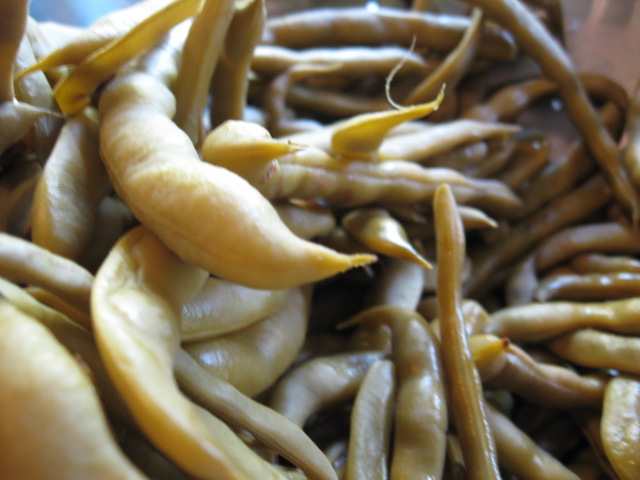
Grief and Green Beans

I harvested the last of my pole beans before J went into hospice. The beans are a bit of trouble, since they take forever to steam to softness, and thick strings seam each pod–hence the name “string” beans. A bag kept them fresh in the fridge while I travelled first to say goodbye to J and, two weeks later, to her memorial.

Late one evening after my second flight home, I cooked and cooked the green beans, drained and stuck them in the fridge for later processing.  A friend took me to wander in Vermont, to touch handmade dishes and pause at autumn leaves in the mist. And talk about J.

Home again, there they sit in the fridge, those green beans. De-stringing and freezing loom but I am too tired. I swim through the air as if it were thin syrup, every day or so surprised by forgetting and remembering suddenly, with a sharp inhale, that J is gone.

I don’t even want to open the container, afraid the beans will be moldy, but in a way hoping they will be, because I find myself unable to make decisions. Especially since, after the leaf peeping, the seven year old computer I’d been nursing along just up and died, Zap! screen gone to black. Finally I have to buy the new computer I’ve talked about and put off for months–the money’s in the bank but it will involve more thought, more study, change more change.

On the dead computer I had written three perfect paragraphs to open this week’s post, the only document not backed up to my external hard drive. Now I can’t remember the story. It certainly had nothing to do with string-beans.

I look in the fridge. Just a small bowl of beans, not quarts and quarts, but I hate to waste food, waste all the time planting seeds, watering through drought, harvesting, boiling–yet perhaps it is too late already; maybe the universe and time passing made the decision for me, just like the computer, just like J’s death, can’t put it off, have to face it, I’ve spent my time how I’ve spent it and here I am.

Ghosts of old surgical pain visit in the afternoon: the sore throat memory of intubation and a deep ache under the ribs. Front teeth throb, revealing I’ve been literally gnashing my teeth during sleep. On the yoga mat, tears come up, the ones held in during the expected talking about her death, the rearranging of schedule and inevitable too-soon return to regular life. I am swept along by daily chores and interactions, like currents pulling at me while I stand in a lake, when all I want is to float without effort, study the changing color of the sky and view fluttering fall leaves reflecting in the water’s surface.

We are always asking to be able to slow down and now I feel more stuck than blessed in my slowed-down-ness.

Serendipitously, my best friend comes to visit from out of state, and speaks that language of not-having-to-speak, of long history together. She drives me to the computer store.

I hear the strange notes my speech strikes, mind-on-grief, describing my work to the saleswoman:  The blog’s about living in the moment, has turned out mostly about gardening, gardening as metaphor for life, but lately it is about death; hearing how flat and dark that sounds, my best friend does what I usually do, elaborates for clarity–because a dear friend of hers died recently. The computer has to be special-ordered; I only complete the purchase because the best friend stands next to me.

After she leaves, I think of Thai food delivery but feel guilt over beans already cooked.

What would J have said?

Don’t worry….think of all the food you DID freeze, make into soup, share with others this summer.

We could order pizza; remember last winter when you taught me I could eat it for breakfast?

Have some more tea.  A new laptop, how exciting! Let me tell you a story about–

I toss the smelly green beans and order takeout. I stare at the auburn and gold out my window. I sit and cry over loss–unintended loss, and loss you can’t put off. I borrow a computer to write and post. 

I live in grief-time.

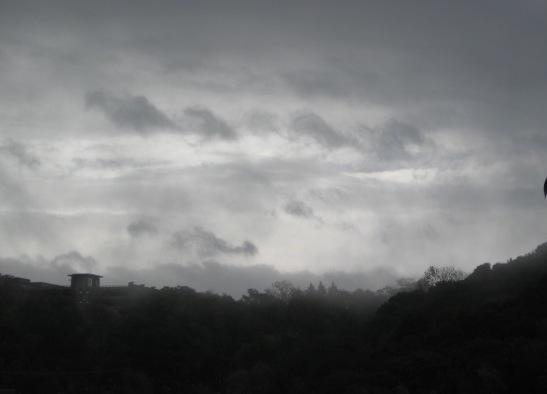
A vista to ponder, Bennington VT


Mind-Out-Of-Time: Writing, and Teapots

My teapot from J, tucked behind an electric kettle, another teapot, and a locally crafted mug,  on my early morning countertop.

I miss talking to J about my writing life.

This afternoon I will concentrate on writing, I’d say.  I’m deliberately ‘concentrating on,’ not ‘working on’–no more of the furrowed brow that ‘work on’ entails.

She’d laugh.  I used to have that furrowed brow, too; hell, look at my wrinkly forehead.  J would talk about the struggle to get to her drawing, even with new chalks and paints around her, how daily chores and her own busy mind pulled her away from something she’d never had time for, yet couldn’t quite get to, even now.  She’d encourage me to keep going, and I’d tell her more.

When I give myself over to writing, or create space for it, then I can relax and play. It’s what I call Mind-Out-Of-Time, what I sometimes think heaven is or would be: you are so involved in something that clock hands move unnoticed, you look up and the afternoon light is bending across your desk and you gasp–how long have I been here?

Mind-Out-Of-Time comes also when I choose to immerse myself in how life looks and feels, tastes, sounds and smells. It comes when I give myself permission to be right where I am, at that very moment, open to pleasure even in the midst of pain.

So I think of J, steeping tea in her beautiful cobalt blue teapot, when I came to visit six months ago. Napkins in hand, she danced oxygen tubing between pieces of furniture as I carried the prepared cups and cookies to the front room. We laughed about how, on our last big trip, she’d pulled her portable oxygenator, nicknamed ‘Fred’ after her father, all over the up-and-down hills of downtown Vancouver.  Fred sure got a workout, didn’t he? Took care of me just like Dad did.  We discussed once again her wish to die at home.  She asked after my teapot, a twin of hers, which she gave me when I moved away. Every time I make tea in it I think of you, I told her.

Two weeks ago, her caregivers still made English Breakfast in her blue teapot; she rested in the home hospital bed, I held the mug, she sipped sweet lukewarm liquid with a straw.  During the moments she was awake, she rolled her eyes sardonically, joking with only a few words about the little yellow curlers in her hair that looked like baby corn; I teased her back about how she finally got us all to wait on her hand and foot, and more seriously, how much we loved doing it.  As she drifted into medicated rest, she murmured about death, it will be pleasant; it will be pleasant. See you on the other side.

After the memorial service last weekend, I wrapped up the cobalt blue teapot in crinkly paper, to deliver it safely to her chaplain, someone who’d shared tea with her every Wednesday for many years, someone whom I suspect also understood mind-out-of-time with her.  I took one of her mugs and packaged one for yet another friend.

This morning, kitchen lights reflect on the curve of my round teapot as rain drips down the apartment windows.  Cars splash black puddles up into the air outside.  J’s goldenrod colored, cartoon-cat covered mug, full of toffee-chocolate-hazelnut tea, sits beside my keyboard.

Guess what.  I’m still talking to J about my writing life.

Living in the Moment: Friendship

Fire tower at Goodnow Mountain

My garden is end-of-season-neglected, but not because all the vegetables have been harvested.

I am not sure what I will find when I return to it, much like I was not sure what I would find when I sat last week in the front room of my friend J, who entered hospice three weeks ago.

Before that visit, she called me.

Hi, it’s Me. I’m really, really sick you know.

J, my dear–sick in the mind or sick in the body? Or sicker in both? Tee hee! Is there a prosecutable offense involved? Or lots of juicy drama?–

–Actually, the pulmonary fibrosis has progressed. A lot.

Oh.  Well, you and I knew that would happen eventually.

At 74, I’m not afraid of dying. I just don’t want to be intubated again.  I don’t want to be poked or prodded or in pain.

Your DNR orders and advance directives—we’ve made sure that won’t happen.

Oh, enough about me! What have you been up to?

J, I hiked a little mountain this weekend, Goodnow, near Santanoni. It took about three hours; the trail was full of tree roots and rocks.  And then I went up the fire tower.

I don’t think I could do it, climb that mountain.

Not with your oxygen tank, no. But perhaps we could get one of those things you sit on, a litter, with the four guys, to carry you up.

Only if they are hunky.

Ok. And fancy tassels will hang off this, waddya call it, palanquin, that’s it! With soft pillows for you to recline on.

And a scarf! I want to wear a white scarf, flowing in the breeze. But wait, what about that dancer, who got strangled by her scarf?  What was her name?

Isadora Duncan! Hmm. I will plan for a fifth guy, who will be there just to make sure the scarf swirls around artistically but doesn’t choke you.

How was it, the mountain?

You could see peaks all around for 360 degrees. The Adirondack lakes below were so cold and clear and blue. My knees were shaking while I climbed and then I was so scared of the heights I was growling like a wild animal to keep myself moving on the stairs! Hanging off the metal fire tower, that was perched on the rock, over those fall colored trees, up on the mountaintop–I was on the edge of the world.

Thanks for taking me there with you. But I’m going to lie down now.

Well, all right….I miss you. I love you.

I love and miss you too.

J, do you want me to come out to see you again?

Yes, please!….It’s been really good talking to you, but my memory is so bad, what if I forget what we said?

Well, are you enjoying yourself right now?

My side hurts from laughing.

All that matters is that we are talking. If you forget, I will remind you what we said. Or if I forget, we’ll do it all over again next time, and just laugh some more.  Wow–I guess that’s what they mean by living in the moment.  See you Tuesday.

Tuesday came, and I went for a week and lived in that space some call Kairos-Time, Meditation-Time, outside of our normal lives, in a place that is exhausting and sad, long and short.  I was glad to be there to say good-bye.

For now, J is at home, and comfortable, resting in her palanquin of quilts. Her bearers,  the many friends and family, come by to visit, waiting in her front room for the moments here and there when she is awake, to share their own memories of the hard climb, glimpses of silk scarves and long views of lakes.

***

While performing final blog-edits, I received word J passed away early this Friday morning.

So my dear friend has finished her own end-of-season harvest.  It may have looked spare and imperfect to outsiders–that’s just the messy way fall in the garden is–but whatever was there had matured and grown somehow perfectly ripe, sweetened even, by the inevitable change of season. I’m grateful that, for eighteen years, we got to hang out together in this part of the garden.

View from Goodnow Mountain fire tower