Open to Change: Tomatoes

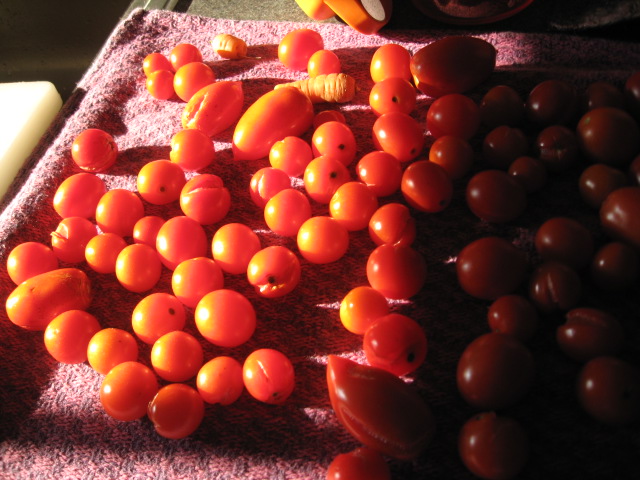
Cherry tomatoes spill over the counter top.

Cherry tomatoes (and one teeny carrot) spill over the counter top into late summer sun.

As a small child, I hated tomatoes in any form. I particularly remember hating spaghetti sauce; it seemed so sour, so acidic, stinging my lips and hurting my stomach. Like many green vegetables at that time, tomatoes also made me gag.

In one of the few food compromises I recall from childhood, my mother made a separate dish for me when spaghetti was served: Buttered Noodles. Soft, squishy, chewy, buttery, salty, peppery, heaping bowls of elbows; it was delightful to surreptitiously poke my tongue into one end of a noodle, split the bent tube and then stick that noodle-covered tongue-tip out at the others around the dinner table.  When finished playing, I could then chew it, and slurp up a few more, since butter didn’t show on my face like splashed tomato sauce might have–all of this presuming no grownups were around.

Comforting and simple, I loved buttered noodles’ starchy blandness–though I didn’t consider them bland;  I considered them delicious beyond words.

**

Then one evening I bravely tested a worm of vermicelli with tomato sauce and my head jerked up, “What?! You’ve been keeping this from me? I LOVE spaghetti with sauce!” My mother, I am sure, rolled her eyes. This particular jarred sauce was savory and didn’t make me feel icky at all. So I left the buttered noodles of childhood behind as my tastes matured.

But I still didn’t like all tomatoes, just spaghetti sauce. No fresh ones, too watery, and my mother agreed–there is no tomato like a New Jersey farm tomato; having none of those available in our Midwestern kitchen, she didn’t press the issue. As a teenager, I tried small quantities of chopped tomatoes on Mexican food, to cut the heat. Then thin slivers of tomato on a burger, or in a salad.  Over time I diversified, and now even love thicker sliced tomato with fresh mozzarella and basil leaves. Every once in a while I get that childhood gag reflex, but not very often.

Tomatoes in salad with carrot, cucumber, sunflower shoots.

Tomatoes in salad with carrot, cucumber, sunflower shoots and bacon.

I changed my mind, I grew my tastes. I didn’t have to force liking tomatoes either–my desire for them came on my own terms, without someone else’s requirements.

Along with tomatoes, I now eat all kinds of green vegetables–they are some of my favorite foods! and in another area, I have expanded past my color palette of jewel-like purple and blue to appreciate earth tones, browns and even oranges. (My kitchen is painted a dull historical green and accented with red, of all colors, with mud- and rust-colored rugs.)

Preferences shift, and I want to be open to that–not too rigid, in food and color choices, or relationships, or beliefs about the world. “Curious” is the word they use in Kripalu yoga.

As I increase my practice in preparation for Yoga School, I learn to be curious as I study the edge of my likes and limits. Ready to laugh at myself and my foibles.  Maybe I will grow to love huge dripping slices of tomato raw in my mouth–maybe I will grow to love the burning ache in my hip during Pigeon Pose or every damned time I lose my balance in Tree Pose.  Who knows?

Frozen tomatoes from the garden--part of the clearing out cooking!

Frozen tomatoes from the garden–part of the clearing out cooking!

….So all that serves as an introduction:  I used up some tomatoes the past couple weeks.

I’m pretty exhausted from weight lifting, walking in the snowstorm that arrived yesterday, and Yoga Flow sessions, so I will share the photos and leave references if you Gentle Readers desire the recipes. Every one of them used tomatoes.
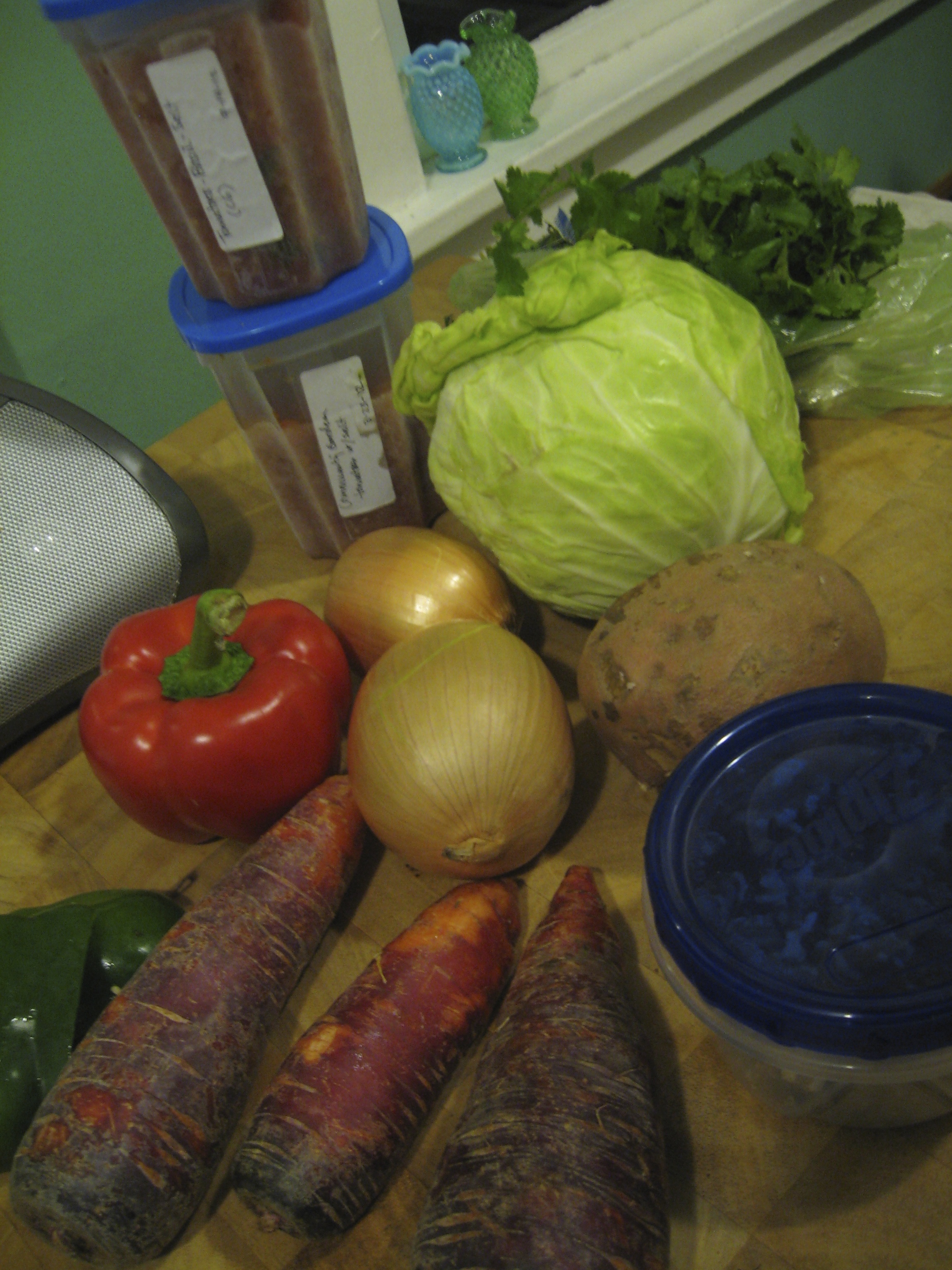
Piles of vegetables, including frozen tomatoes, crowd the counter.

Piles of vegetables, including frozen tomatoes, crowd the butcher block table.

Cabbage and sweet potatoes formed the basis of Cape Verde Vegetable Soup.
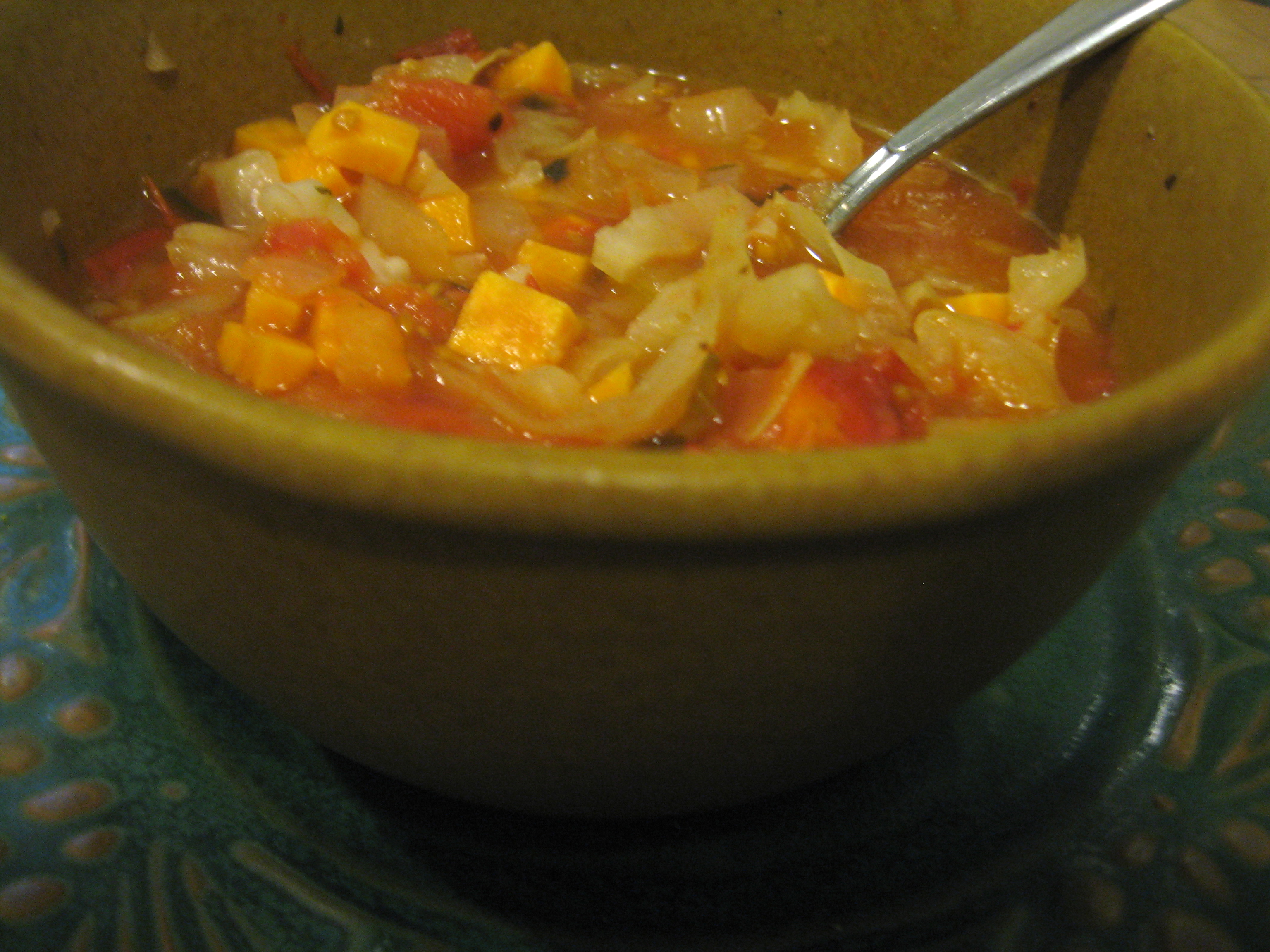
Cape Verde Vegetable Soup, from Sundays at the Moosewood, published by The Moosewood Collective.

Cape Verde Vegetable Soup, from Sundays at the Moosewood, published by The Moosewood Collective.

The carrots and peppers filled out vegetarian chili.

Vegetarian chili, from The Moosewood Cookbook by Mollie Katzen.

Vegetarian chili, from The Moosewood Cookbook by Mollie Katzen.

My favorite adapted recipe, Green Chili and Corn soup, used tough late summer Community Garden corn softened by the freezing process, and more black beans.

Highly adapted version of Crema de Elote Soup (no cheese, no milk, waaay more green chilies) from Sundays at the Moosewood.

Highly adapted version of Crema de Elote Soup (no cheese, no milk, no potatoes, plus black beans and waaay more green chilies than originally called for) from Sundays at the Moosewood.

Plenty of tomato based soups and chilies to go around this frozen month of February–though I think I’ll make some buttered noodles, very soon.

I hated tomatoes and then I loved them, but only in some forms. What does that say about changing your mind? Being open? What happens when you don’t force things?

To Plan a Garden, And a Life

Finger Lakes vineyard, with Seneca Lake steaming on a 5 degree below zero morning.

Finger Lakes vineyard, with Seneca Lake steaming on a 5 degree below zero morning.

It flew in through my postal slot this week, a stiff green mailer I’ve received twice before: Continuing Gardener Sign-ups. It means that in February, I’ll toddle down to the public library, pay my small fee, re-read the rules, and confirm my plot.  Ok, so I knew the mailer was coming since I am a Garden Coordinator, but it’s satisfying to jot the date on the calendar anyway, marking the beginning of my fourth growing season with the Capital District Community Gardens.

We are in the midst of deep winter here in upstate New York; when it is absolutely necessary to wear gloves the minute you step out of doors or else risk wind-burned and skin-split fingers; when billowing road salt coats our cars and our street and our pants when we lean over those cars, even flies into our mouths if we are thoughtless enough to open them before tossing ourselves shivering back into our homes.

The standard picture of Gardener Dreaming About Spring is someone escaping that salty, snowy weather, cardigan-wrapped and hugged by an overstuffed recliner. The silhouetted figure, plush-slippered, pores over seed catalogs by a roaring fire, sipping hot chocolate or spiked cider as the wind screams outdoors.

I’m not exactly like that. Don’t own a recliner, fireplace, or seed catalogs, and slippers make my feet sweat. I clomp around the apartment in old socks and clogs and mostly I’ve used the seeds that are donated to the Community Gardens office or buy plants when the mood strikes me or they are on sale during the growing season.

However, this year I’ve been thinking hard about my planting choices. For example,  cherry tomatoes dominated my rows in the past–round red, little snips of yellow, some shaped like mini-butternut squash. I kept them because they volunteered from the first summer my garden was planted for me while I was recovering from surgery.

Now I think I want plum tomatoes instead.

The carrots were such a roaring success last summer, those tasty sweet morsels; if started early enough, multiple harvests would be possible.

I desire green beans, but don’t want to mess with the strings. Maybe I’ll grow lacinato kale along with my rainbow chard. And broccoli-one of my fellow gardeners shared broccoli with me, I could do that! I love broccoli. Perhaps I’ll plant the whole damn plot in flowers to cut for my dining table–then again, zucchini are not only traditional but useful.

I am practicing making choices, not just doing what I did before, not doing what is merely expected.

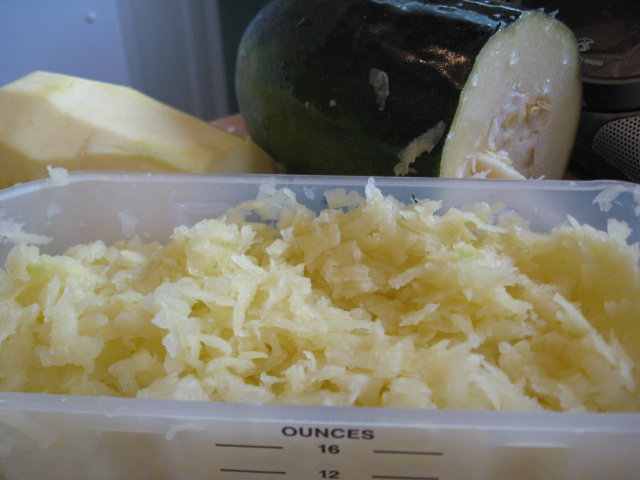
Last summer's zucchini shredded...

Last summer’s zucchini shredded…

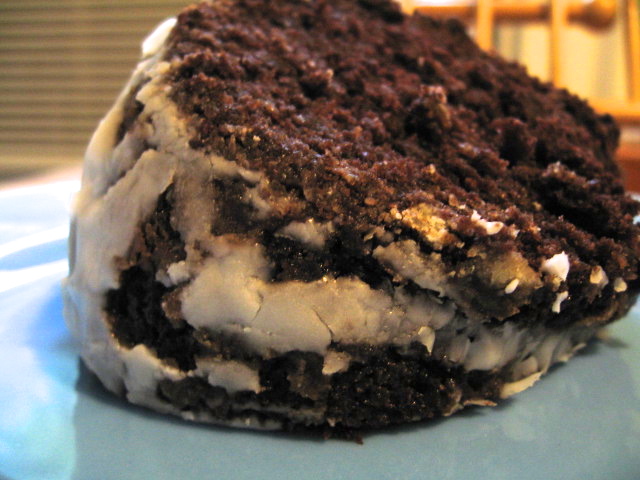
...to make chocolate zucchini cake!

…to make chocolate zucchini cake!

Another envelope arrived this week, not through the mail slot but in my email queue (the way of so much these days), announcing my acceptance to a yoga teacher training program. Another spring planting to look forward to, drowse with by the metaphorical fire–though a more active drowsing, as my challenge now is not only to plan but to become physically stronger and more disciplined in my yoga, before I arrive mid-April. I also must battle my demons of self-doubt, in order for the A+ student to go back to school in a new and different way.

Like the garden, what do I plant?  What do I discard because it doesn’t work for me? How can I be publicly not-perfect, in a setting (learning) where I was so driven before? The plan: to be relaxed like I am about my garden plot: not the best and not neglectful, something in-between.

I’m going in as probably the worst student in Sanskrit names for poses, as well as a mediocre memorizer of everything else, with a life-battered body that hasn’t been doing yoga for very long. But my true subject matter will be one of the themes of Kripalu yoga: compassion. I will learn compassion toward myself.

When I am “not successful” at a particular physical or mental task, I will attempt to be successful at compassion for myself, and gentle even in discovering my lack of compassion. This I can do, and it is all I need to bring.

I vow to break out of my old gardener habits and make new ones, different ones, not sure what the harvest will be, but trusting it will be–something–something wonderful. Storms will come, and drought, and interruptions by the personal and political and societal–and the skills I’ve acquired in the garden will get me through what I’m calling “sleep-away camp” at Kripalu.

Here at the end of January I open the seed catalog of my life, once again dreaming the future into being.

Seneca Lake warmed by the sun, readying for the end of winter, and then spring!

Seneca Lake warmed by the sun, readying for the rest of winter, and then spring! Who knows what transformed things will come out of this ground?

Confidence That I Know Nothing–The Labyrinth

One of several trees that greet you at the entrance to the labyrinth.

A meditation labyrinth is a winding path, but unlike a maze, the traveler knows she will follow the course to the center and traverse the same path out with no fear of becoming lost. People have walked labyrinths of various forms for millennia; as they amble, they seek answers to particular questions, or to touch their G/god or Spirit or inner being.

When I began my weekend retreat at Kripalu Yoga Center last Friday with a walk in the outdoor labyrinth, I thought about self-definition, and work.

Winding the curves, tears dripped down my cheeks: I don’t want to get to the center— because then I will have to come back out, and I’m not sure what I will discover about myself in the process, specifically, my options for future paid work. Recently, before I even claim any idea as a “possible next career,” I’ve gotten scared, run away from thinking, watched too much TV, over-filled the schedule or just done nothing.

Achy and stiff, I haven’t participated in my usual yoga classes at home and have avoided extended concentration on breath and difficult positions. Yoga has merely served as a stretching regimen a couple times a week. Last year in the autumn my body was so much more mobile, technically and muscularly strong in the postures, and confident. Lighter, too.

Old habits of anxiety haunt me, a drive to squeeze everything I can out of this time away, to find answers to my questions. But at what expense? I ask as I wander. To feel the drivenness more than the experience?

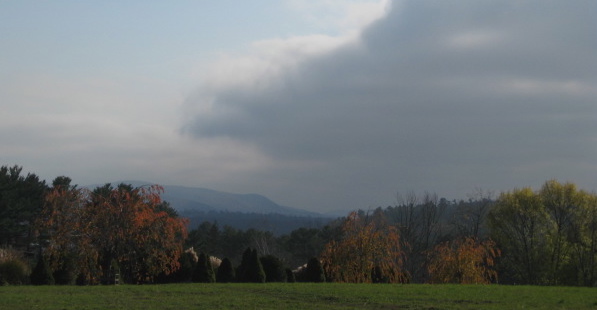
I notice that there are more reds in the trees here than in New York; the weeping trees quiver with neon orange, yellow and green in their seasonal change; shadowy evergreens cover the Berkshire mountains behind the labyrinth. Exiting, the view stretches wide, with a broad grassy hill up to buildings where the first session, and then dinner, then more yoga, await me.

A community of grasses accompanies you.

I wish I’d been conveniently struck by some slam-bang inspiration about work while in the labyrinth, but then in yoga class the falsehood is revealed that when you discover something, you are then finished or complete–an impossibility, because we are constantly changing, and the world is constantly changing. The instructor reminded: take your time, make your own choices, move how you want to, experiment!

The intense physical activity scrubs me clean and pares me down, open to see daily life as simultaneously not that important and amazingly huge, miraculous, splendid. The sixth sense, we are told, is Awareness. Yoga calls me to the corporeal plane, and the spiritual plane, and beyond that, even–but by 10 pm I am so tired and roiling in self-judgment, it hurts.

Washing up before bed, I remember: when my best friend visited a few weeks ago, she commented, You believe you are not moving fast enough with this puzzle. But for the first time in your life you are looking at each piece and not trying to press it in the form right away, instead asking does it fit? does it even belong in this puzzle?

I want to trust that the picture will emerge. Mostly I believe it will, but I’ve been sidelined and undermining myself, avoiding “the work thing” because I have been afraid–of failing, or finding a big nothingness at the center of myself and my search.

The next day, during the Kundalini yoga, in the repeating pose of punches-through-an obstacle, I strike through the negative messages, through self-doubt into compassion for myself, thus revealing a glorious version of Me. It is repeated: Revelation will come and there will always be more to understand and grow into.

As we tell our life stories during lunch, my roommate remarks on my tenacity, and offers unexpected observations about my skills.

In a Kripalu Yoga session, frank acknowledgment that everyone suffers heart break leads to a vision of the body as energetic river, where damage from that pain has an impact, but can be repaired.

Words from the Prana Flow teacher: Move with courage into whatever life brings. Practicing yoga can give you confidence that we know nothing. Spending time with yoga itself will give us “nothing”–but through breathing, doing asanas (poses), and other practices, we can tap into the teacher we have within us. A bit theoretical, hopeful, maybe even too far-out. But I like it.

After fourteen hours of yoga in two-and-a-half-days, hours of breathing and meditation and strengthening of the body and compassion toward myself, listening to the body and listening to the body some more, having my value reflected back to me by others and myself–I approach the labyrinth once again, to close the weekend.

I stop at each planting on the way in: sets of willows, vanilla-cupcake-colored, Seuss-ian tufts of grasses flopping in the wind, and some unidentified saplings; I reach out to touch each one in turn, and step to the next pair, like a slow procession up a church aisle, until I come to the labyrinth entrance, stroke the wood of the arch and walk through.

Seuss-ian soft grass-tops.

I deliberately slow my gait, returning to the meditative walking that I’ve read about: sense the heel touch the ground, roll through the middle, and let the toes make contact. Then don’t do the expected forward movement, just rest there; then, pick up the other foot, shift weight and move. One step. Pause. One step. Pause. One step.

I brush against a bushy bottomed evergreen, and it felt like I was joshing a friend, approaching a teenage boy uncomfortable with hugs, him pushing his shoulder against mine, Hey, dude, whuzzup?, a camaraderie with the trees, like we were buddies, old pals, kidding around with each other, glad to see each other, relieved actually. So I stop to give each head-high evergreen a gentle shoulder bump and a half-smile of recognition.

Following that, I tromp, wide-hipped, swinging my legs with energy. Clomp-clomp-clomp. Then stand, smelling the musty grasses dry in their rustling, slipping their feathery lengths through my fingers. Next, glide forward slowly again, with few tears, in fact triumphant, bubbling over some with alternative ideas and ways of looking at Work. Think to myself with a sigh: god knows I will run into obstacles and I may be completely wrong about the possibilities, but I’ll use the yoga practice–no, I’ll just DO it, and through that, trust I will get to know how I feel about things; motivate myself by being in touch with my body–no, I’ll NOTICE motivation and excitement from within, seeing and leaving behind the berating messages, the patterns of avoidance–cleansing with breath, clearing, opening; like the trees are changing and opening to the heavy gray fall sky over lake and mountain here in the Berkshires.

I resolve to create a new Practice in my life, instead of the old Routine: new ways of walking through my days and taking care of myself. Cup of hot tea with honey in hand, I drive back home.

Of course next day I am exhausted by the weekend, and then overstimulated by classes at the computer store: required to be intellectual before I am ready, blasted by the fluorescent lights, too-loud Muzak, and super-saturated color. The coming rainstorm from Sandy pushes me to watch old episodes of Glee “while I can” and then the darned electricity never goes out! and I worry I have fallen right back into all my old habits.

But–every day I’ve eaten well, gone into my yoga room and felt the muscles loosen along with my busy mind, remembered what my community of yoga teachers taught me, heard their laughing voices, and breathed compassion toward myself. Started again with the next moment.

Yes, life is a series of beginnings, to be taken puzzle piece by puzzle piece, step by step, breath by breath. Perhaps life is also a series of puzzles, where the fun, the point, is putting it together, not the final image.

I am confident I know nothing. I have entered the labyrinth, journeyed to the center, and come back out. I’m holding the puzzle pieces, thinking.

A far-away view of the labyrinth, after you re-enter the world.