Washing Dishes

Today’s view from the kitchen window

There the pile sits in the morning kitchen: water glasses with lip marks and fingerprints; small plates smeared with food, accompanying utensils splayed over them; tea cups and travel mugs with rings of dried milk and sugar; plastic leftover containers, greasy lids akimbo.

Usually it doesn’t feel like an onerous chore. But a not-unexpected sadness has come to nest in my house this fall.

I know that when you lose someone, like I’ve lost J, you revisit your other deaths, especially those you have not finished mourning. You acknowledge and examine the loss of friends, places, homes, relationships, belongings, patterns of behavior, certainty.

That is the work I am doing.

Part of the floundering has included a scary disinclination to write, choosing entertainment over introspection, an old habit I thought I was done with. I haven’t felt like cooking. Or even cleaning up after the take-out.

But then I remember J half-joking, half-begging: With these lungs, I may not be able to vacuum or dust, but I can still stand here and wash a few dishes. Just let me do them!

A little bleary-eyed, still in slippers and ‘jammies, I set up the water boiler on the counter, fill the empty ice cube trays and put away the clean dishes washed a week ago.

Another voice from the dead, Great-Aunt Helen, whose legs were heavy and painful, fingers mangled by arthritis: This is my house and don’t you touch those dishes!

But Aunt Helen, we helped make this mess, and you must be tired after baking cookies and Mahogany Cake–and cooking brisket and dirty rice. It will be so much easier for us to clean up.

We’all are gonna sit in the screen room, have some Dr. Pepper, and listen to the night sounds. Leave the dishes ‘til morning! When I wash ‘em up tomorrow, I can take as long as I want and relive all the arguments, and the jokes, and the silliness. I know you mean well, but I want to remember the good time we had while dirtying these very dishes.  No arguments; it’s settled.

So today at the sink I pay monk-like attention to details: the sound of the tea water moving toward a boil, then the smooth matte surface of robin’s egg and gold stoneware plates in the sink, essential oil of lavender soap bubbling my hands.

I remember the phone conversation with a fellow writer while I drank the Earl Gray Cream out of this Shakespeare Quotes mug, and commiseration with an out-of-work friend accompanied by Russian Caravan in that blue flowered cup.

Having reached temperature, the water in the boiler is poured over loose Truffle black tea, bits of dried coconut and chocolate chips visible. Back at the sink while it steeps, I revisit Lad Nar over garden green beans here, the half sandwich left from a writing session at Professor Java’s there, and an apple-farm Honeycrisp purchased in September after a sunny bike ride along the Mohawk River, sliced carefully onto a blackberry colored plate. Washing, rinsing. Washing, rinsing.

October ivy

Outside the window, ivy reddens on my building, the green ivy opposite just barely blushing yet. Rain pelts the cars rushing by and students grind wet gravel underfoot as they hurry to class. Up the hill, willows and maples and birches and oaks are all changing color at different speeds.

I scrub to get every bit of scrud off a pot, rinse it thoroughly in hot water, then place all the dishes one by one on the gas stove so as to be perfectly dried by the heat of the pilot lights. When ready, there will be the satisfaction of putting each plate, each mug, in its own place once again.

After the fixtures and counter are wiped down and dry, I pour a cup of tea and finally, finally make the frittata I planned a week ago.

It consists of: freezer spinach overdue for use, a teeny green pepper from my garden (one of five whose existence completely surprised me two weeks ago), four ounces of muenster cheese, half a white onion, a teaspoon of salt, some crumbled dried sage from another friend’s garden, a pinch of nutmeg, six local eggs, a couple tablespoons of flour to thicken. Out of milk, haven’t gotten myself to the store, so I just steam all the veggies in the microwave, keep the liquid, and stir it all together with a tablespoon of butter chopped up.

I bake the sun-yellow concoction in a greased oval pan in my convection toaster oven at 375 for 15 minutes. With puffy browned edges, eaten off a pretty green plate, the frittata tastes of warm kitchens past and present, meals present and savory meals to come.

Tomorrow morning I will make tea and wash these dishes, too.  No arguments; it’s settled.

Peas! Beautiful Peas!

Peas and where they come from

I planted the seeds in May, thinking of slim pea-pods stir-fried with rice, but then the plants bleached in the July sun while I was home sick. Finally working in the garden, I thought, Damn, they are done, I left them on the vine too long! but harvested anyway. Maybe there will be some that are still tender….

Back in my kitchen, the pale, bumpy, now-inedible pods surprised me with actually-edible peas hidden inside! This gardener didn’t realize they’d continue on and make something different, like green bell peppers ripening into red.

The big pile of Pisum Sativum pods yielded four ounces of fresh peas—they are sugar snap peas; that’s what I planted, and now I know the difference.  For stir-fry alone, I could have planted snow peas. And if I’d gotten to these sugar snaps sooner, the pods (considered a fruit) would have been edible along with the green vegetable globes. Of course if I had just wanted plain ol’ peas, “shell” would have been the variety for me.

I discovered all this in my favorite educational cookbook: From Asparagus to Zucchini: A Guide to Cooking Farm-Fresh Seasonal Produce 3rd edition by the Madison Wisconsin Area Community Supported Agriculture Coalition, 2004. (You can check out MACSAC here.)

My other lesson for the day–Some of the peapods made just one pea. The thick skin cupped and protected a single perfectly shaped emerald ball.

I used to be like one of the pods that made five, six, seven of these beauties, boom-boom-boom, lemme make some more! —  I believed I had to be the pod that constructed the most and the most exquisite peas!

But look–here is a capsule, so cute, so delightful, that curls around just one pea. Or maybe two, as in my photo, both well formed.  What does that say about production schedules, quantity and quality of what we make?

Sheepishly, I admit now that I don’t have to make “more”, “most”, “better” all the time. Just one pea can be enough.

Some of the pods, bulky and hard to open, reveal withered peas, a few undeveloped blips, little nubs of pre-pea. The cases looked good, but the contents are not as promised.  I don’t want that, either, to half-heartedly construct a life, the outside looking good but the inside empty.

Or, if I see these as unborn creations, ones I didn’t have time or attention for, I could mourn, but not fret too much over them.

Because there are plenty of seeds and soil and water, if I just keep returning to the garden. And thus, plenty of pods to come.

***

Here’s what I made with the peas, again adapted from a favorite Moosewood Cookbook recipe; the original Sri Wasano’s Indonesian Rice Salad involves among other things pineapple and peanuts which, as you may imagine, is a whole different taste sensation.

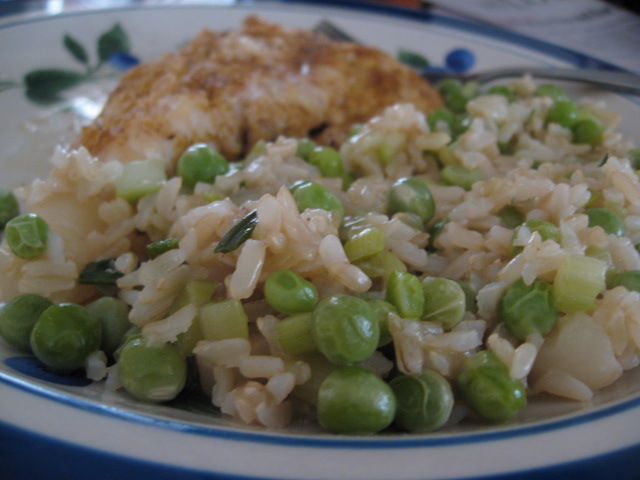
This is not the originally fantasized stir-fry, but satisfied my craving for savory rice with veggies. I served it with a butter-and-olive oil broiled, seasoned whitefish.

Smoky Honey Rice, showcasing my fresh community garden peas.

Smoky Honey Rice

1 ½ cups of (organic) basmati brown rice, cooked in 3 cups of water–while still hot, mix with 4 oz of fresh peas steamed for about 8-10 minutes or until soft, 6 TB of toasted sesame oil, 6 TB of honey, a couple stalks of chopped celery, ½ bunch of chopped scallion (green and white parts), a can of chopped water chestnuts, 1/8 to ¾ tsp of cayenne pepper depending on how spicy you like it, salt or soy sauce & fresh ground pepper to taste.

First harvest in my community garden plot

As someone who cooks a lot, for myself and others, I use fair trade, seasonal and local, and/or organic ingredients, whenever possible.   Call me crazy but I just believe in these defining attributes strongly, try hard to find them, and encourage others to prefer them over imported, old, pesticide-covered & water-polluting, factory-farm, long-distance food.

Having said all this, I don’t flog myself when I can’t find them. (Striving for perfection, not necessarily reaching it, right?)

As a city dweller without yard access, my fresh veggies with those descriptors come from the farmers’ market, the local grocery, and in the summer, my community garden plot. “Community garden” just means I grew it myself, or a friend did, in a local shared garden; in the Albany & Schenectady area, that would be part of Capital District Community Gardens.

So for me the literal ground-work of April and planting of May have now yielded July’s bounty—

Basil. Many poetic words have been waxed about its delicious properties, its pungent, fruity addition to dishes. But look how gosh darned pretty it is, coming out of the dark earth, growing hard in the night and day! I can taste the sun in it, taste other seashores and countries. As long as I pinch off the tops to keep it from bolting (flowering), it will continue to give me pesto and Thai-spiced vegetables and lime & basil vinaigrettes all summer.

And nothing like the morning light streaming through red chard….Yes, it got a bit old and spotted before I got to it, so I picked leaf after leaf, and tossed it all into green bags in the fridge until it could be washed properly; yes, I used the fancy salad spinner, rinsed it again and again to get the grit off, spin-spin-spin, and then finally cooked it all down. Mild and wonderful to float in soup or drop into stir-fry, it’s one of the “top ten vegetables” for nutrition. Go chard, you subtle thing, you.

Can I tell you what happens when you plant radish seeds in the ground, water them and then leave town without thinning them? You get a lot of radishes. I ended up with piles and piles of mildly spicy roots popping up out of the ground, mostly red but many pink, and a few exciting purple ones. You’ll see the basil here in the sink too, and a little parsley:  clean flavors to go into my salads.

Finally, this is a picture of my bush beans, before they were beans, back when they were just beautiful pinky-purple flowers. I watered, weeded some, went out of town (see above), came back, and almost missed the long stems of bean, hanging hidden behind leaves. They would have been spotty themselves and over-ripe the next time I came to my plot, if another gardener hadn’t pointed them out to me while I was frantically weeding the nasturtiums and watermelons. The former-flowers now-beans have been turned into Five Bean Salad, complete with parsley picked the same day.

Marinated Five Bean Salad Adapted from  Moosewood Cookbook by Mollie Katzen, Ten Speed Press, 1977:

¼ cup raw apple cider vinegar and ¼ cup fair trade olive oil

2 tsp salt and some fresh ground pepper

½ tsp oregano and 1-1 ½ tsp basil

1-2 heaping teaspoons of minced garlic

zest (the yellow part of the peel, taken off with a tool handily called a zester) and juice from half a lemon

1 can each of well-rinsed dark kidneys, black beans, great northern beans, garbanzo beans—or whatever else you’ve got. Mollie recommends freshly cooked beans, but it was just too hot this week!

2 heaping handfuls of fresh community garden bush beans, washed and trimmed

½ bunch of community garden parsley, chopped

1 finely minced red onion; maybe 1 1/2 if you like more onion

Mix all the sauce ingredients together. Cook the green beans in a bit of water (1/2 cup to a cup) until tender (5-10 minutes depending on their age and your definition of “tender”; some people like a crunch to beans; others desire complete abdication).  Mix green beans with canned beans and other ingredients in a big bowl.

This version is much lower fat than the original; I wanted to be able to taste the lemon and the different beans’ nuttiness more than just taste and feel the oil; a cup measures roughly 225 calories. Yummy cold or room temperature.

What To Do When Your Fridge Dies

This is what you do when your fridge breaks on one of the hottest days so far this year.

You stuff all the frozen and refrigerated food into two big bins (not owning big coolers), and wrap the bins in blankets until your landlord gets a new fridge moved upstairs.

Of course you cook the defrosting shrimp with the half-lemon from the crisper, and some salt, and eat it with the cocktail sauce you’d have to throw out otherwise (to reference George Carlin’s Ice Box Man).

All while you cry with a good friend.

Then you wipe your eyes and make an amazing pasta salad with the already cooked natural chicken breasts, organic red pepper, defrosted green beans, a can of mushrooms (‘cuz you can’t help loving canned  mushrooms, comfort food from your childhood), Flour City multicolor “pizza” pasta, oregano dried from the community garden, and basil & garlic cheese curds from Argyle Cheese Farmers, sold to you by Marjorie with a smile lo those months ago, and hidden in the freezer for a cheese emergency.

You feed the pasta salad to everybody who comes by to mourn the fridge’s demise.

Then you meditate on food you’ve saved, food you’ve lost, food you’ve hoarded; the temporal nature of foodstuffs and life, and finally, how delicious it is to be forced to eat cold shrimps on a hot afternoon, accompanied by a Long Trail Blackbeary beer and people who love you.

(If you want to know more about Argyle Cheese Farmers, look here.  For Capital District Community Gardens, here, and the tasty pasta I used, here.)