Mind-Out-Of-Time: Writing, and Teapots

My teapot from J, tucked behind an electric kettle, another teapot, and a locally crafted mug,  on my early morning countertop.

I miss talking to J about my writing life.

This afternoon I will concentrate on writing, I’d say.  I’m deliberately ‘concentrating on,’ not ‘working on’–no more of the furrowed brow that ‘work on’ entails.

She’d laugh.  I used to have that furrowed brow, too; hell, look at my wrinkly forehead.  J would talk about the struggle to get to her drawing, even with new chalks and paints around her, how daily chores and her own busy mind pulled her away from something she’d never had time for, yet couldn’t quite get to, even now.  She’d encourage me to keep going, and I’d tell her more.

When I give myself over to writing, or create space for it, then I can relax and play. It’s what I call Mind-Out-Of-Time, what I sometimes think heaven is or would be: you are so involved in something that clock hands move unnoticed, you look up and the afternoon light is bending across your desk and you gasp–how long have I been here?

Mind-Out-Of-Time comes also when I choose to immerse myself in how life looks and feels, tastes, sounds and smells. It comes when I give myself permission to be right where I am, at that very moment, open to pleasure even in the midst of pain.

So I think of J, steeping tea in her beautiful cobalt blue teapot, when I came to visit six months ago. Napkins in hand, she danced oxygen tubing between pieces of furniture as I carried the prepared cups and cookies to the front room. We laughed about how, on our last big trip, she’d pulled her portable oxygenator, nicknamed ‘Fred’ after her father, all over the up-and-down hills of downtown Vancouver.  Fred sure got a workout, didn’t he? Took care of me just like Dad did.  We discussed once again her wish to die at home.  She asked after my teapot, a twin of hers, which she gave me when I moved away. Every time I make tea in it I think of you, I told her.

Two weeks ago, her caregivers still made English Breakfast in her blue teapot; she rested in the home hospital bed, I held the mug, she sipped sweet lukewarm liquid with a straw.  During the moments she was awake, she rolled her eyes sardonically, joking with only a few words about the little yellow curlers in her hair that looked like baby corn; I teased her back about how she finally got us all to wait on her hand and foot, and more seriously, how much we loved doing it.  As she drifted into medicated rest, she murmured about death, it will be pleasant; it will be pleasant. See you on the other side.

After the memorial service last weekend, I wrapped up the cobalt blue teapot in crinkly paper, to deliver it safely to her chaplain, someone who’d shared tea with her every Wednesday for many years, someone whom I suspect also understood mind-out-of-time with her.  I took one of her mugs and packaged one for yet another friend.

This morning, kitchen lights reflect on the curve of my round teapot as rain drips down the apartment windows.  Cars splash black puddles up into the air outside.  J’s goldenrod colored, cartoon-cat covered mug, full of toffee-chocolate-hazelnut tea, sits beside my keyboard.

Guess what.  I’m still talking to J about my writing life.

Eating Out: A Light-Hearted Post

Since I am on my way out of town once again, here are some meals to sink your eyes into, from local non-chain restaurants.

OUTDOOR FARE

Ok, seriously fried food: crab cakes and onion rings, outdoors at The Boardwalk, Lake George NY. The view of the water and people para-sailing was more fun than the food; washing lunch down with local brews helped.

I ended up taking most of this home, and reheating it in the toaster oven over several days. Also had to make big piles of vegetables to eat with it, as I am just not used to the oil.

P.S. Never reheat crispy/fried/texture-driven food in the microwave; it’s such a disappointment.

Next, cheeseburgers with slaw on top at Jumpin Jack’s Drive-In, Scotia NY, with a side of excellent onion rings; rode up hungry on bicycles for the first summer visit and on a motorcycle for the second. A large sweating cup of icy unsweetened tea rounded out the meal.

Last summer we saw television pictures of Jumpin Jack’s under water from Hurricane Irene. Apparently they are all dried out now and back to long but quick-moving lines of customers again.

I don’t eat that much red meat, so when I do it has to be worth it.  Even then, I usually split a burger with other people, and nibble on two or three onion rings. Ok, maybe four. I really, really enjoy the zesty crunch of the coleslaw as my teeth sink into the salty cheese and meat.  All right, maybe five onion rings, you know, if I’m really hungry.

BREAKFASTS

Oh my heavens, mascarpone-stuffed French toast topped by fruit compote at The Parkside House, Buffalo NY.  The Parkside is a B&B three blocks from Frank Lloyd Wright’s Darwin Martin House (note the FLW inspired china).

This meal kept me going for absorbing architecture in the morning, followed by three hours of hiking Niagara Gorge at Whirlpool State Park. Thanks, Chris and Jonny–breakfast was delightful.

Home-made waffle and broccoli rabe (aka rapini, a brassica related to turnips of all things!) & mushroom omelet, with some of the least greasy breakfast potatoes I have ever eaten. Someone was bringing in fresh local bunches of chard, for lunch I presume, as I sat drinking tea.  Skyport Diner, Schenectady NY

DINNERS

Crab cake with–get this!–lemon & vanilla-bean aioli (kept thinking there was something “chocolatey” about it ’til I double-checked the menu) over mango coleslaw, at Waters Edge Lighthouse  Restaurant, Glenville NY.

I suspect most people who dine out have a food they just must sample and compare to previous versions whenever they see it. Mine used to be chicken fried steak with sausage gravy (known in Yankee country as “southern” or “country” fried steak), but since I spend most of my time in the north now, I eat much less meat and fried food–oh, and I’ve eaten more than enough chicken fried steak for several lifetimes—I am now a crab cake taster. This exquisite cake proved one of the best ever, not too bread-y or fried-tasting, accompanied by such exotic flavors! What’s your “search out food”?

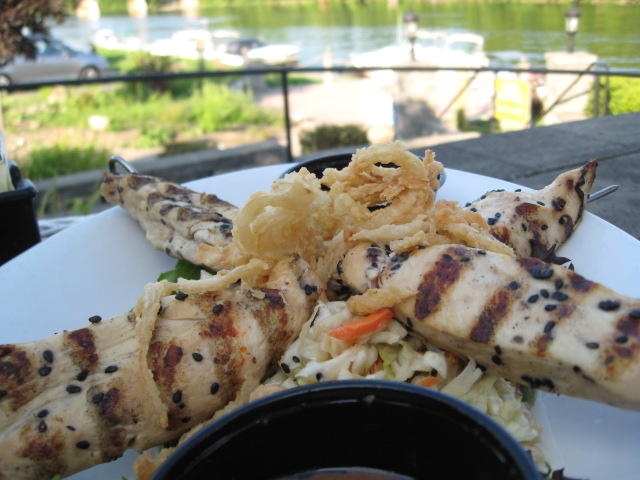
The chicken satay appetizer (big enough for a meal), again at Waters Edge Lighthouse. Note the Mohawk River flowing by behind the food, and yes, boats are bobbing there with the sun reflecting on them. Eating on the water is wonderful—especially when Hurricane Irene is not overflowing the banks; this was another restaurant that flooded last summer.

Vegetable samosa nestled behind a bowl of shrimp masala at Shalimar in Delmar NY. The creamy masala sauce with its peppers and onions is best eaten by dipping garlic naan (bread) into it, though you can eat an awful lot of naan in the process. I am also partial to the bund gobi aloo (cabbage and potatoes) all golden and yummy.

NOT DESSERT—INSTEAD, PRETTY COLORS TO FINISH WITH.

The beer flight at Madison Brewery, Bennington VT. The color, just look at the color and the varying opacities!—so many shades of red, amber, gold. Included in this sampler were Crowtown Pale Ale, Sucker Pond Blonde, Wassick’s White Wall (the cloudy one), Buck’s Honey Wheat, Willoughby’s Scottish Ale, and Old 76 Strong Ale.

Cheers, summer!

Peas! Beautiful Peas!

Peas and where they come from

I planted the seeds in May, thinking of slim pea-pods stir-fried with rice, but then the plants bleached in the July sun while I was home sick. Finally working in the garden, I thought, Damn, they are done, I left them on the vine too long! but harvested anyway. Maybe there will be some that are still tender….

Back in my kitchen, the pale, bumpy, now-inedible pods surprised me with actually-edible peas hidden inside! This gardener didn’t realize they’d continue on and make something different, like green bell peppers ripening into red.

The big pile of Pisum Sativum pods yielded four ounces of fresh peas—they are sugar snap peas; that’s what I planted, and now I know the difference.  For stir-fry alone, I could have planted snow peas. And if I’d gotten to these sugar snaps sooner, the pods (considered a fruit) would have been edible along with the green vegetable globes. Of course if I had just wanted plain ol’ peas, “shell” would have been the variety for me.

I discovered all this in my favorite educational cookbook: From Asparagus to Zucchini: A Guide to Cooking Farm-Fresh Seasonal Produce 3rd edition by the Madison Wisconsin Area Community Supported Agriculture Coalition, 2004. (You can check out MACSAC here.)

My other lesson for the day–Some of the peapods made just one pea. The thick skin cupped and protected a single perfectly shaped emerald ball.

I used to be like one of the pods that made five, six, seven of these beauties, boom-boom-boom, lemme make some more! —  I believed I had to be the pod that constructed the most and the most exquisite peas!

But look–here is a capsule, so cute, so delightful, that curls around just one pea. Or maybe two, as in my photo, both well formed.  What does that say about production schedules, quantity and quality of what we make?

Sheepishly, I admit now that I don’t have to make “more”, “most”, “better” all the time. Just one pea can be enough.

Some of the pods, bulky and hard to open, reveal withered peas, a few undeveloped blips, little nubs of pre-pea. The cases looked good, but the contents are not as promised.  I don’t want that, either, to half-heartedly construct a life, the outside looking good but the inside empty.

Or, if I see these as unborn creations, ones I didn’t have time or attention for, I could mourn, but not fret too much over them.

Because there are plenty of seeds and soil and water, if I just keep returning to the garden. And thus, plenty of pods to come.

***

Here’s what I made with the peas, again adapted from a favorite Moosewood Cookbook recipe; the original Sri Wasano’s Indonesian Rice Salad involves among other things pineapple and peanuts which, as you may imagine, is a whole different taste sensation.

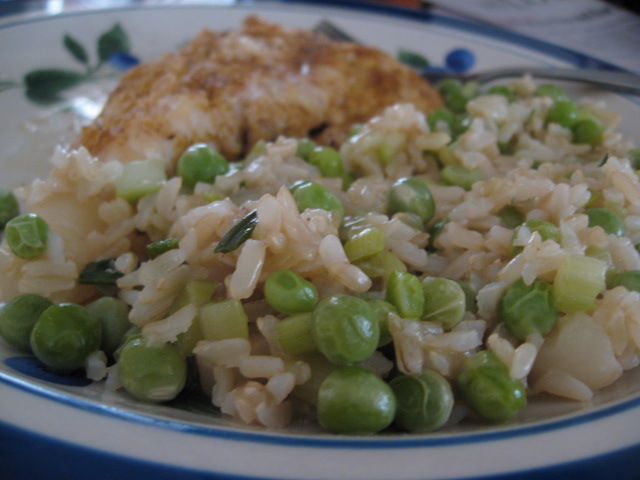
This is not the originally fantasized stir-fry, but satisfied my craving for savory rice with veggies. I served it with a butter-and-olive oil broiled, seasoned whitefish.

Smoky Honey Rice, showcasing my fresh community garden peas.

Smoky Honey Rice

1 ½ cups of (organic) basmati brown rice, cooked in 3 cups of water–while still hot, mix with 4 oz of fresh peas steamed for about 8-10 minutes or until soft, 6 TB of toasted sesame oil, 6 TB of honey, a couple stalks of chopped celery, ½ bunch of chopped scallion (green and white parts), a can of chopped water chestnuts, 1/8 to ¾ tsp of cayenne pepper depending on how spicy you like it, salt or soy sauce & fresh ground pepper to taste.

First harvest in my community garden plot

As someone who cooks a lot, for myself and others, I use fair trade, seasonal and local, and/or organic ingredients, whenever possible.   Call me crazy but I just believe in these defining attributes strongly, try hard to find them, and encourage others to prefer them over imported, old, pesticide-covered & water-polluting, factory-farm, long-distance food.

Having said all this, I don’t flog myself when I can’t find them. (Striving for perfection, not necessarily reaching it, right?)

As a city dweller without yard access, my fresh veggies with those descriptors come from the farmers’ market, the local grocery, and in the summer, my community garden plot. “Community garden” just means I grew it myself, or a friend did, in a local shared garden; in the Albany & Schenectady area, that would be part of Capital District Community Gardens.

So for me the literal ground-work of April and planting of May have now yielded July’s bounty—

Basil. Many poetic words have been waxed about its delicious properties, its pungent, fruity addition to dishes. But look how gosh darned pretty it is, coming out of the dark earth, growing hard in the night and day! I can taste the sun in it, taste other seashores and countries. As long as I pinch off the tops to keep it from bolting (flowering), it will continue to give me pesto and Thai-spiced vegetables and lime & basil vinaigrettes all summer.

And nothing like the morning light streaming through red chard….Yes, it got a bit old and spotted before I got to it, so I picked leaf after leaf, and tossed it all into green bags in the fridge until it could be washed properly; yes, I used the fancy salad spinner, rinsed it again and again to get the grit off, spin-spin-spin, and then finally cooked it all down. Mild and wonderful to float in soup or drop into stir-fry, it’s one of the “top ten vegetables” for nutrition. Go chard, you subtle thing, you.

Can I tell you what happens when you plant radish seeds in the ground, water them and then leave town without thinning them? You get a lot of radishes. I ended up with piles and piles of mildly spicy roots popping up out of the ground, mostly red but many pink, and a few exciting purple ones. You’ll see the basil here in the sink too, and a little parsley:  clean flavors to go into my salads.

Finally, this is a picture of my bush beans, before they were beans, back when they were just beautiful pinky-purple flowers. I watered, weeded some, went out of town (see above), came back, and almost missed the long stems of bean, hanging hidden behind leaves. They would have been spotty themselves and over-ripe the next time I came to my plot, if another gardener hadn’t pointed them out to me while I was frantically weeding the nasturtiums and watermelons. The former-flowers now-beans have been turned into Five Bean Salad, complete with parsley picked the same day.

Marinated Five Bean Salad Adapted from  Moosewood Cookbook by Mollie Katzen, Ten Speed Press, 1977:

¼ cup raw apple cider vinegar and ¼ cup fair trade olive oil

2 tsp salt and some fresh ground pepper

½ tsp oregano and 1-1 ½ tsp basil

1-2 heaping teaspoons of minced garlic

zest (the yellow part of the peel, taken off with a tool handily called a zester) and juice from half a lemon

1 can each of well-rinsed dark kidneys, black beans, great northern beans, garbanzo beans—or whatever else you’ve got. Mollie recommends freshly cooked beans, but it was just too hot this week!

2 heaping handfuls of fresh community garden bush beans, washed and trimmed

½ bunch of community garden parsley, chopped

1 finely minced red onion; maybe 1 1/2 if you like more onion

Mix all the sauce ingredients together. Cook the green beans in a bit of water (1/2 cup to a cup) until tender (5-10 minutes depending on their age and your definition of “tender”; some people like a crunch to beans; others desire complete abdication).  Mix green beans with canned beans and other ingredients in a big bowl.

This version is much lower fat than the original; I wanted to be able to taste the lemon and the different beans’ nuttiness more than just taste and feel the oil; a cup measures roughly 225 calories. Yummy cold or room temperature.

What To Do When Your Fridge Dies

This is what you do when your fridge breaks on one of the hottest days so far this year.

You stuff all the frozen and refrigerated food into two big bins (not owning big coolers), and wrap the bins in blankets until your landlord gets a new fridge moved upstairs.

Of course you cook the defrosting shrimp with the half-lemon from the crisper, and some salt, and eat it with the cocktail sauce you’d have to throw out otherwise (to reference George Carlin’s Ice Box Man).

All while you cry with a good friend.

Then you wipe your eyes and make an amazing pasta salad with the already cooked natural chicken breasts, organic red pepper, defrosted green beans, a can of mushrooms (‘cuz you can’t help loving canned  mushrooms, comfort food from your childhood), Flour City multicolor “pizza” pasta, oregano dried from the community garden, and basil & garlic cheese curds from Argyle Cheese Farmers, sold to you by Marjorie with a smile lo those months ago, and hidden in the freezer for a cheese emergency.

You feed the pasta salad to everybody who comes by to mourn the fridge’s demise.

Then you meditate on food you’ve saved, food you’ve lost, food you’ve hoarded; the temporal nature of foodstuffs and life, and finally, how delicious it is to be forced to eat cold shrimps on a hot afternoon, accompanied by a Long Trail Blackbeary beer and people who love you.

(If you want to know more about Argyle Cheese Farmers, look here.  For Capital District Community Gardens, here, and the tasty pasta I used, here.)