Structure: the Old Year, in Pictures

Bridge over the Mississippi, Minneapolis MN

Reflections that create balance. (Bridge over the Mississippi, Minneapolis MN)

Like monthly bills and seasonal equipment, 2012 will soon be put away.

Annually I take the week between Christmas and New Year’s and look back.  Not that I don’t regularly return to carefully saved artifacts and reflect on my journey at other times, but it’s an interesting practice to hold the twelve months in hand all at once.

Because I am still coming to the words–how can you encapsulate a year, a month, a day?and should you?–this week’s blog is almost purely visual: an admittedly incomplete retrospective of what has fed me, gifts given and received over the year.

The theme that emerged in my almost-random selection from the 6,000 digital photos? Structure.  Structure in general, and the structures I am building. Of what underlies my daily life, how to not split time into dreaded work and distracting play, but to find joy in all of it.

Once again, I wish I’d hatched a fully grown, spectacularly stunning concept that would bring surprising insight, followed by deep understanding–and aw heck, while I’m at it, world peace!–but laughing, I repeat the mantra: I accept being in-process in my thoughts and in my life.

Oh, and thank you, Gentle Readers, for joining me (however briefly or steadily) during the past six months.

The whimsical dancing turnip.

The whimsical turnip.

The whimsical turnip: its graceful arms reminded me of Shiva, whose cosmic Dance of Bliss simultaneously brings destruction and creation. How appropriate in studying days gone by, the wave pattern of the past, present, and future.  On the culinary side, it became part of a potato-turnip-leek au gratin dish for Christmas Day.

Watermelon radish in a salad of green leaf, cucumber, green and orange sweet pepper, carrots.

Watermelon radish in a salad of green leaf, cucumber, green and orange sweet pepper, carrots.

That shocking pink, what a surprise! Yes, I was ready to laugh at surprises, and open to new foods and sensations and thoughts and concepts.
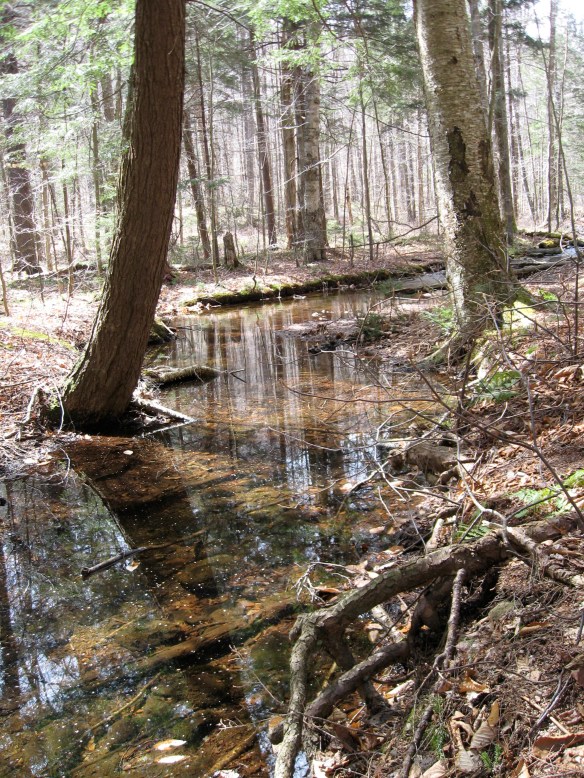
Adirondack Park creek, near Jockeybush and Good Luck Lake

Adirondack Park creek, near Jockeybush and Good Luck Lake

Stillness in the water allows reflections. Same with my life.

Snowy tree early 2012

Snowy tree early 2012

Snow on tree. Just looking outside my window, I found meditation objects, beauty.

Votives, St. Patrick's Cathedral, NYC

Votives, St. Patrick’s Cathedral, NYC

I took them where I found them, those meditation objects and rituals, and adapted them to my own house: candles, incense, writing, yoga, walks, cooking, talking, time with friends and family.

Mohawk River: beauty in browns and blues.

Mohawk River: beauty in browns and blues.

Yeah, just some grasses along the Mohawk River, nothin’ special. But no–eminently special, subtle color and stillness again. Just look, that’s all. So I did.

A study in red, brown, and white

Food is fun! A study in red, brown, and white.

The daily is worth attending to, including the daily food.  Vegetarian chili with Community Garden tomatoes, those familiar basil-garlic cheese curds and black beans, followed by strawberries with chocolate sauce and slivered almonds.  (Yes, technically the tomatoes are more orange than red, but in other light they matched quite closely.)

Ice at Dyken Pond

Ice at Dyken Pond

Like a modern art painting of skyscrapers, just the beginning of the freezing process–I spend a lot of time “at the beginning,” but those moments are striking, too.

Mountain beyond Hildene (Battenkill Valley), Manchester VT

Mountain beyond Robert Todd Lincoln’s home Hildene, in the Battenkill Valley, Manchester VT

A classic wind battered evergreen with snow topped mountain behind. What does it evoke? Back to the idea of stillness. But more: active stillness, strength from within, a yoga thing. Responding to the wind, relaxing into holding the snow, moving with circumstances as they arrive.

Tomatoes and pears: early morning still life.

Tomatoes and pears: early morning still life.

My life is art, my food is art: more meditation objects.

Sunset over the Helderbergs

Sunset over the Helderbergs: note the teeny electric pole on the right,  which helps you realize the distance you are viewing

Beginnings and endings and the in-between.  A huge sky sweeps toward me, over me, I am immense and minuscule all at once. 

Pea sprouting in late spring

Pea sprouting in late spring

Back to the garden.

A pea plant breaks through hard ground, living into its defined structure, but how it grows, the rhythm and size and potential production, are all to come yet. How fragile it looks there, and yet it is so strong.

That’s me, that’s the new year. Delicate, to be nurtured, but hardy and riotously ecstatic and full of surprises. To be attended to every day, carefully but not with anxiety, just responding to changes as they come.
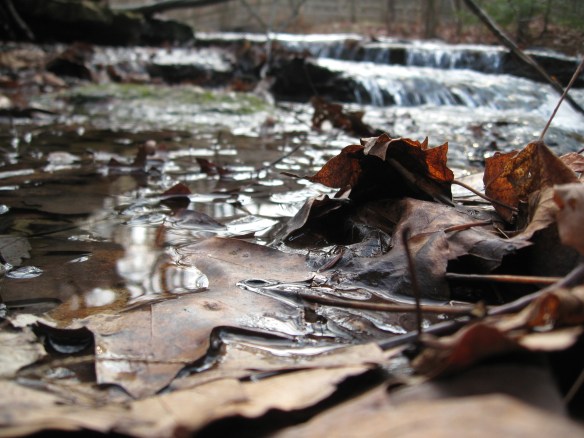
Along the Long Path at John Boyd Thacher Park: fall leaves color streams that are just above freezing.

Along the Long Path at John Boyd Thacher Park: fall leaves color streams that are just above freezing mark.

Detritus of the old is beautiful, and will feed the new life to come, after the quiet time, the enforced rest, of winter. Welcome, winter; Welcome, new year!

A wonder-ful 2013 to all.

Winter Solstice At Home, with Rice Noodles

Curried chicken, one of my childhood comfort foods, over rice noodles.

Curried chicken, one of my childhood comfort foods, over rice noodles.

I’m having a hard time settling in this week, as winter holidays come and go, approach and recede, as personal and national losses do the same.

So I go to the kitchen.

The hills and bare trees and apartment roofs that stretch to the east bear witness through the windows. I write as I do my little jobs–if I think of them as little, building like snowflakes into larger things, they are easier to begin.  I jot down thoughts, recipe ideas, insights that spring on me like the birds who dive past.  Sunrise glows dimly through the clouds.

Since the rest of the world feels sad and chaotic, I create order in my corner of it: there are the clean dishes dried and warmed by the gas stove pilot lights. Now to stack the mixing bowls by size and slip them into the cabinet, organize the post-Cookie Party baking pans, and ponder which ingredients are to be used up next out of the freezer and fridge. Here’s the softness of a purple dish towel, water splashing everywhere while I clean the last of the teacups, and that final step: wiping down the counters and sink, sweeping the floor. Now to the cooking.

**

Frozen chicken thighs started me off, and some of the Community Garden string beans I had managed to harvest and de-string and freeze before my last visit with J–and a rock-solid jar of cooking juices, added to each time I’d roasted or baked chicken since June. When defrosted, the glass was golden-full of olive oil, salt, floating bits of garlic, Pappadew sweet piquante pepper seasoning, and chicken fat.

The broth blended with milk and sautéed dried onion on the way to my mother’s Curried Chicken sauce. The original recipe appeared decades before curry was a household word in the U.S., in Redbook, or Good Housekeeping, or some other 1960s ladies’ magazine; I’m sure they promised an exotic meal, able to be put together in 30 minutes or less, conveniently utilizing leftover cooked poultry.  Originally the sauce was served over rice (red-boxed “Minute Rice” in Mom’s kitchen) mixed with dried parsley, always with a side of canned pineapple chunks.

But horrors!–the bag of brown basmati rice (standard in my interpretation of the dish) was empty, and so I hurriedly dug through the cabinets to find rice noodles, purchased for another, more modern curry dish–Thai coconut and Kaffir lime.  Since the comfort-food sauce was almost finished, I quickly boiled the noodles like a wheat-based spaghetti, and they turned out to be a wonderful substitution.

After eating, I walked into the rest of the apartment where chores awaited patiently: the end of year budget, memorabilia to be sorted, work research and networking to be initiated.  I brought in the sense of order from my clean kitchen and home-cooked meal, lit a candle, later burned some incense, and calmly did small parts of huge projects.

I drank tea, cried about tragedies, and thought about some joys as well.

Candle and tea, for the shadowed afternoon.

Candle and tea, for the shadowed afternoons.

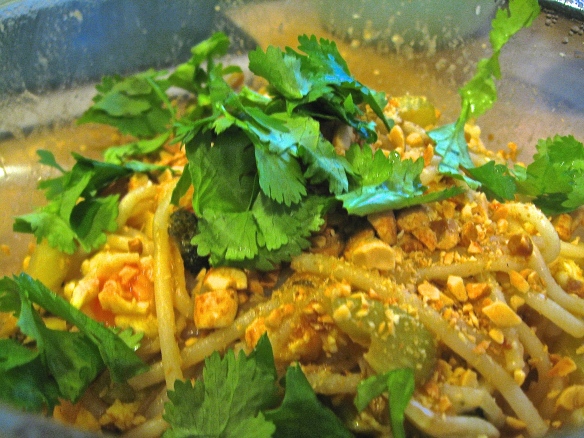
Later in the week I wanted to use up the rest of the dried noodles, so I hot-soaked them and then stir-fried with a jarred Pad Thai sauce I’d bought for “some day when I wanted Thai but didn’t want to order out or cook from scratch.”  I managed to employ this sauce, the rice noodles, about ten frozen raw shrimp left from Thanksgiving appetizers, some eggs and broccoli and aging celery, even had salted peanuts hiding behind the dried pasta; only had to buy fresh cilantro and bean sprouts.

I trust that if I eat up all the food I have, there will be more.

Shrimp pad thai, with crushed peanuts and cilantro leaf.

Shrimp pad thai, with crushed peanuts and cilantro leaf. Oh, and broccoli and celery and bean sprouts. And a little egg.

This week, in the spirit of being empty, I even skipped a writing deadline, deliberately watching the clock tick down and observing my reactions. The piece I wanted to submit just wasn’t ready yet, so I didn’t force it.  I trust that it’s stewing inside me, and I’ll know it’s ready, if I keep close watch on the pot.

So instead of indulging the A+ student, I hiked for hours along the Niskayuna Bike Path, on the last sunny afternoon predicted for a while, then hunkered down for the blowzy day on Friday.

I trust there will be other opportunities in my writing life; that missing this one won’t be the end of me.

Almost-official-winter reflections in the Mohawk River, along Niskayuna Bike Path

Almost-official-winter reflections in the Mohawk River, along Niskayuna Bike Path

I conversed on the day of solstice with author E.P. Beaumont (http://epbeaumont.com).  E.P. describes late fall as “the end of things, the beginning of things, a gateway time, where the gates to the other world are wide open–and remember the other world includes The Past, as well.”  This is a time for processing, meditating, mulling. It reminds us of other darknesses that will inevitably come, and trains us to hold on to the memory of light and lightness, which will also inevitably return.

Though deeper cold chills the landscape and bits of snow flew outside this morning, winter solstice has come and gone and the days increase, even if imperceptibly for now.  I will continue consuming my culinary caches, making order, making messes, identifying my life’s work through my daily work. Lighting candles and cooking noodles.  Drinking tea. Trusting I carry my peace and emptiness with me, into the darkness, as I seek the growing light.

The list of cached freezer food grows shorter.

The list of cached freezer food grows shorter.

Mom’s Curried Chicken Recipe:  Saute 1 1/2 tsp curry powder and 1 TB instant minced onion in 3 TB of margarine. Remove from heat and add 3 TB flour, 3/4 tsp sugar, 3/4 tsp salt, 1/4 tsp ginger. Stir until thickened. Add 1 cup milk and 1 cup chicken broth. Put back on heat and bring to a boil. Simmer one minute, Remove from heat and stir in 1 cup cooked cut up chicken, 3/4 tsp lemon juice. Serve on top of rice mixed with parsley flakes.

I usually double all the ingredients, thoroughly mix in more flour than recommended so the sauce will be thicker, and whisk the roux incrementally with the liquids, before heating, to avoid lumps. This time I also added 32 oz of cooked Community Garden green beans along with the chicken. And more chicken than recommended. Of course.

Shrimp Pad Thai. I used a whole jar of Thai Kitchen Pad Thai sauce, and followed the instructions on the label for stir-frying 2 eggs first, then the shrimp, then the sliced veggies, mixing in bean sprouts at the end, topping with crushed peanuts and cilantro. I followed the directions on the rice noodles for hot soaking, then stir fried them with the sauce, again per the Thai Kitchen label. Nice and easy….

Saving Food/Wasting Food

Kitchen window, cup of tea and colored glass

Kitchen window, cup of tea and colored glass

Last week’s blog did not get finished or posted–all because I made an inedible pot of soup.

In a hurry; measurement ignored; ingredients tossed together; forgot to break up the frozen chard so instead of tasty green bits, slimy strings floated; didn’t realize the pinto beans had been freezer burnt by a crack in the container until they were already in the stew; frugally used up an open beef bouillon concentrate, but the whole thing tasted too dark and earthy, not savory.

Finally I admitted to myself that beef base just didn’t work here, and neither did anything else.  Staring at the congealed mess in the stockpot: How did I come to make this lousy food? 

Fear. The word bubbled up, like the greenish-brown liquid in the pot.  It’s fear. 

A discussion before Thanksgiving at a local barbecue restaurant prompted this reaction. One friend had grown up in an Italian family, but not one that stuffed him like a manicotti; plenty to eat, but no forcing, “take however much or little you want.” Therefore, few food issues emerged afterward, and he is able to enjoy a bit of protein, or a bit of sweet, knowing pretty instantly when he might be over-eating. My other friend grew up with nutrition from the pantry at her church, sometimes shamed by charity, and sometimes sending back food that was so unpleasant her family couldn’t accept it, for others more desperate than them. Later food allergies made meal preparation tedious and very limited.

I grew up with meals measured out carefully, only intermittent seconds or extras, and desserts strictly regulated–even though the cupboards and Frigidaires were full, a practice dating from the blizzard-on-the-farm days of my mother’s teenager-hood. We had enough, but the equal-sized and small portions of meat, starch, vegetable, fruit, though nutritionally well balanced, usually tasty, and not bad looking on the plate, combined with later skirting with poverty during grad school days to create an enduring sense of scarcity, and lack of knowing what my body actually needed and craved, aside from “more.”

After sharing our stories, we three studied our plates and take-out containers in shock, individually mulling over alternate universes–What would it be like to live with his relationship to food? With hers? With mine?

Weeks later, this led to my realization and then extended thoughts about fear, as I stood over my unpalatable potage, but a different fear interrupted–about meeting the Friday writing deadline. All this thinking is taking too long!

Then I remembered the book I’ve been slowly reading lately: Sarah Susanka’s The Not So Big Life, wherein she says some very cogent things about Running Out of Time and  Attachment to Outcomes.

With a sigh, I went back to page 36. Susanka reminded me to not make the end product the goal, but rather the process; the process of figuring out what I wanted to say, the process of understanding myself–that was the goal.

The A+ Student in me got sent to a time-out, to cool her proverbial heels for a week, and I lived my life and read my book and wrote pages and pages about my childhood and young-married life, and my relationship with food.

J's crazy-cats keep me company.

J’s crazy-cats keep me company while I write and ponder.

Now multiple essays are emerging, all linked by a challenge I’ve set for myself.

Don’t worry–it’s not a challenge that will cause the A+ Student to come roaring from her room with fangs out and lists streaming behind her. It’s just a challenge to gently help me and the A+ Student identify what ideational platforms I’m standing on, where they come from, and ask:  Are they true? Are they helpful?

So…I now take a vow to clear out old food, to undo the feeling of scarcity in my eating life. No more stuffing the freezer and shelves with food because I am worried about not having enough. 

In fact, I am going to “spend down” my supplies. I will buy the fresh things necessary for daily use, or specific ingredients to make something fun or follow a recipe, but no more stockpiling. If a food item is past due, or icky, it’s gone. After cooking, I can put an extra portion away, but will share it or eat it within a short period.

Reminding myself: it’s one person for many meals, little amounts of food, not like when I was cooking for a family of four, which with teenagers makes it more like six, and their friends, plus leftovers for the food needs that will come a few hours or a day later– Whoops, better cook for eight or ten.

Homemade pizza with a big family used to mean two 9 X 12 cookie sheets. Today I eat one piece, with salad and fruit. Lasagna in the past? Twelve pieces for today, twelve pieces for the freezer, regardless of the future texture. Who cared about that? It was speed, availability, and quantity!  Nowadays, lasagna is layered with vegetables, a delicate sauce, fresh cheeses, and no more than two or three servings over several days. Yes, life is different and the action I’m taking will be accompanied by meditating and writing.

A list is posted now in my kitchen, what’s kept cold and what’s kept frozen and what’s kept waiting in the pantry, along with a few lovely potential recipes.  A month of this, and the new year has a chance to begin fresh and open.

How will it feel to have emptier cabinets, an almost empty freezer?

***

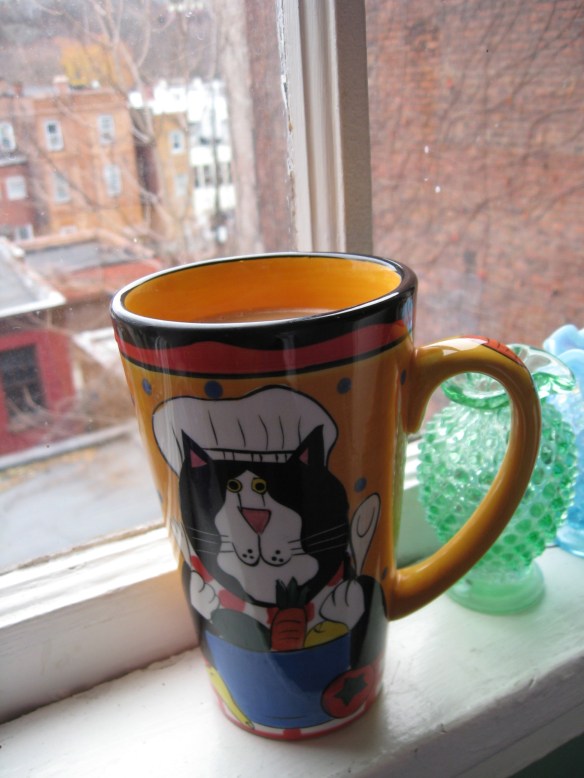
Approaching frozen containers was too daunting after the soup fiasco, so I started by opening a can of sweetened condensed milk whose “best by” date I can’t even admit to.  It tastes fine, the texture is merely thicker and the color more caramel than usual, and I am using it instead of the standard turbinado and milk to lace my morning tea. It’s beautiful in J’s cat-covered mug, and stirs up nicely. A good start, I say.

Next week the menu includes Broccoli Macaroni and Cheese, and a side of My Personal History with Commodity (Government) Cheese. Soon to come: Phyllo Chicken Pot Pie accompanied by Women & Preparedness; Losing Books and the Purpose of Stuff; a dessert of Poverty, Pie, and the Possibility of Blizzards.

See? I tell myself. There’s still fullness, and not just of food.

IMG_8866

Creamy and filling, the tea with sweetened condensed milk–whose time had finally come!


Popovers, and Peace with Myself

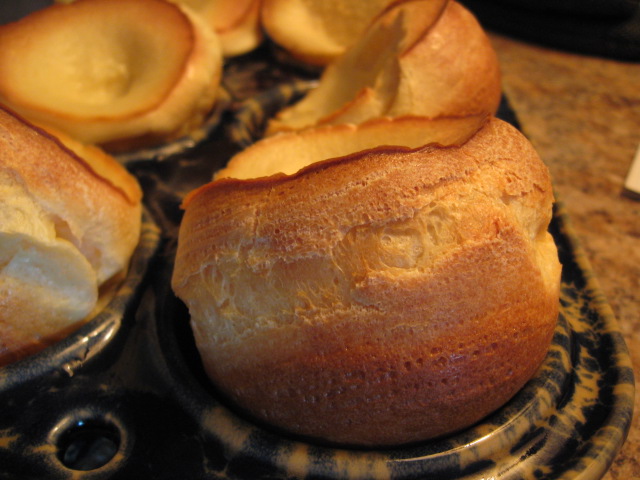
Popovers in all their particularity–and fullness.

I hadn’t ever eaten them, I don’t think, before last year.

I learned to use a borrowed Bennington Potters smooth-glazed stoneware 6-count muffin pan.  (Metal just doesn’t work the same.)

I have discovered much, in my new friendship with popovers.

***

From a friend’s five-ring, first edition (1950) Betty Crocker Cookbook:

Beat together just until smooth: one cup sifted…flour, 1/2 tsp salt, 1 cup milk, 2 eggs. Pour into well greased, deep muffin cups, three-quarters full. (Oven-glass cups make highest popovers). Bake at 425 degrees, hot oven, until golden brown, 35-45 minutes. Serve immediately. 

Amount: 5 to 9 popovers, depending on size.  It is not necessary to preheat baking cups.

***

An oven light reveals them becoming the “high hat muffins” Betty describes next to her typical mid-century artificially colored photo of breakfast on a red-checked tablecloth.  The clock’s slow countdown gives me time to watch and muse.

Sometimes the edges pull up in one direction or the other, sometimes they rise evenly–inflating caramel, tan, and white, puffing like out of control teenagers careening around corners, not caring where they spill, yet contained by their individual muffin cup.

A half dozen “high hat muffins”

Bulge, distend, inflate, expand, enlarge, all the synonyms for the process, feel kind of distasteful, instead of the happy idea of claiming volume, having plenty of room. We aren’t supposed to take up too much space, are we? especially women. Popovers stretch out as they heat and settle back in as they cool; it’s not their nature to be tiny, uniform and controllable, and I realize it’s not mine either.

In addition, each one tastes good, regardless of lumpy or cracked shape.

Remember that, I tell myself, when you are poking your belly as you look in the mirror. Remember that we all feel good, warm and toasty, to someone ready for our toasty-ness, our hidden steam–and that first person, who should love us best, is our own self.

The phrase “muffin top” comes to mind:, we don’t like to spill out, be exposed for our size.  Is a muffin top to be ashamed of? When we squeeze ourselves into tight clothes, our softness squished hither and yon, we are measuring against only one standard; I remind myself that muffin cups are there to hold and separate the baked goods, not painfully compress them.

All the different ways the popovers rise up makes each one itself. Not that we want to be overly heavy or fool ourselves if we’re being unhealthy. We just want to appreciate our popover-ness, our crispy freshness, our lovely expansiveness.

***

So after the 35 to 45 minutes, at the height of puffy but not to dark brown yet, it’s time to pull them out.  They deflate and darken a bit with rest, settle into their-selves, creating a little place for the knife to slide in and deposit butter without too much steam burning fingers. The defined crispy edges, crunchy and chewy to the tooth, lead to an airy eggy center, filling but light enough. I usually add a smear of summer blackberry preserves or honey.

Popover releasing steam, ready for butter and jam

After cooking, you have to eat them right away. Even an hour later, they just aren’t as tender, tending to be eggier, heavier instead.

Precisely because of that short peak, popovers are not popular.  I am the first to admit my royal role as Queen of Leftovers, doggy-bagging at restaurants or preparing extra portions so I can have something tasty tomorrow as well as today.  Popovers teach me a lesson in Right Now.

They only require a few things: flour, milk, eggs, salt. The right kind of pan, a hot oven, and enough time.  Blended components change and shift before your eyes, and then you get to savor them in your mouth. On these cold or snowy late fall mornings, you can share the making and tasting with family, a friend, or yourself–good company, all.

We, like popovers, are delicious, delicious beings–if we let ourselves be at the temperature we need, for long enough, in the proper container, no more than a few ingredients, then water and oxygen moving in and out with a sense of plenty–plenty of space, plenty of time to be spent on just this one thing, making and eating popovers, making and being ourselves.

Delightful, savory, just right. Aren’t we all?

Mind-Out-Of-Time: Writing, and Teapots

My teapot from J, tucked behind an electric kettle, another teapot, and a locally crafted mug,  on my early morning countertop.

I miss talking to J about my writing life.

This afternoon I will concentrate on writing, I’d say.  I’m deliberately ‘concentrating on,’ not ‘working on’–no more of the furrowed brow that ‘work on’ entails.

She’d laugh.  I used to have that furrowed brow, too; hell, look at my wrinkly forehead.  J would talk about the struggle to get to her drawing, even with new chalks and paints around her, how daily chores and her own busy mind pulled her away from something she’d never had time for, yet couldn’t quite get to, even now.  She’d encourage me to keep going, and I’d tell her more.

When I give myself over to writing, or create space for it, then I can relax and play. It’s what I call Mind-Out-Of-Time, what I sometimes think heaven is or would be: you are so involved in something that clock hands move unnoticed, you look up and the afternoon light is bending across your desk and you gasp–how long have I been here?

Mind-Out-Of-Time comes also when I choose to immerse myself in how life looks and feels, tastes, sounds and smells. It comes when I give myself permission to be right where I am, at that very moment, open to pleasure even in the midst of pain.

So I think of J, steeping tea in her beautiful cobalt blue teapot, when I came to visit six months ago. Napkins in hand, she danced oxygen tubing between pieces of furniture as I carried the prepared cups and cookies to the front room. We laughed about how, on our last big trip, she’d pulled her portable oxygenator, nicknamed ‘Fred’ after her father, all over the up-and-down hills of downtown Vancouver.  Fred sure got a workout, didn’t he? Took care of me just like Dad did.  We discussed once again her wish to die at home.  She asked after my teapot, a twin of hers, which she gave me when I moved away. Every time I make tea in it I think of you, I told her.

Two weeks ago, her caregivers still made English Breakfast in her blue teapot; she rested in the home hospital bed, I held the mug, she sipped sweet lukewarm liquid with a straw.  During the moments she was awake, she rolled her eyes sardonically, joking with only a few words about the little yellow curlers in her hair that looked like baby corn; I teased her back about how she finally got us all to wait on her hand and foot, and more seriously, how much we loved doing it.  As she drifted into medicated rest, she murmured about death, it will be pleasant; it will be pleasant. See you on the other side.

After the memorial service last weekend, I wrapped up the cobalt blue teapot in crinkly paper, to deliver it safely to her chaplain, someone who’d shared tea with her every Wednesday for many years, someone whom I suspect also understood mind-out-of-time with her.  I took one of her mugs and packaged one for yet another friend.

This morning, kitchen lights reflect on the curve of my round teapot as rain drips down the apartment windows.  Cars splash black puddles up into the air outside.  J’s goldenrod colored, cartoon-cat covered mug, full of toffee-chocolate-hazelnut tea, sits beside my keyboard.

Guess what.  I’m still talking to J about my writing life.

Woodchucks (Actual and Otherwise), Part II: Woodchucks Otherwise

There are Woodchucks in my writing.

The phrase popped into my head in January, far from the days of warm dirt between my fingers. There are Woodchucks in my writing.

I had become discouraged by a work-in-progress, unhealthily attached to its “success,” and had returned to that old refrain–I’ll never have a piece that is good enough. Undermined by my own thoughts, tempted to give up, give in, to forces that seemed greater than myself–What the heck, my essays will never amount to much, so it would be best to give up now.

Dig-dig. Burrow-burrow.

I began to see how Woodchucks appear in many forms, and got excited about creating a guide–yes! a field guide! isn’t that clever?–Identification and Management of Woodchucks in the Writing.

And then one of those damnable Woodchucks swaggered up and bit me in the butt, before I even got to the garden gate. So let’s begin with that one.

Scratch-scratch. Tunnel-tunnel.

I scribbled down stories almost as soon as my oldest sister taught me to read, when I was four. She also wrote, lush adventure stories and even whole novels.   I studied her fiction—the form, the characters, the movement of the action. In my admiration, I believed I could never be as accomplished. As I aged, prolific and polished and Pulitzer-prize winning authors entered my consciousness, and my Inner Critic, a nasty Woodchuck, emerged–

–to the point where I believed that somebody else could probably pen this essay better, draw out the metaphor with more sophistication and grace; so at first the vision of this non-existent essay stopped me like the sight of my chomped down, messy garden in the midst of everyone else’s blossoms.

But I committed to the task, anyway. (Even though the moment I publish, I will have changes I want to make.)

Yes, we learn from studying how other authors work, but we also just have to write. Yes, we can analyze when other gardeners plant, how they organize their pieces of ground, but our plot is our plot, for us to grow our choices of vegetables, fruits and flowers. Flourish or fail—but not to compare to others’.

Toddle-toddle, shuffle-shuffle.

The big ol’ Papa-Bear of a Woodchuck, previously identified as  A+ Student Syndrome, shows up regularly.  The creatures will come, and they will eat part of the garden. Like the nasty self-deprecating voices in our heads, they can be addressed.  If you let Woodchucks keep you from planting or weeding, you will never get to where you want to be. Or you will have to adjust your expectations. The garden can never be perfect, and in fact is kind of attractive in its messiness, like being a human is imperfect, and a little messy.

During the summer, I called myself the worst garden coordinator, thinking I had to be the best. Why couldn’t I be just-ok, sometimes great, sometimes not?

Peck-peck, bite-bite.

It happened so fast!

The first time the cauliflowers were damaged I had tried to wish away the Woodchucks, but that’s like anticipating the sun to not rise tomorrow: Highly Unlikely. Instead, look at the evidence of sneaky invaders and name them: Yup, those little critters look like groundhogs to me!

What a difference a fence makes—the fence in your mind that says, Whoa! That’s an undermining message!, from the Supposed Expert or Mumsie & Dadsie, or those composition teachers or that nosy neighbor or The Permanent Record, of all our wrongs, mistakes, mis-steps, mis-understandings, pain we have caused others, pain we have caused ourselves—here’s the slippery slope to doing nothing, being stymied by the prospect of not doing so well.

Steel yourself against incursions, gather your resolve. I had these beautiful little cauliflower plants, carefully planned out. Something went wrong and I just wanted to give up, but I didn’t.  Try again.

Nibble-nibble, crunch-crunch.

Sometimes you avoid the feelings: you avoid what you might find (destroyed or not growing or scary) by shunning the garden, by shunning the writing.

Chew-chew. Snack-snack.

My favorite therapist says we are not “bad” at things; we’re just not always skillful. Helpful mantras: I am learning new skills. I have become more skillful. I have options.

With Woodchucks, we learn to face a difficulty and not “fix” it, but discover how to live with it, with patience, becoming more proficient every year.

Crunch-crunch, gulp-gulp.

Sometimes we need a partner in our work; a garden-mate, an encourager.  The garden-mate is about asking for help, knowing you don’t have to do it by yourself.

Enlist the help of others, to do these things. Trade knowledge. Even if the suggestions don’t work, you can commiserate.  The people who choose to be in the garden reinforce my choice to be there, and so it is a circle, a wheel of support, like my writers groups where we read each other’s work, or have writing bouts together, to get the work done.

Munch-munch. Chomp-chomp.

Scamper-scamper. Scurry-scurry.

Because I planted anyway, in spite of my worries/concerns/downheartedness, because I wrote when I didn’t think I had it in me; because I fought back against the Woodchucks of the Mind, eventually I succeeded.

Gulp-gulp, waddle-waddle.

My garden mate thinks woodchucks are cute, even in their destructiveness. I am not so sure about that. And yet, being able to step back and see them as not so large, not so vicious, yeah they are just those fuzzy things, that takes some of the sting and power away; they are just doing what they do, and I just need to do what I need to do. No need for panic or drama.

Gnaw-gnaw, Taste-taste.

Make no mistake, they will still be there, come next year. They will not somehow miraculously mislay the directions to our gardens.  The fencing will have to go up, we will have to be vigilant. The doubts, I have to be vigilant about those too. I tell myself: don’t be caught up in the hurry-hurry of getting it done; instead, relish the moments, second by second, breath by breath.

I write to slow down and look, to figure things out, to show others what I’ve seen so they might enjoy it as well.  I go to the garden not just to reap the squash and basil, but to step into the muddy soil, feel the weeds dripping onto my sandal-exposed toes while I tromp up to my plot, take in the cicadas’ buzz and smell the cilantro in the heat, hear a friendly voice in a fellow gardener, feel a part of a community and be reminded of what I bring to them that is valued.

Scramble-scramble. Clamber-clamber.

Often life intervenes; we make other choices so we don’t make it to the garden or the writing. But growth is still going on, even if we aren’t tending actively. Even the halfheartedly planted seeds.

Run-run! Dive-dive. Under the fence and out.

You rally. Every spring you rally. Every piece you write, you rally. Sometimes like a good gardening day, it flows, and other days you struggle to get there, wrestle to get the tools up the hill, get smacked by the damage you find, find bugs you weren’t expecting—but then those bugs (Old Yeller!) might be found helpful after all.

There’s a whole range of experiences to be delighted in, and we won’t have them if we let the specter of Woodchucks keep us from wandering up to that sun-filled garden.

Things to remember when you encounter real and other woodchucks:

Don’t compare your creation to others’.

Let go of perfectionism.

Anticipate invaders; identify them as the Woodchucks they are.

Don’t look away.

If you “fix” it once, it is not “fixed” forever. This is an ongoing struggle–but your worst attempts are getting better.

Structure and persistence are your friends.

Don’t let fear or doubts keep you from starting or following through on your work.

Live moment by moment, in beauty.

Community is valuable; you don’t have to go it alone.

Don’t take it so damned seriously!

A+ Student Syndrome, Part Two

The A+ student had a goal.  Or rather, the Artist Formerly Known To Participate in A+ Student Syndrome, who still liked to get things done–that person had a goal.

It was a set of little deadlines, leading to one blog post per week, on Fridays.

In fact, that exceptionally smart person was going to get a few posts ahead, “in the can” as they say, ready to automatically publish–so she wouldn’t have to worry about producing every single week; she could take a little time away if needed, or work on something for longer if it was, you know, Not Quite Ready But Almost.  She luxuriated in thinking and writing, felt cured of the perfectionism.

But then…you might have noticed Of-the-Essence-Blog started on a Wednesday, followed by two Friday posts in a row and…silence until today.

Yes, life intervened before she could get the next piece finished, without that comfortable backlog of essays. Life intervened when she lost a filling on Thursday–Thursday before the Friday when the blog needed updating.

~~~

Just a filling, but really, when you are breakfasting on delicious pastries, and you think, Wow this muffin must have been made with stone-ground corn, and then you see it’s not a misplaced part of the grinding mill, it’s a big hunk of silver which until moments ago fit nicely into a back molar and you’ve never had trouble with fillings before and the jagged tooth then shreds the side of your tongue and egad this needs to be fixed very, very soon and you berate yourself in good A+ student manner for not finding a dentist right away when you moved here and then you think about all the awful life crises that happened to prevent you from finding said dentist and in addition you realize you now can’t eat all the crunchy healthy food in your fridge, thus undermining your campaign to get the clothes you bought last summer to fit more loosely again, and oh my gosh you still haven’t chosen which short piece to edit and put up on your blog–well of course you are going to be emotionally and physically exhausted and incapable of writing about anything for days and days.

~~~

Friday and Saturday went by with no post. Dammit. Behind already.

The list of self-imposed deadlines grew from “little” to “little and belated” to “really overdue and huge and monstrous”; the writer berated herself and returned to strict requirements for things to be Just So.

Aside from not being on time, she saw she hadn’t prettied up her site to her own exacting internal specifications, so she avoided what now felt like drudgery instead of delight, with hours of television episodes on Netflix on Sunday and cleaning out the email queue on Monday and Tuesday, all the while eating too much soft white bread and honey-butter.

The voices returned.

I can’t do this writing thing, I am letting my few readers down, I am letting myself down, I am failing already and I just started.

An unexpected interruption had collapsed the proverbial dromedary’s spine; the pack animal wasn’t as strong as she thought.

Then the former A-plus-er realized that being tired or in pain can turn up the whispers of doubt, which don’t ever go away fully anyhow.  You just get better at identification and quicker at banishment. After seeing them for the untruths they are, no worries linger about straw and burdens–because you are just out enjoying the day’s walk.

Hey! I am not letting anyone down; so I didn’t get to do what I planned.  What’s the big deal? There’s no failure here, just falling down and getting up.

You are a writer. Only fear makes it logical to pulverize your creative children before they are even born. So, write already!

After the new dentist put in a temporary crown and chewing was no longer painful, she took a deep breath. I will try to publish this next Friday. I will.  Then she smiled and shook her head.

In the first post, I said I would be continuing my description of A Plus Student Syndrome. Just didn’t think it would be quite so soon.


A+ Student Syndrome

NOT the perfect apple–or a perfect photo of one, either. But it was a delicious small Honeycrisp, dewy and resting in my sink, juicy and refreshing when finally cut.

I thought this first post was going to be about food. After all, that’s what got me excited about blogging in the first place.

You see, I find myself taking pictures of meals—at home, while I cook and when dishes are completed; out at restaurants, hollering: Wait! I have to get a picture of this first!; over at friends’ houses as they roll their eyes: Don’t put your fork into it yet…hold on…just one shot! Ok, a couple more….

Preparing food is contemplative, and I delight in thinking about the meaning of eating. So I could have started by describing a particular food, a recipe, the importance of local produce or gardening and community—all great subjects.

Then I thought it would be about writing, that I write in order to process the world—which has kept me sane, literally, through the past few years. There’s nothing like the luscious correct word for something, or getting blasted to another time through smells or sounds or an overheard phrase.

Next it struck me this opening post might be about the outdoors, discovering an ecosystem new to me, here in the Adirondacks, Catskills and Berkshires. Exactly how walking is meditative, and yoga keeps my body able to do the hiking and biking I enjoy.

But it seems the voices in my head want to keep me from this initial foray into the e-writing world, with worries about perfection and “getting it just right, first.”

I’ve gnashed my intellectual teeth and wept fearful tears over what to write, how to write it, editing so as to put something really worthwhile out into the world. Which has kept me from starting in the first place–What if it’s a disaster?

Now I know my topic!  Meet a phrase I coined several years ago in my memoir work, though other writers I know have come up with it independently as well:

A+ Student Syndrome.

A+ Student Syndrome says you can never do enough. Period. End of story.

You cannot earn an A because only an A+ is acceptable. How could you think of publishing something that is less than a highly polished pearl of perfection?

Even if you do produce something spectacular, you have to move on without pause to the next job, chore, affirmation of your worth, once you are finished with the one at hand. The internal standards rise with every creation you finish, no matter how good that creation was.

So you get stuck when you want to try something, something you are not sure you will be good enough at.

Stuck big-time.

In my head right now—How many people will comment on the preposition at the end of the sentence up there? Maybe I should fix it. What about my other word choices? Maybe I should move the paragraphs around a little more. Or my photos? Maybe they suck! On the other hand, what if this blog is horribly popular and then I have to keep writing better and better pieces, longer and longer until I don’t have anything interesting left to say? What if people reading this think: Exactly! Already she doesn’t have a damn thing to say!

Are you nodding your head in recognition at that driven self-doubt? I’ll write more about this running life-theme later. But I am going to post my first piece, in spite of my A+ Student Syndrome, in fact because I am recovering from it. Hence the subtitle of this blog: Building a life moment by moment.

There! I have committed to leaping in joyfully and wondrously and knowing I am enough, all by myself, even if my words aren’t flawless, even if a dish flops or I’m not skillful at certain parts of my life.

Fall down—get up. That’s what I am supposed to do. One motion, repeating itself.

Not fall down and berate myself for falling. Not get up and never ever fall down again. Not worry about how to avoid falling at every moment.

Fall down—get up. Gloriously. With style, even. Not worrying about whether it rates an A or a C. Yup, building a life, messy moment by messy moment.