Phyllo, and Preparedness

Lemon that has been cooked in syrup for baklava: honey, water, orange blossom water

Lemon that has been cooked in syrup for baklava: with honey and orange blossom water

Mom, is there any GOOD STUFF in here? 

Sweetie, some guys from the lab want to have a party, just a little one. What do we have for appetizers?

She’s not eating meat anymore–well, maybe sausage, but not pig-sausage.

Ten people from the social justice group will be coming by post-conference for dessert.

Your apple cider cornbread is scrumptious! 

The church needs platters of cut-up vegetables for a funeral reception.

His unemployment check is late this week; do you have a couple slices of  bread for the kids’ sandwiches?

Can we drop by and talk at dinner time? I’ll bring wine…

Yes, a vegan birthday cake–how about that carob one with peanut butter frosting that you made for last year’s party? Oh, and some of the kids can’t have wheat.

Mom, is there any GOOD STUFF in here?

**

I loved meeting people’s food needs. And I still do.

But I had a different life before; my personal food requirements have changed, even though my buying and supplying habits have not–yet.  Hence the recent challenge to make dishes with what I have in the house, and then face the world empty-handed, empty-casseroled.

Don’t get me wrong–vegetarians, vegans, and omnivores still visit; I welcome the gluten-intolerant, yeast-free, soy-sensitive and low-fat, the teenager-like appetites, but also smaller appetites as well.  Tasty comestibles invite people to come and relax, and I want to create a comfortable place for not only myself but others as well.

However, it’s crazy, even as a personal chef, even as someone who likes to cook to special dietary needs, having this much food around.

For example, I discovered that I had all the fixings for a recipe out of an old Country Living Magazine, involving leftover Thanksgiving turkey and half a pound of phyllo dough.  The other half-pound of phyllo went into baklava –for which I also happened to have all the ingredients.

A little ridiculous, but indeed, I am the kind of person who often has phyllo dough (and a thousand other odd ingredients) in the freezer; I respond to any possible incredulity–well, I might have a spanakopita emergency!

When I mentioned this at a writing group recently, thinking I was the only crazy one there, four out of four of us had the makings at home, at that moment, for spanakopita (spinach pie with feta).  Along with ingredients for Indian curries, pesto, and multiple varieties of soup.  So does that just mean we are all foodies? Or that amazing numbers of people are now conversant with multicultural foods? Or do all four of us happen to regularly host huge numbers of last-minute get-togethers?

Some or all of those theories might apply, but it’s bigger than that.

We women are taught to have plenty, to be plenty.

We are called on to make miracles with what we have on hand, so we learn to have a lot on hand: in our pantries, in our emotional capacities, in our organization of tasks large and small, in our intellectual understanding and knowledge of the world.

We utilize our reserves over and over again, often struggle to keep a brave smile, a “full pantry” all the time, without opportunity for rest and rejuvenation.

**

In performing my usual writerly vocabulary-check I asked:  For my title, does “preparedness” differ from “being prepared”? The dictionary answered: Preparedness is the state of being ready, especially for war.  Ah! so this is like war for the keepers of the larder: under attack, scarcity approaching.

Apparently, this incipient battle requires phyllo dough at-the-ready.

And guacamole and salsa and four kinds of crackers for the various demands that might present themselves. Humus, tabbouleh, pita chips. Chicken, hamburger, mozzarella, edamame. And ingredients for phyllo poultry pot pie, and baklava.

Sautéing in my enamel pan, for pot pie

Sautéing pearl onions, carrots, parsley in my enamel pan, for pot pie

As a belt-and-suspenders person the message is:  be ready for emergencies, don’t be caught unaware, unready, especially if you know it is a possibility–and so many bad things are a possibility. 

Lately I am learning instead: Yeah, I’ve had it scarce, but I am learning to trust if the world falls apart, my community and I will work it out.  I’m prepared but don’t need to live in a state of fearful preparedness. I am acceptable with my hands empty; I will not go hungry. 

In addition, I can choose when and where my arms are open and gifts are shared, to choose without incurring exhaustion or potential resentment–claiming my right to decide what I want to offer, and when.

Even though it is tasty and fun–I don’t always have to have phyllo dough in my freezer.
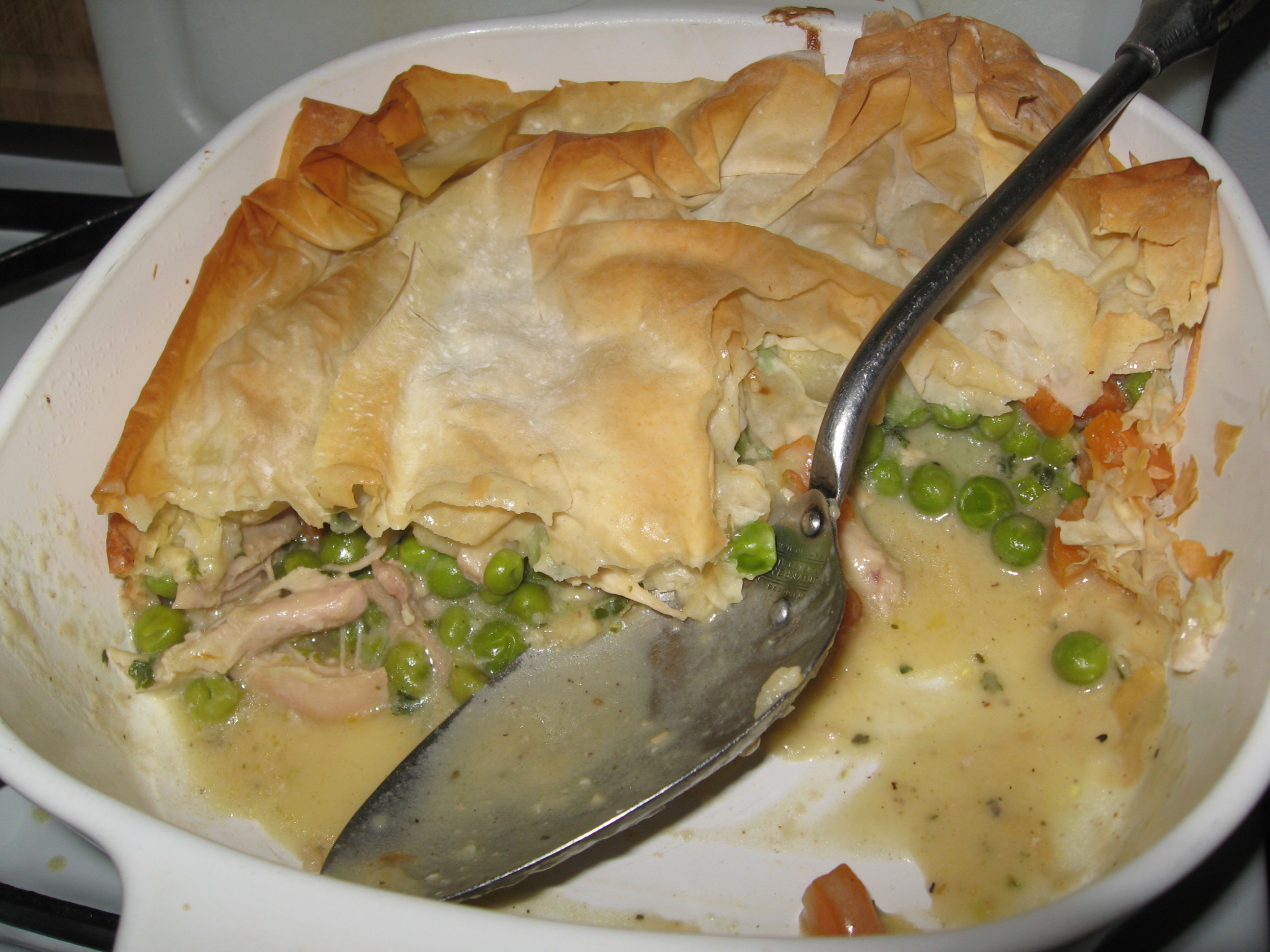
Phyllo chicken pot pie

Phyllo chicken pot pie, with peas in gravy

RECIPES, WITH ANNOTATION

Chicken (originally Turkey) Potpie with Phyllo Crust, adapted from Country Living Magazine, November 2010, page 112.

I cooked in a large skillet over medium heat: splash of olive oil, 10 oz fresh pearl onions (boiled for 2 minutes and plunged into cold water for two minutes so you can cut the ends and squeeze out the center portion without hand-peeling), cooked them until golden brown, about 8 minutes. Added 3 community garden carrots, diced, and garlic from the fridge. I cooked all that about 5 minutes, until the carrots were just tender, and stirred in a handful of community garden parsley. Sprinkled vegetables with 3 tablespoons of flour and cooked a little (the original recipe called for flour to turn golden brown, but it was too easy to burn it).

I added 1 1/2 cups chicken broth–made from chicken pan drippings (including Pappadew seasoning, salt, pepper, garlic, olive oil) AND a cup of 2% milk, a squeeze of spicy brown mustard (the original recipe called for Dijon, didn’t have it, oh well), salt and pepper. Cooked until mixture thickened, about 6 minutes. Stirred in 2 1/2 cups shredded roasted chicken, 1 1/2 cups frozen peas (rinsed since they’d been in the freezer so long), and broken up Community Garden dried sage. I used half a box of phyllo with butter softened by sitting in the hot kitchen.  Don’t have a pastry brush so used fingers to brush butter here and there between the sheets, and on top, baked in regular oven at 400 degrees for 20-25 minutes, watching the phyllo turn medium brown.

The Baklava recipe came from The Joy of Cooking, and I even had essential oil of Neroli (orange blossom) in my aromatherapy supplies to make the called-for, very dilute orange blossom water. It added a subtle, delicate aroma to the syrup.

I used local honey, a fresh lemon left from Thanksgiving, half the butter the original called for, cinnamon & cloves, sugar, chopped pistachios, walnuts, almonds–and a half-pound of phyllo dough.

Plated baklava, glistening with honey and crystals of sugar

Plated baklava, glistening with nuts in honey-syrup, and sugar crystals on the edge

Structure: the Old Year, in Pictures

Bridge over the Mississippi, Minneapolis MN

Reflections that create balance. (Bridge over the Mississippi, Minneapolis MN)

Like monthly bills and seasonal equipment, 2012 will soon be put away.

Annually I take the week between Christmas and New Year’s and look back.  Not that I don’t regularly return to carefully saved artifacts and reflect on my journey at other times, but it’s an interesting practice to hold the twelve months in hand all at once.

Because I am still coming to the words–how can you encapsulate a year, a month, a day?and should you?–this week’s blog is almost purely visual: an admittedly incomplete retrospective of what has fed me, gifts given and received over the year.

The theme that emerged in my almost-random selection from the 6,000 digital photos? Structure.  Structure in general, and the structures I am building. Of what underlies my daily life, how to not split time into dreaded work and distracting play, but to find joy in all of it.

Once again, I wish I’d hatched a fully grown, spectacularly stunning concept that would bring surprising insight, followed by deep understanding–and aw heck, while I’m at it, world peace!–but laughing, I repeat the mantra: I accept being in-process in my thoughts and in my life.

Oh, and thank you, Gentle Readers, for joining me (however briefly or steadily) during the past six months.

The whimsical dancing turnip.

The whimsical turnip.

The whimsical turnip: its graceful arms reminded me of Shiva, whose cosmic Dance of Bliss simultaneously brings destruction and creation. How appropriate in studying days gone by, the wave pattern of the past, present, and future.  On the culinary side, it became part of a potato-turnip-leek au gratin dish for Christmas Day.

Watermelon radish in a salad of green leaf, cucumber, green and orange sweet pepper, carrots.

Watermelon radish in a salad of green leaf, cucumber, green and orange sweet pepper, carrots.

That shocking pink, what a surprise! Yes, I was ready to laugh at surprises, and open to new foods and sensations and thoughts and concepts.

Adirondack Park creek, near Jockeybush and Good Luck Lake

Adirondack Park creek, near Jockeybush and Good Luck Lake

Stillness in the water allows reflections. Same with my life.

Snowy tree early 2012

Snowy tree early 2012

Snow on tree. Just looking outside my window, I found meditation objects, beauty.

Votives, St. Patrick's Cathedral, NYC

Votives, St. Patrick’s Cathedral, NYC

I took them where I found them, those meditation objects and rituals, and adapted them to my own house: candles, incense, writing, yoga, walks, cooking, talking, time with friends and family.

Mohawk River: beauty in browns and blues.

Mohawk River: beauty in browns and blues.

Yeah, just some grasses along the Mohawk River, nothin’ special. But no–eminently special, subtle color and stillness again. Just look, that’s all. So I did.

A study in red, brown, and white

Food is fun! A study in red, brown, and white.

The daily is worth attending to, including the daily food.  Vegetarian chili with Community Garden tomatoes, those familiar basil-garlic cheese curds and black beans, followed by strawberries with chocolate sauce and slivered almonds.  (Yes, technically the tomatoes are more orange than red, but in other light they matched quite closely.)

Ice at Dyken Pond

Ice at Dyken Pond

Like a modern art painting of skyscrapers, just the beginning of the freezing process–I spend a lot of time “at the beginning,” but those moments are striking, too.

Mountain beyond Hildene (Battenkill Valley), Manchester VT

Mountain beyond Robert Todd Lincoln’s home Hildene, in the Battenkill Valley, Manchester VT

A classic wind battered evergreen with snow topped mountain behind. What does it evoke? Back to the idea of stillness. But more: active stillness, strength from within, a yoga thing. Responding to the wind, relaxing into holding the snow, moving with circumstances as they arrive.

Tomatoes and pears: early morning still life.

Tomatoes and pears: early morning still life.

My life is art, my food is art: more meditation objects.

Sunset over the Helderbergs

Sunset over the Helderbergs: note the teeny electric pole on the right,  which helps you realize the distance you are viewing

Beginnings and endings and the in-between.  A huge sky sweeps toward me, over me, I am immense and minuscule all at once. 

Pea sprouting in late spring

Pea sprouting in late spring

Back to the garden.

A pea plant breaks through hard ground, living into its defined structure, but how it grows, the rhythm and size and potential production, are all to come yet. How fragile it looks there, and yet it is so strong.

That’s me, that’s the new year. Delicate, to be nurtured, but hardy and riotously ecstatic and full of surprises. To be attended to every day, carefully but not with anxiety, just responding to changes as they come.

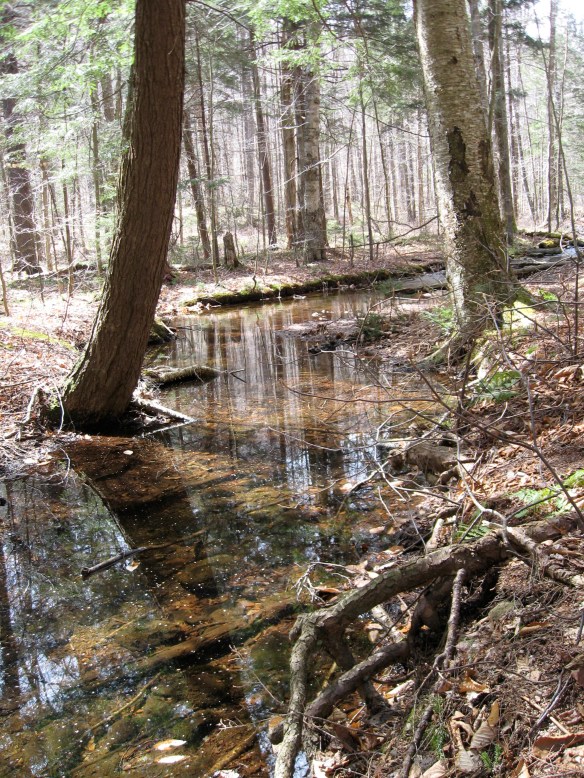
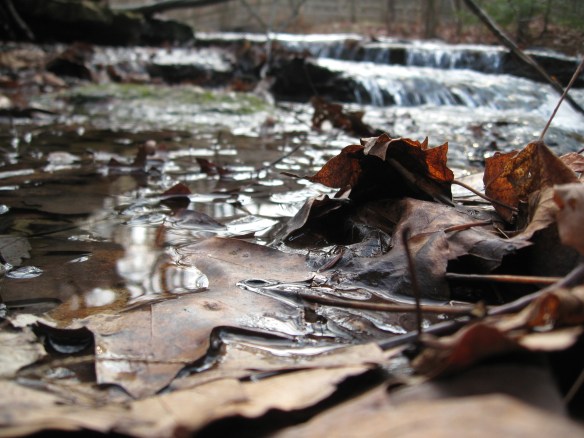
Along the Long Path at John Boyd Thacher Park: fall leaves color streams that are just above freezing.

Along the Long Path at John Boyd Thacher Park: fall leaves color streams that are just above freezing mark.

Detritus of the old is beautiful, and will feed the new life to come, after the quiet time, the enforced rest, of winter. Welcome, winter; Welcome, new year!

A wonder-ful 2013 to all.

Winter Solstice At Home, with Rice Noodles

Curried chicken, one of my childhood comfort foods, over rice noodles.

Curried chicken, one of my childhood comfort foods, over rice noodles.

I’m having a hard time settling in this week, as winter holidays come and go, approach and recede, as personal and national losses do the same.

So I go to the kitchen.

The hills and bare trees and apartment roofs that stretch to the east bear witness through the windows. I write as I do my little jobs–if I think of them as little, building like snowflakes into larger things, they are easier to begin.  I jot down thoughts, recipe ideas, insights that spring on me like the birds who dive past.  Sunrise glows dimly through the clouds.

Since the rest of the world feels sad and chaotic, I create order in my corner of it: there are the clean dishes dried and warmed by the gas stove pilot lights. Now to stack the mixing bowls by size and slip them into the cabinet, organize the post-Cookie Party baking pans, and ponder which ingredients are to be used up next out of the freezer and fridge. Here’s the softness of a purple dish towel, water splashing everywhere while I clean the last of the teacups, and that final step: wiping down the counters and sink, sweeping the floor. Now to the cooking.

**

Frozen chicken thighs started me off, and some of the Community Garden string beans I had managed to harvest and de-string and freeze before my last visit with J–and a rock-solid jar of cooking juices, added to each time I’d roasted or baked chicken since June. When defrosted, the glass was golden-full of olive oil, salt, floating bits of garlic, Pappadew sweet piquante pepper seasoning, and chicken fat.

The broth blended with milk and sautéed dried onion on the way to my mother’s Curried Chicken sauce. The original recipe appeared decades before curry was a household word in the U.S., in Redbook, or Good Housekeeping, or some other 1960s ladies’ magazine; I’m sure they promised an exotic meal, able to be put together in 30 minutes or less, conveniently utilizing leftover cooked poultry.  Originally the sauce was served over rice (red-boxed “Minute Rice” in Mom’s kitchen) mixed with dried parsley, always with a side of canned pineapple chunks.

But horrors!–the bag of brown basmati rice (standard in my interpretation of the dish) was empty, and so I hurriedly dug through the cabinets to find rice noodles, purchased for another, more modern curry dish–Thai coconut and Kaffir lime.  Since the comfort-food sauce was almost finished, I quickly boiled the noodles like a wheat-based spaghetti, and they turned out to be a wonderful substitution.

After eating, I walked into the rest of the apartment where chores awaited patiently: the end of year budget, memorabilia to be sorted, work research and networking to be initiated.  I brought in the sense of order from my clean kitchen and home-cooked meal, lit a candle, later burned some incense, and calmly did small parts of huge projects.

I drank tea, cried about tragedies, and thought about some joys as well.

Candle and tea, for the shadowed afternoon.

Candle and tea, for the shadowed afternoons.

Later in the week I wanted to use up the rest of the dried noodles, so I hot-soaked them and then stir-fried with a jarred Pad Thai sauce I’d bought for “some day when I wanted Thai but didn’t want to order out or cook from scratch.”  I managed to employ this sauce, the rice noodles, about ten frozen raw shrimp left from Thanksgiving appetizers, some eggs and broccoli and aging celery, even had salted peanuts hiding behind the dried pasta; only had to buy fresh cilantro and bean sprouts.

I trust that if I eat up all the food I have, there will be more.

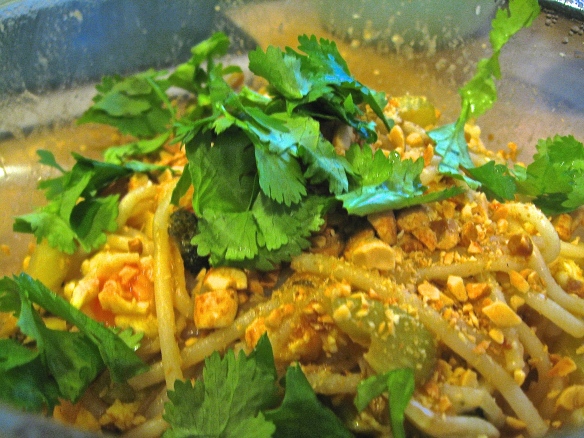
Shrimp pad thai, with crushed peanuts and cilantro leaf.

Shrimp pad thai, with crushed peanuts and cilantro leaf. Oh, and broccoli and celery and bean sprouts. And a little egg.

This week, in the spirit of being empty, I even skipped a writing deadline, deliberately watching the clock tick down and observing my reactions. The piece I wanted to submit just wasn’t ready yet, so I didn’t force it.  I trust that it’s stewing inside me, and I’ll know it’s ready, if I keep close watch on the pot.

So instead of indulging the A+ student, I hiked for hours along the Niskayuna Bike Path, on the last sunny afternoon predicted for a while, then hunkered down for the blowzy day on Friday.

I trust there will be other opportunities in my writing life; that missing this one won’t be the end of me.

Almost-official-winter reflections in the Mohawk River, along Niskayuna Bike Path

Almost-official-winter reflections in the Mohawk River, along Niskayuna Bike Path

I conversed on the day of solstice with author E.P. Beaumont (http://epbeaumont.com).  E.P. describes late fall as “the end of things, the beginning of things, a gateway time, where the gates to the other world are wide open–and remember the other world includes The Past, as well.”  This is a time for processing, meditating, mulling. It reminds us of other darknesses that will inevitably come, and trains us to hold on to the memory of light and lightness, which will also inevitably return.

Though deeper cold chills the landscape and bits of snow flew outside this morning, winter solstice has come and gone and the days increase, even if imperceptibly for now.  I will continue consuming my culinary caches, making order, making messes, identifying my life’s work through my daily work. Lighting candles and cooking noodles.  Drinking tea. Trusting I carry my peace and emptiness with me, into the darkness, as I seek the growing light.

The list of cached freezer food grows shorter.

The list of cached freezer food grows shorter.

Mom’s Curried Chicken Recipe:  Saute 1 1/2 tsp curry powder and 1 TB instant minced onion in 3 TB of margarine. Remove from heat and add 3 TB flour, 3/4 tsp sugar, 3/4 tsp salt, 1/4 tsp ginger. Stir until thickened. Add 1 cup milk and 1 cup chicken broth. Put back on heat and bring to a boil. Simmer one minute, Remove from heat and stir in 1 cup cooked cut up chicken, 3/4 tsp lemon juice. Serve on top of rice mixed with parsley flakes.

I usually double all the ingredients, thoroughly mix in more flour than recommended so the sauce will be thicker, and whisk the roux incrementally with the liquids, before heating, to avoid lumps. This time I also added 32 oz of cooked Community Garden green beans along with the chicken. And more chicken than recommended. Of course.

Shrimp Pad Thai. I used a whole jar of Thai Kitchen Pad Thai sauce, and followed the instructions on the label for stir-frying 2 eggs first, then the shrimp, then the sliced veggies, mixing in bean sprouts at the end, topping with crushed peanuts and cilantro. I followed the directions on the rice noodles for hot soaking, then stir fried them with the sauce, again per the Thai Kitchen label. Nice and easy….

Saving Food/Wasting Food

Kitchen window, cup of tea and colored glass

Kitchen window, cup of tea and colored glass

Last week’s blog did not get finished or posted–all because I made an inedible pot of soup.

In a hurry; measurement ignored; ingredients tossed together; forgot to break up the frozen chard so instead of tasty green bits, slimy strings floated; didn’t realize the pinto beans had been freezer burnt by a crack in the container until they were already in the stew; frugally used up an open beef bouillon concentrate, but the whole thing tasted too dark and earthy, not savory.

Finally I admitted to myself that beef base just didn’t work here, and neither did anything else.  Staring at the congealed mess in the stockpot: How did I come to make this lousy food? 

Fear. The word bubbled up, like the greenish-brown liquid in the pot.  It’s fear. 

A discussion before Thanksgiving at a local barbecue restaurant prompted this reaction. One friend had grown up in an Italian family, but not one that stuffed him like a manicotti; plenty to eat, but no forcing, “take however much or little you want.” Therefore, few food issues emerged afterward, and he is able to enjoy a bit of protein, or a bit of sweet, knowing pretty instantly when he might be over-eating. My other friend grew up with nutrition from the pantry at her church, sometimes shamed by charity, and sometimes sending back food that was so unpleasant her family couldn’t accept it, for others more desperate than them. Later food allergies made meal preparation tedious and very limited.

I grew up with meals measured out carefully, only intermittent seconds or extras, and desserts strictly regulated–even though the cupboards and Frigidaires were full, a practice dating from the blizzard-on-the-farm days of my mother’s teenager-hood. We had enough, but the equal-sized and small portions of meat, starch, vegetable, fruit, though nutritionally well balanced, usually tasty, and not bad looking on the plate, combined with later skirting with poverty during grad school days to create an enduring sense of scarcity, and lack of knowing what my body actually needed and craved, aside from “more.”

After sharing our stories, we three studied our plates and take-out containers in shock, individually mulling over alternate universes–What would it be like to live with his relationship to food? With hers? With mine?

Weeks later, this led to my realization and then extended thoughts about fear, as I stood over my unpalatable potage, but a different fear interrupted–about meeting the Friday writing deadline. All this thinking is taking too long!

Then I remembered the book I’ve been slowly reading lately: Sarah Susanka’s The Not So Big Life, wherein she says some very cogent things about Running Out of Time and  Attachment to Outcomes.

With a sigh, I went back to page 36. Susanka reminded me to not make the end product the goal, but rather the process; the process of figuring out what I wanted to say, the process of understanding myself–that was the goal.

The A+ Student in me got sent to a time-out, to cool her proverbial heels for a week, and I lived my life and read my book and wrote pages and pages about my childhood and young-married life, and my relationship with food.

J's crazy-cats keep me company.

J’s crazy-cats keep me company while I write and ponder.

Now multiple essays are emerging, all linked by a challenge I’ve set for myself.

Don’t worry–it’s not a challenge that will cause the A+ Student to come roaring from her room with fangs out and lists streaming behind her. It’s just a challenge to gently help me and the A+ Student identify what ideational platforms I’m standing on, where they come from, and ask:  Are they true? Are they helpful?

So…I now take a vow to clear out old food, to undo the feeling of scarcity in my eating life. No more stuffing the freezer and shelves with food because I am worried about not having enough. 

In fact, I am going to “spend down” my supplies. I will buy the fresh things necessary for daily use, or specific ingredients to make something fun or follow a recipe, but no more stockpiling. If a food item is past due, or icky, it’s gone. After cooking, I can put an extra portion away, but will share it or eat it within a short period.

Reminding myself: it’s one person for many meals, little amounts of food, not like when I was cooking for a family of four, which with teenagers makes it more like six, and their friends, plus leftovers for the food needs that will come a few hours or a day later– Whoops, better cook for eight or ten.

Homemade pizza with a big family used to mean two 9 X 12 cookie sheets. Today I eat one piece, with salad and fruit. Lasagna in the past? Twelve pieces for today, twelve pieces for the freezer, regardless of the future texture. Who cared about that? It was speed, availability, and quantity!  Nowadays, lasagna is layered with vegetables, a delicate sauce, fresh cheeses, and no more than two or three servings over several days. Yes, life is different and the action I’m taking will be accompanied by meditating and writing.

A list is posted now in my kitchen, what’s kept cold and what’s kept frozen and what’s kept waiting in the pantry, along with a few lovely potential recipes.  A month of this, and the new year has a chance to begin fresh and open.

How will it feel to have emptier cabinets, an almost empty freezer?

***

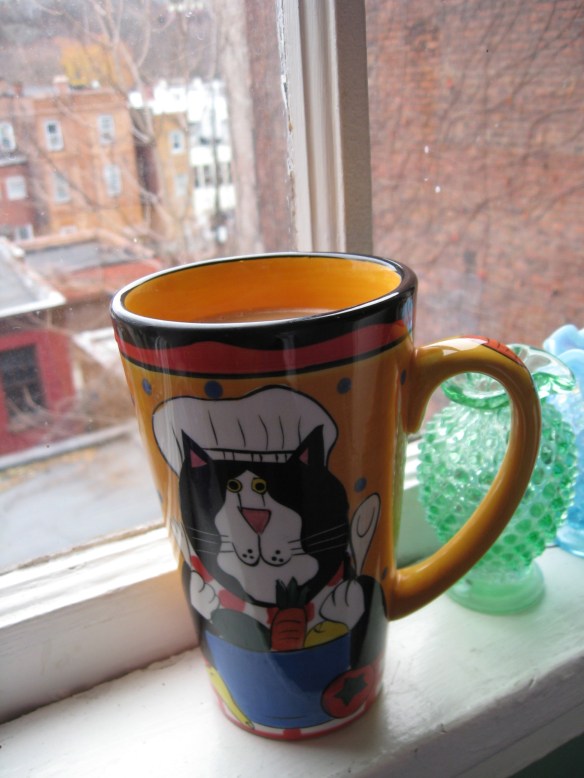
Approaching frozen containers was too daunting after the soup fiasco, so I started by opening a can of sweetened condensed milk whose “best by” date I can’t even admit to.  It tastes fine, the texture is merely thicker and the color more caramel than usual, and I am using it instead of the standard turbinado and milk to lace my morning tea. It’s beautiful in J’s cat-covered mug, and stirs up nicely. A good start, I say.

Next week the menu includes Broccoli Macaroni and Cheese, and a side of My Personal History with Commodity (Government) Cheese. Soon to come: Phyllo Chicken Pot Pie accompanied by Women & Preparedness; Losing Books and the Purpose of Stuff; a dessert of Poverty, Pie, and the Possibility of Blizzards.

See? I tell myself. There’s still fullness, and not just of food.

IMG_8866

Creamy and filling, the tea with sweetened condensed milk–whose time had finally come!


Popovers, and Peace with Myself

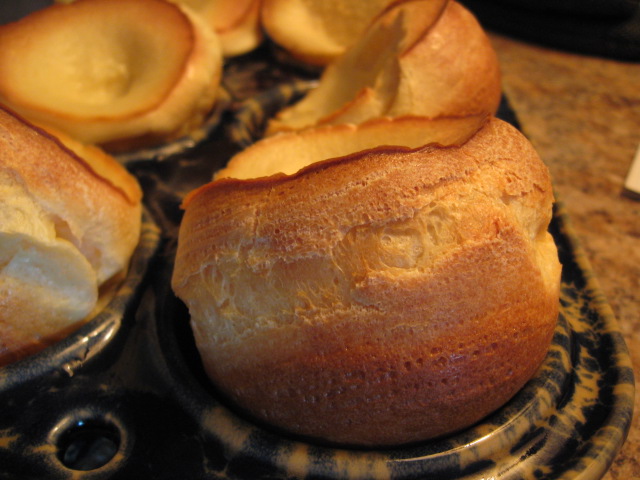
Popovers in all their particularity–and fullness.

I hadn’t ever eaten them, I don’t think, before last year.

I learned to use a borrowed Bennington Potters smooth-glazed stoneware 6-count muffin pan.  (Metal just doesn’t work the same.)

I have discovered much, in my new friendship with popovers.

***

From a friend’s five-ring, first edition (1950) Betty Crocker Cookbook:

Beat together just until smooth: one cup sifted…flour, 1/2 tsp salt, 1 cup milk, 2 eggs. Pour into well greased, deep muffin cups, three-quarters full. (Oven-glass cups make highest popovers). Bake at 425 degrees, hot oven, until golden brown, 35-45 minutes. Serve immediately. 

Amount: 5 to 9 popovers, depending on size.  It is not necessary to preheat baking cups.

***

An oven light reveals them becoming the “high hat muffins” Betty describes next to her typical mid-century artificially colored photo of breakfast on a red-checked tablecloth.  The clock’s slow countdown gives me time to watch and muse.

Sometimes the edges pull up in one direction or the other, sometimes they rise evenly–inflating caramel, tan, and white, puffing like out of control teenagers careening around corners, not caring where they spill, yet contained by their individual muffin cup.

A half dozen “high hat muffins”

Bulge, distend, inflate, expand, enlarge, all the synonyms for the process, feel kind of distasteful, instead of the happy idea of claiming volume, having plenty of room. We aren’t supposed to take up too much space, are we? especially women. Popovers stretch out as they heat and settle back in as they cool; it’s not their nature to be tiny, uniform and controllable, and I realize it’s not mine either.

In addition, each one tastes good, regardless of lumpy or cracked shape.

Remember that, I tell myself, when you are poking your belly as you look in the mirror. Remember that we all feel good, warm and toasty, to someone ready for our toasty-ness, our hidden steam–and that first person, who should love us best, is our own self.

The phrase “muffin top” comes to mind:, we don’t like to spill out, be exposed for our size.  Is a muffin top to be ashamed of? When we squeeze ourselves into tight clothes, our softness squished hither and yon, we are measuring against only one standard; I remind myself that muffin cups are there to hold and separate the baked goods, not painfully compress them.

All the different ways the popovers rise up makes each one itself. Not that we want to be overly heavy or fool ourselves if we’re being unhealthy. We just want to appreciate our popover-ness, our crispy freshness, our lovely expansiveness.

***

So after the 35 to 45 minutes, at the height of puffy but not to dark brown yet, it’s time to pull them out.  They deflate and darken a bit with rest, settle into their-selves, creating a little place for the knife to slide in and deposit butter without too much steam burning fingers. The defined crispy edges, crunchy and chewy to the tooth, lead to an airy eggy center, filling but light enough. I usually add a smear of summer blackberry preserves or honey.

Popover releasing steam, ready for butter and jam

After cooking, you have to eat them right away. Even an hour later, they just aren’t as tender, tending to be eggier, heavier instead.

Precisely because of that short peak, popovers are not popular.  I am the first to admit my royal role as Queen of Leftovers, doggy-bagging at restaurants or preparing extra portions so I can have something tasty tomorrow as well as today.  Popovers teach me a lesson in Right Now.

They only require a few things: flour, milk, eggs, salt. The right kind of pan, a hot oven, and enough time.  Blended components change and shift before your eyes, and then you get to savor them in your mouth. On these cold or snowy late fall mornings, you can share the making and tasting with family, a friend, or yourself–good company, all.

We, like popovers, are delicious, delicious beings–if we let ourselves be at the temperature we need, for long enough, in the proper container, no more than a few ingredients, then water and oxygen moving in and out with a sense of plenty–plenty of space, plenty of time to be spent on just this one thing, making and eating popovers, making and being ourselves.

Delightful, savory, just right. Aren’t we all?

Confidence That I Know Nothing–The Labyrinth

One of several trees that greet you at the entrance to the labyrinth.

A meditation labyrinth is a winding path, but unlike a maze, the traveler knows she will follow the course to the center and traverse the same path out with no fear of becoming lost. People have walked labyrinths of various forms for millennia; as they amble, they seek answers to particular questions, or to touch their G/god or Spirit or inner being.

When I began my weekend retreat at Kripalu Yoga Center last Friday with a walk in the outdoor labyrinth, I thought about self-definition, and work.

Winding the curves, tears dripped down my cheeks: I don’t want to get to the center— because then I will have to come back out, and I’m not sure what I will discover about myself in the process, specifically, my options for future paid work. Recently, before I even claim any idea as a “possible next career,” I’ve gotten scared, run away from thinking, watched too much TV, over-filled the schedule or just done nothing.

Achy and stiff, I haven’t participated in my usual yoga classes at home and have avoided extended concentration on breath and difficult positions. Yoga has merely served as a stretching regimen a couple times a week. Last year in the autumn my body was so much more mobile, technically and muscularly strong in the postures, and confident. Lighter, too.

Old habits of anxiety haunt me, a drive to squeeze everything I can out of this time away, to find answers to my questions. But at what expense? I ask as I wander. To feel the drivenness more than the experience?

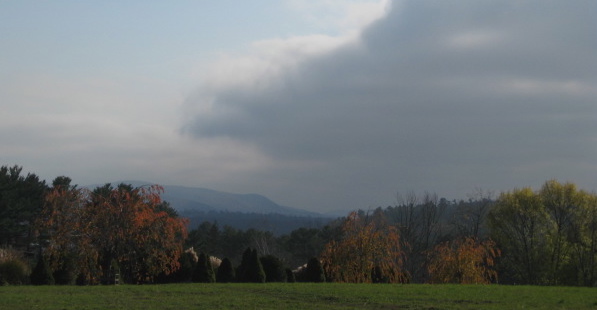
I notice that there are more reds in the trees here than in New York; the weeping trees quiver with neon orange, yellow and green in their seasonal change; shadowy evergreens cover the Berkshire mountains behind the labyrinth. Exiting, the view stretches wide, with a broad grassy hill up to buildings where the first session, and then dinner, then more yoga, await me.

A community of grasses accompanies you.

I wish I’d been conveniently struck by some slam-bang inspiration about work while in the labyrinth, but then in yoga class the falsehood is revealed that when you discover something, you are then finished or complete–an impossibility, because we are constantly changing, and the world is constantly changing. The instructor reminded: take your time, make your own choices, move how you want to, experiment!

The intense physical activity scrubs me clean and pares me down, open to see daily life as simultaneously not that important and amazingly huge, miraculous, splendid. The sixth sense, we are told, is Awareness. Yoga calls me to the corporeal plane, and the spiritual plane, and beyond that, even–but by 10 pm I am so tired and roiling in self-judgment, it hurts.

Washing up before bed, I remember: when my best friend visited a few weeks ago, she commented, You believe you are not moving fast enough with this puzzle. But for the first time in your life you are looking at each piece and not trying to press it in the form right away, instead asking does it fit? does it even belong in this puzzle?

I want to trust that the picture will emerge. Mostly I believe it will, but I’ve been sidelined and undermining myself, avoiding “the work thing” because I have been afraid–of failing, or finding a big nothingness at the center of myself and my search.

The next day, during the Kundalini yoga, in the repeating pose of punches-through-an obstacle, I strike through the negative messages, through self-doubt into compassion for myself, thus revealing a glorious version of Me. It is repeated: Revelation will come and there will always be more to understand and grow into.

As we tell our life stories during lunch, my roommate remarks on my tenacity, and offers unexpected observations about my skills.

In a Kripalu Yoga session, frank acknowledgment that everyone suffers heart break leads to a vision of the body as energetic river, where damage from that pain has an impact, but can be repaired.

Words from the Prana Flow teacher: Move with courage into whatever life brings. Practicing yoga can give you confidence that we know nothing. Spending time with yoga itself will give us “nothing”–but through breathing, doing asanas (poses), and other practices, we can tap into the teacher we have within us. A bit theoretical, hopeful, maybe even too far-out. But I like it.

After fourteen hours of yoga in two-and-a-half-days, hours of breathing and meditation and strengthening of the body and compassion toward myself, listening to the body and listening to the body some more, having my value reflected back to me by others and myself–I approach the labyrinth once again, to close the weekend.

I stop at each planting on the way in: sets of willows, vanilla-cupcake-colored, Seuss-ian tufts of grasses flopping in the wind, and some unidentified saplings; I reach out to touch each one in turn, and step to the next pair, like a slow procession up a church aisle, until I come to the labyrinth entrance, stroke the wood of the arch and walk through.

Seuss-ian soft grass-tops.

I deliberately slow my gait, returning to the meditative walking that I’ve read about: sense the heel touch the ground, roll through the middle, and let the toes make contact. Then don’t do the expected forward movement, just rest there; then, pick up the other foot, shift weight and move. One step. Pause. One step. Pause. One step.

I brush against a bushy bottomed evergreen, and it felt like I was joshing a friend, approaching a teenage boy uncomfortable with hugs, him pushing his shoulder against mine, Hey, dude, whuzzup?, a camaraderie with the trees, like we were buddies, old pals, kidding around with each other, glad to see each other, relieved actually. So I stop to give each head-high evergreen a gentle shoulder bump and a half-smile of recognition.

Following that, I tromp, wide-hipped, swinging my legs with energy. Clomp-clomp-clomp. Then stand, smelling the musty grasses dry in their rustling, slipping their feathery lengths through my fingers. Next, glide forward slowly again, with few tears, in fact triumphant, bubbling over some with alternative ideas and ways of looking at Work. Think to myself with a sigh: god knows I will run into obstacles and I may be completely wrong about the possibilities, but I’ll use the yoga practice–no, I’ll just DO it, and through that, trust I will get to know how I feel about things; motivate myself by being in touch with my body–no, I’ll NOTICE motivation and excitement from within, seeing and leaving behind the berating messages, the patterns of avoidance–cleansing with breath, clearing, opening; like the trees are changing and opening to the heavy gray fall sky over lake and mountain here in the Berkshires.

I resolve to create a new Practice in my life, instead of the old Routine: new ways of walking through my days and taking care of myself. Cup of hot tea with honey in hand, I drive back home.

Of course next day I am exhausted by the weekend, and then overstimulated by classes at the computer store: required to be intellectual before I am ready, blasted by the fluorescent lights, too-loud Muzak, and super-saturated color. The coming rainstorm from Sandy pushes me to watch old episodes of Glee “while I can” and then the darned electricity never goes out! and I worry I have fallen right back into all my old habits.

But–every day I’ve eaten well, gone into my yoga room and felt the muscles loosen along with my busy mind, remembered what my community of yoga teachers taught me, heard their laughing voices, and breathed compassion toward myself. Started again with the next moment.

Yes, life is a series of beginnings, to be taken puzzle piece by puzzle piece, step by step, breath by breath. Perhaps life is also a series of puzzles, where the fun, the point, is putting it together, not the final image.

I am confident I know nothing. I have entered the labyrinth, journeyed to the center, and come back out. I’m holding the puzzle pieces, thinking.

A far-away view of the labyrinth, after you re-enter the world.

The Golden Tamaracks

From the bridge on Route 30, facing Simon Pond, across from Raquette Pond and Tupper River.

It was a mustard-and-rust-colored couple of fall days through the northern Adirondacks, driving Keene Valley and Lake Placid, returning via Blue Mountain Lake and Speculator. The white trunks of broken-topped birches climbed up the side of Route 73/9N along the rocky AuSable River.  Rain had been heavy the previous week, so High Falls Gorge rushed amber with hemlock tannin’d water, reminding me of Tahquamenon Falls in Michigan’s Upper Peninsula, colored also by swamp trees. I piloted my car next to flowing mountain ridges covered with smoky smears, indicating trees whose leaves had already fallen; but then there were these spires of gold, stands of trees matted in green by the pines and balsam firs around and behind them.

The instant these particular trees sparkled at me from a distance, I was entranced; they seemed like perfect Christmas trees, but colored flaxen and lit from within. What were they?

Tamaracks, I was told. What a poetic name for a tree, an Algonquian name I learned later, the only deciduous conifer–a tree that seasonally loses its needles, with a color change first from bright green to yellow.

Tamarack. Here was a plant I’d heard mentioned as part of the name of a place–Tamarack Lodge, Tamarack Inn–but never observed live. Didn’t know they were the source of turpentine, or another moniker for a Larch.  I’d even seen the outlines of them on wood signs, just thought it was Plain Ol’ Woods, or Evergreens. And here they aren’t ever-green at all.

Ecstatic with their discovery, I spent my day searching for a wonderful picture to take of the Golden Tamaracks. My travel companion told me they show up in patches here and there, but warned they would not be seen when we headed south, out of the spruce flats of the Adirondack Park.  I spied them here and there, but the roadside shoulder was too narrow to park on, or shadows marred their brilliance. Some half-way passable photos were taken at a quick muddy pullover, but electric lines disfigured the oh-so-unforgettable vista I craved in my viewfinder. I comforted myself with more common rust colored beech leaves and the sparse quaking aspen foliage.

Beech leaves, which will stay on the trees all winter, dabbing the snowy landscape with splashes of brown.

Finally, at the end of the day, heading back to the main road from a side trip up Route 8 in Wells, we came upon a single glorious glowing larch, lit by the sunset beyond it, a calendar-perfect shot backed by the curves of the mountains. And yet…I was tired from the fresh air of the day, the five hundred snaps already taken, watching river otters and walking out to Oxbow Marsh at The Wild Center in Tupper Lake.  I didn’t want to stop the car and get out yet another time.

So in my lethargy I sat back and watched the tamarack approach, growing taller then taller still, rising like the trunk and down-thrust arms of a giant slender woman, until I was finally staring from below, a child gawping up at the enormity of its towering parent.

The sun behind revealed the black bumpy outlines of the very top shoots, and I twisted my head around to see the back of it, as my auto moved on into the setting sunlight of Route 30 south.

Then the golden tamarack was past, gone, somehow irretrievable even though I could have stopped the car and turned around.  As soon as the moment was over, I regretted not photographing it. It became a lost moment, like other lost moments, not seized fully, followed by wondering if I would try to recapture it ever after.

But–I wanted to live it, see it, feel my mouth widen into an O as we advanced on the tree, let the light of the west-falling sun hit the back of my eyeballs, fully; hold that–and let it go. I decided to make do with the other, less impressive photos, to remind me of the one that got away, my own catch and release program for that single vision–only with a mental catch, then mental release. Of course now I attempt to relive it in words, amorphous dances around the reality, redrawing the picture in my head from many angles.

Even this morning, I see the yellow elm leaves outside my kitchen window carried off by the insistent wind, my red ivy leaves thumping the window hard as they fall, the ivy opposite now deepening its blush and splashing Neapolitan against the brick. I feel the urge to take pictures of the shift, but don’t; I can’t stop the change, can’t hold every second, have to let some of them go, and allow the memory to mellow into blurred edges, warm thoughts, awareness of having had an experience without clutching desperately at specificity of the details.

Autumn has come. Autumn will go. In the winter, spring and summer–indeed, until I can search them out again next fall–I will remember (not through a spectacular photo) that I have discovered Golden Tamaracks.

Golden Tamaracks in the Adirondack Park

Washing Dishes

Today’s view from the kitchen window

There the pile sits in the morning kitchen: water glasses with lip marks and fingerprints; small plates smeared with food, accompanying utensils splayed over them; tea cups and travel mugs with rings of dried milk and sugar; plastic leftover containers, greasy lids akimbo.

Usually it doesn’t feel like an onerous chore. But a not-unexpected sadness has come to nest in my house this fall.

I know that when you lose someone, like I’ve lost J, you revisit your other deaths, especially those you have not finished mourning. You acknowledge and examine the loss of friends, places, homes, relationships, belongings, patterns of behavior, certainty.

That is the work I am doing.

Part of the floundering has included a scary disinclination to write, choosing entertainment over introspection, an old habit I thought I was done with. I haven’t felt like cooking. Or even cleaning up after the take-out.

But then I remember J half-joking, half-begging: With these lungs, I may not be able to vacuum or dust, but I can still stand here and wash a few dishes. Just let me do them!

A little bleary-eyed, still in slippers and ‘jammies, I set up the water boiler on the counter, fill the empty ice cube trays and put away the clean dishes washed a week ago.

Another voice from the dead, Great-Aunt Helen, whose legs were heavy and painful, fingers mangled by arthritis: This is my house and don’t you touch those dishes!

But Aunt Helen, we helped make this mess, and you must be tired after baking cookies and Mahogany Cake–and cooking brisket and dirty rice. It will be so much easier for us to clean up.

We’all are gonna sit in the screen room, have some Dr. Pepper, and listen to the night sounds. Leave the dishes ‘til morning! When I wash ‘em up tomorrow, I can take as long as I want and relive all the arguments, and the jokes, and the silliness. I know you mean well, but I want to remember the good time we had while dirtying these very dishes.  No arguments; it’s settled.

So today at the sink I pay monk-like attention to details: the sound of the tea water moving toward a boil, then the smooth matte surface of robin’s egg and gold stoneware plates in the sink, essential oil of lavender soap bubbling my hands.

I remember the phone conversation with a fellow writer while I drank the Earl Gray Cream out of this Shakespeare Quotes mug, and commiseration with an out-of-work friend accompanied by Russian Caravan in that blue flowered cup.

Having reached temperature, the water in the boiler is poured over loose Truffle black tea, bits of dried coconut and chocolate chips visible. Back at the sink while it steeps, I revisit Lad Nar over garden green beans here, the half sandwich left from a writing session at Professor Java’s there, and an apple-farm Honeycrisp purchased in September after a sunny bike ride along the Mohawk River, sliced carefully onto a blackberry colored plate. Washing, rinsing. Washing, rinsing.

October ivy

Outside the window, ivy reddens on my building, the green ivy opposite just barely blushing yet. Rain pelts the cars rushing by and students grind wet gravel underfoot as they hurry to class. Up the hill, willows and maples and birches and oaks are all changing color at different speeds.

I scrub to get every bit of scrud off a pot, rinse it thoroughly in hot water, then place all the dishes one by one on the gas stove so as to be perfectly dried by the heat of the pilot lights. When ready, there will be the satisfaction of putting each plate, each mug, in its own place once again.

After the fixtures and counter are wiped down and dry, I pour a cup of tea and finally, finally make the frittata I planned a week ago.

It consists of: freezer spinach overdue for use, a teeny green pepper from my garden (one of five whose existence completely surprised me two weeks ago), four ounces of muenster cheese, half a white onion, a teaspoon of salt, some crumbled dried sage from another friend’s garden, a pinch of nutmeg, six local eggs, a couple tablespoons of flour to thicken. Out of milk, haven’t gotten myself to the store, so I just steam all the veggies in the microwave, keep the liquid, and stir it all together with a tablespoon of butter chopped up.

I bake the sun-yellow concoction in a greased oval pan in my convection toaster oven at 375 for 15 minutes. With puffy browned edges, eaten off a pretty green plate, the frittata tastes of warm kitchens past and present, meals present and savory meals to come.

Tomorrow morning I will make tea and wash these dishes, too.  No arguments; it’s settled.

Grief and Green Beans

I harvested the last of my pole beans before J went into hospice. The beans are a bit of trouble, since they take forever to steam to softness, and thick strings seam each pod–hence the name “string” beans. A bag kept them fresh in the fridge while I travelled first to say goodbye to J and, two weeks later, to her memorial.
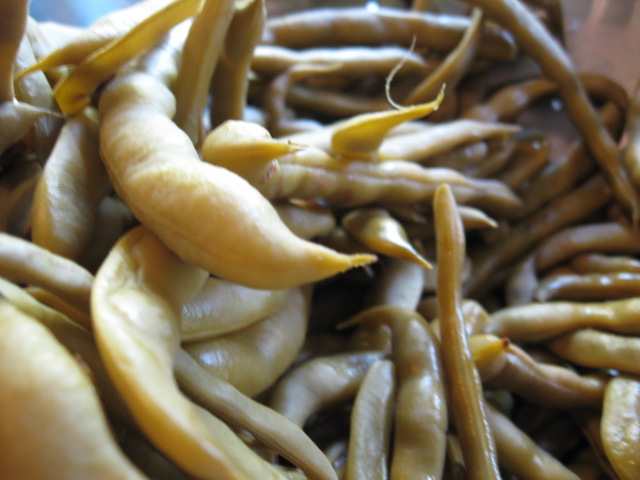
Late one evening after my second flight home, I cooked and cooked the green beans, drained and stuck them in the fridge for later processing.  A friend took me to wander in Vermont, to touch handmade dishes and pause at autumn leaves in the mist. And talk about J.

Home again, there they sit in the fridge, those green beans. De-stringing and freezing loom but I am too tired. I swim through the air as if it were thin syrup, every day or so surprised by forgetting and remembering suddenly, with a sharp inhale, that J is gone.

I don’t even want to open the container, afraid the beans will be moldy, but in a way hoping they will be, because I find myself unable to make decisions. Especially since, after the leaf peeping, the seven year old computer I’d been nursing along just up and died, Zap! screen gone to black. Finally I have to buy the new computer I’ve talked about and put off for months–the money’s in the bank but it will involve more thought, more study, change more change.

On the dead computer I had written three perfect paragraphs to open this week’s post, the only document not backed up to my external hard drive. Now I can’t remember the story. It certainly had nothing to do with string-beans.

I look in the fridge. Just a small bowl of beans, not quarts and quarts, but I hate to waste food, waste all the time planting seeds, watering through drought, harvesting, boiling–yet perhaps it is too late already; maybe the universe and time passing made the decision for me, just like the computer, just like J’s death, can’t put it off, have to face it, I’ve spent my time how I’ve spent it and here I am.

Ghosts of old surgical pain visit in the afternoon: the sore throat memory of intubation and a deep ache under the ribs. Front teeth throb, revealing I’ve been literally gnashing my teeth during sleep. On the yoga mat, tears come up, the ones held in during the expected talking about her death, the rearranging of schedule and inevitable too-soon return to regular life. I am swept along by daily chores and interactions, like currents pulling at me while I stand in a lake, when all I want is to float without effort, study the changing color of the sky and view fluttering fall leaves reflecting in the water’s surface.

We are always asking to be able to slow down and now I feel more stuck than blessed in my slowed-down-ness.

Serendipitously, my best friend comes to visit from out of state, and speaks that language of not-having-to-speak, of long history together. She drives me to the computer store.

I hear the strange notes my speech strikes, mind-on-grief, describing my work to the saleswoman:  The blog’s about living in the moment, has turned out mostly about gardening, gardening as metaphor for life, but lately it is about death; hearing how flat and dark that sounds, my best friend does what I usually do, elaborates for clarity–because a dear friend of hers died recently. The computer has to be special-ordered; I only complete the purchase because the best friend stands next to me.

After she leaves, I think of Thai food delivery but feel guilt over beans already cooked.

What would J have said?

Don’t worry….think of all the food you DID freeze, make into soup, share with others this summer.

We could order pizza; remember last winter when you taught me I could eat it for breakfast?

Have some more tea.  A new laptop, how exciting! Let me tell you a story about–

I toss the smelly green beans and order takeout. I stare at the auburn and gold out my window. I sit and cry over loss–unintended loss, and loss you can’t put off. I borrow a computer to write and post. 

I live in grief-time.

A vista to ponder, Bennington VT


Mind-Out-Of-Time: Writing, and Teapots

My teapot from J, tucked behind an electric kettle, another teapot, and a locally crafted mug,  on my early morning countertop.

I miss talking to J about my writing life.

This afternoon I will concentrate on writing, I’d say.  I’m deliberately ‘concentrating on,’ not ‘working on’–no more of the furrowed brow that ‘work on’ entails.

She’d laugh.  I used to have that furrowed brow, too; hell, look at my wrinkly forehead.  J would talk about the struggle to get to her drawing, even with new chalks and paints around her, how daily chores and her own busy mind pulled her away from something she’d never had time for, yet couldn’t quite get to, even now.  She’d encourage me to keep going, and I’d tell her more.

When I give myself over to writing, or create space for it, then I can relax and play. It’s what I call Mind-Out-Of-Time, what I sometimes think heaven is or would be: you are so involved in something that clock hands move unnoticed, you look up and the afternoon light is bending across your desk and you gasp–how long have I been here?

Mind-Out-Of-Time comes also when I choose to immerse myself in how life looks and feels, tastes, sounds and smells. It comes when I give myself permission to be right where I am, at that very moment, open to pleasure even in the midst of pain.

So I think of J, steeping tea in her beautiful cobalt blue teapot, when I came to visit six months ago. Napkins in hand, she danced oxygen tubing between pieces of furniture as I carried the prepared cups and cookies to the front room. We laughed about how, on our last big trip, she’d pulled her portable oxygenator, nicknamed ‘Fred’ after her father, all over the up-and-down hills of downtown Vancouver.  Fred sure got a workout, didn’t he? Took care of me just like Dad did.  We discussed once again her wish to die at home.  She asked after my teapot, a twin of hers, which she gave me when I moved away. Every time I make tea in it I think of you, I told her.

Two weeks ago, her caregivers still made English Breakfast in her blue teapot; she rested in the home hospital bed, I held the mug, she sipped sweet lukewarm liquid with a straw.  During the moments she was awake, she rolled her eyes sardonically, joking with only a few words about the little yellow curlers in her hair that looked like baby corn; I teased her back about how she finally got us all to wait on her hand and foot, and more seriously, how much we loved doing it.  As she drifted into medicated rest, she murmured about death, it will be pleasant; it will be pleasant. See you on the other side.

After the memorial service last weekend, I wrapped up the cobalt blue teapot in crinkly paper, to deliver it safely to her chaplain, someone who’d shared tea with her every Wednesday for many years, someone whom I suspect also understood mind-out-of-time with her.  I took one of her mugs and packaged one for yet another friend.

This morning, kitchen lights reflect on the curve of my round teapot as rain drips down the apartment windows.  Cars splash black puddles up into the air outside.  J’s goldenrod colored, cartoon-cat covered mug, full of toffee-chocolate-hazelnut tea, sits beside my keyboard.

Guess what.  I’m still talking to J about my writing life.