Part the Fifth, Wherein I Am Surprised, and Meditate on Metamorphosis


Surprise! on the bedspread

Surprise! on the bedspread

February 17 2015. I can’t believe it—thought I’d lost the butterfly, that our short term friendship, for that’s all it could be, was done; but when I went into the bedroom, there she was, after two days, on my bedspread! I laughed out loud, even skipped a little, couldn’t believe it! How did she get there? Why was she there? Giddy, I got my spoon of sweet water in case she needed it.

She wasn’t quite so excited as me–or thirsty; perhaps she found other sources for nourishment in the kitchen when I wasn’t looking. I still couldn’t believe she was back. If she were on the bed in the night, I could have crushed her, but apparently she is busy taking care of herself, flying around my apartment, exploring and living her own short little life.

I want her to go back to the kitchen where it is safer but she is having none of it. Thank you very much, I prefer the rug under your bed. Like my children as infants who pressed their lips together to refuse more baby oatmeal, she knows what she needs better than I.

So she’s had a drink and her picture taken again, and I’ve left her to her own devices.

Resting on the carpet.

Resting on the carpet.

I didn’t know I’d missed her so much. Or rather, that I would be so excited to see her again. I’ve gotten to know more and more, as I’ve read about the butterfly life cycle, Dainty Sulphurs, and different families of butterflies. (Did you know that Monarchs have six legs like the other butterflies, but two of them tuck against the thorax, having lost the ability to aid in walking?) I fear showing too many photos of her to my friends and blog followers, like an obsessed parent incessantly pushing phone images of their cute child.

A friend came by, curious about the butterfly visitor and when I talked about feeding her, said, Oh I think you are not supposed to use honey; I know with hummingbirds you use white sugar. Just in case, I start mixing sugar and water….

I’m talking to a butterfly, in my bedroom.

A more external metamorphosis, of wood into nutrients.

A more external metamorphosis, of wood into nutrients, at the north end of Partridge Run.

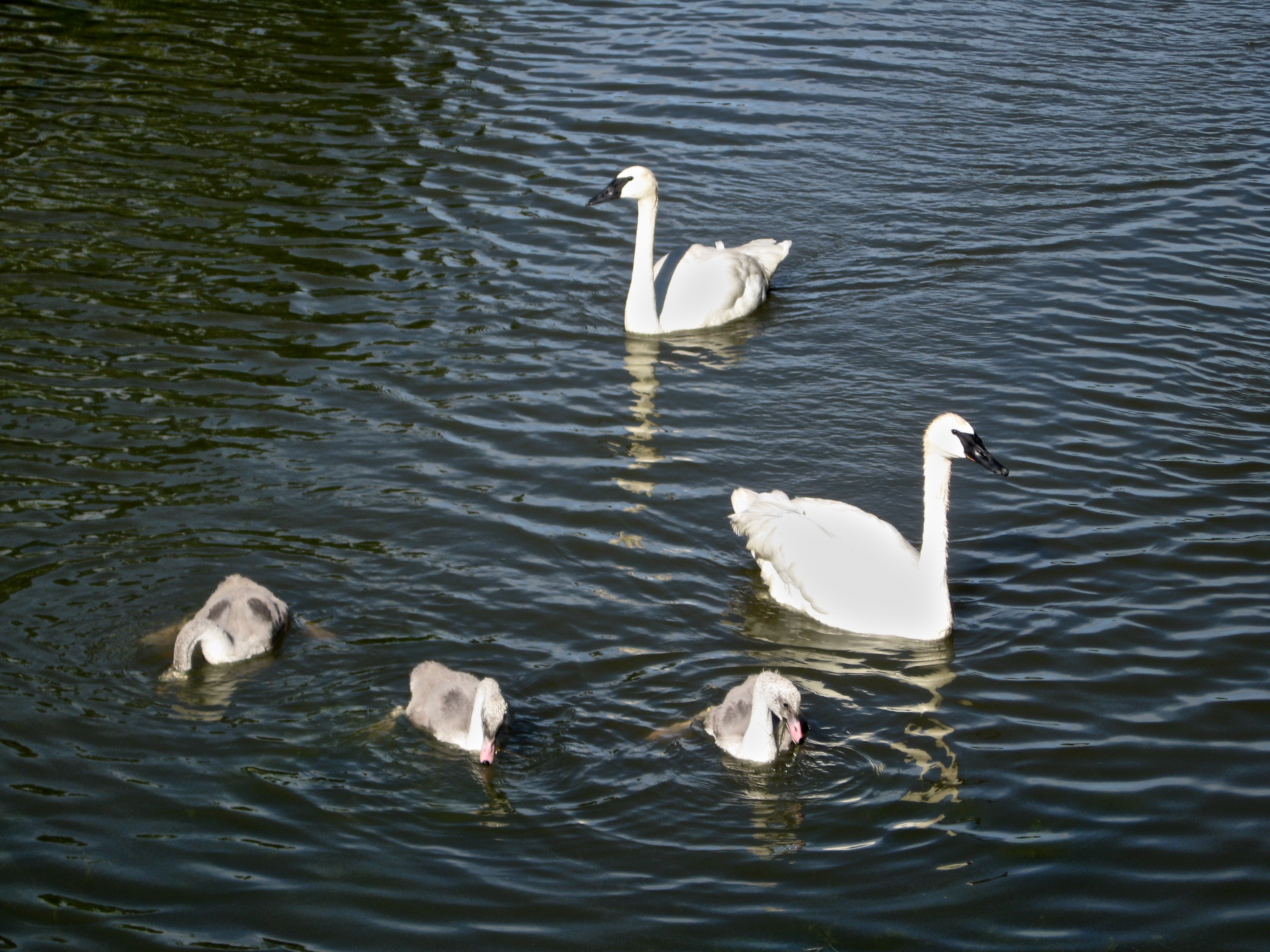
The idea of metamorphosis now strikes me, all those grade school posters about caterpillars becoming butterflies, stories of ugly ducklings becoming swans. What being “ugly” meant to me as a child—a label I took on as a chubby kid with glasses. It still horrifies me that the duckling—actually a cygnet—was considered ugly and had to grow into some culturally defined idea of perfection, of others-judged beauty.

What if, instead, we felt perfect as we are, comfortable in our skin even as we grew into something else? That each stage, even in its clumsiness, was considered beautiful?

I was told once that in the metamorphosis of a caterpillar, its face melts. What a thought. In order to change, you will not be able to recognize yourself, because you change so very dramatically. Am I willing to take on that kind of scary change?

When I did research and found the original article, (by Ferris Jabr, at ScientificAmerican.com, August 10, 2012) I learned that it’s not just the face that melts—the whole caterpillar dissolves inside the chrysalis. Releasing enzymes, it digests itself, creates a kind of caterpillar soup, Jabr calls it, though with special organized cells called “imaginal discs” that help it reorganize to the next stage, into the butterfly with wings, antennae and mature sex organs.

What lessons for myself from this re-encounter with the Dainty Sulphur? To take time apart, build my own chrysalis for change, tuck in to look within myself, then take on the change, and emerge. Not to emerge too early. Not to do it without the structure and support I need. To know flying—whatever that means for each of us—is possible even if we can’t imagine it right now.

We have within us what we need for the next step. The taking of the next step can be messy, scary, and look disorganized, but it is exactly as it was and is supposed to be, when we move into it.

Yes (of course), to be continued.

Winter sun in the woods, waiting as things grow and change under the snow.
Winter sun in the woods, waiting as things grow and change under the snow.


Part the Third, Wherein the Butterfly Disappears and I Ponder Life, Death, and Survival

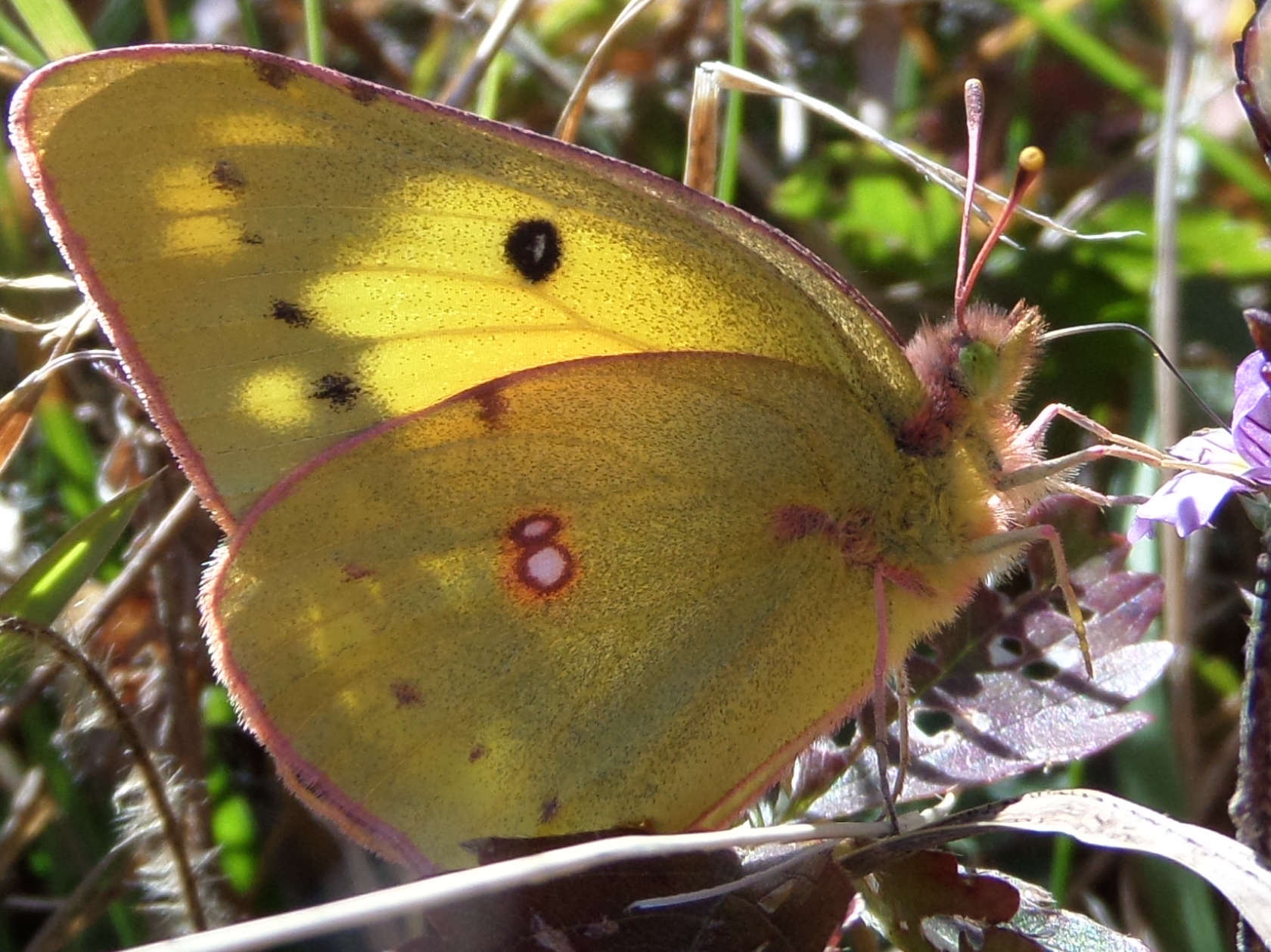
A different sulphur, this one either a Pink Edged or Cloudy Sulphur, observed on the slopes of Gore Mountain NY Ski Area, in the fall.

A different sulphur, this one either a Pink Edged or Clouded Sulphur, observed on the slopes of Gore Mountain NY Ski Area, in the fall.

February 13, 2015 morning. Yesterday, after I looked up all the photographs of butterflies I’d taken in the last couple years–I had no idea I had so many!– I took more pictures of the Dainty Sulphur at the window, from different angles, and in the afternoon she moved down next to the air conditioner. By evening she was hanging at the floor trim. This morning—gone! can’t see the butterfly high or low. She might have been eaten by a spider.

There’s part of the situation where I don’t have responsibility—how far do you really chase a butterfly? It follows its instinct.

Even though one of my own instincts is a tendency to care-take (“Hey, I’ve got food here, places you can rest, even!”), I have to let the butterfly go where she will. In the same way I learned to let my teenaged children venture out into the world, and then release them completely (well, almost). I needed to let them go, for my own sake and theirs.

This butterfly, like my own children, like humans, has its schedule of daily life, and of life and death.

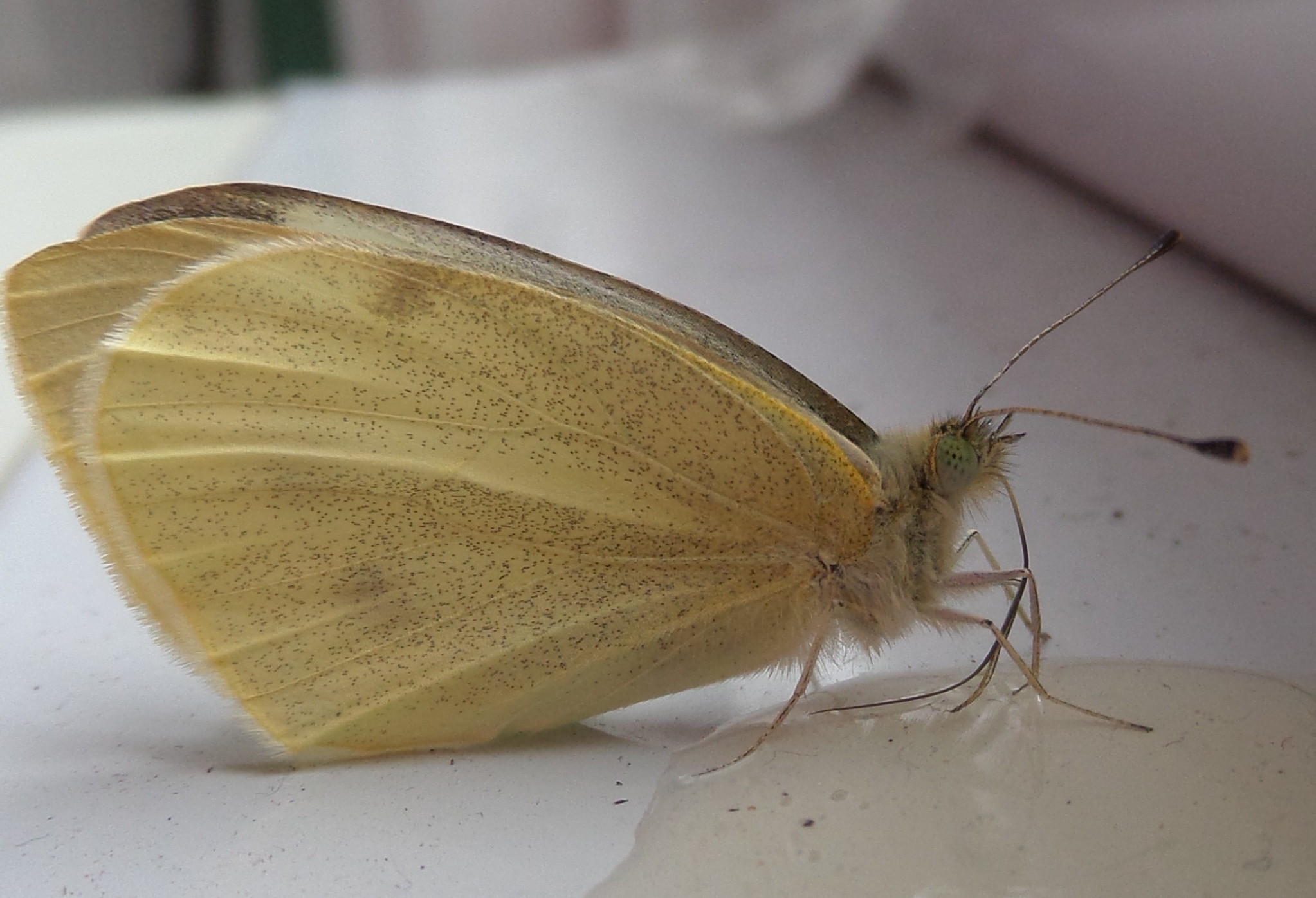
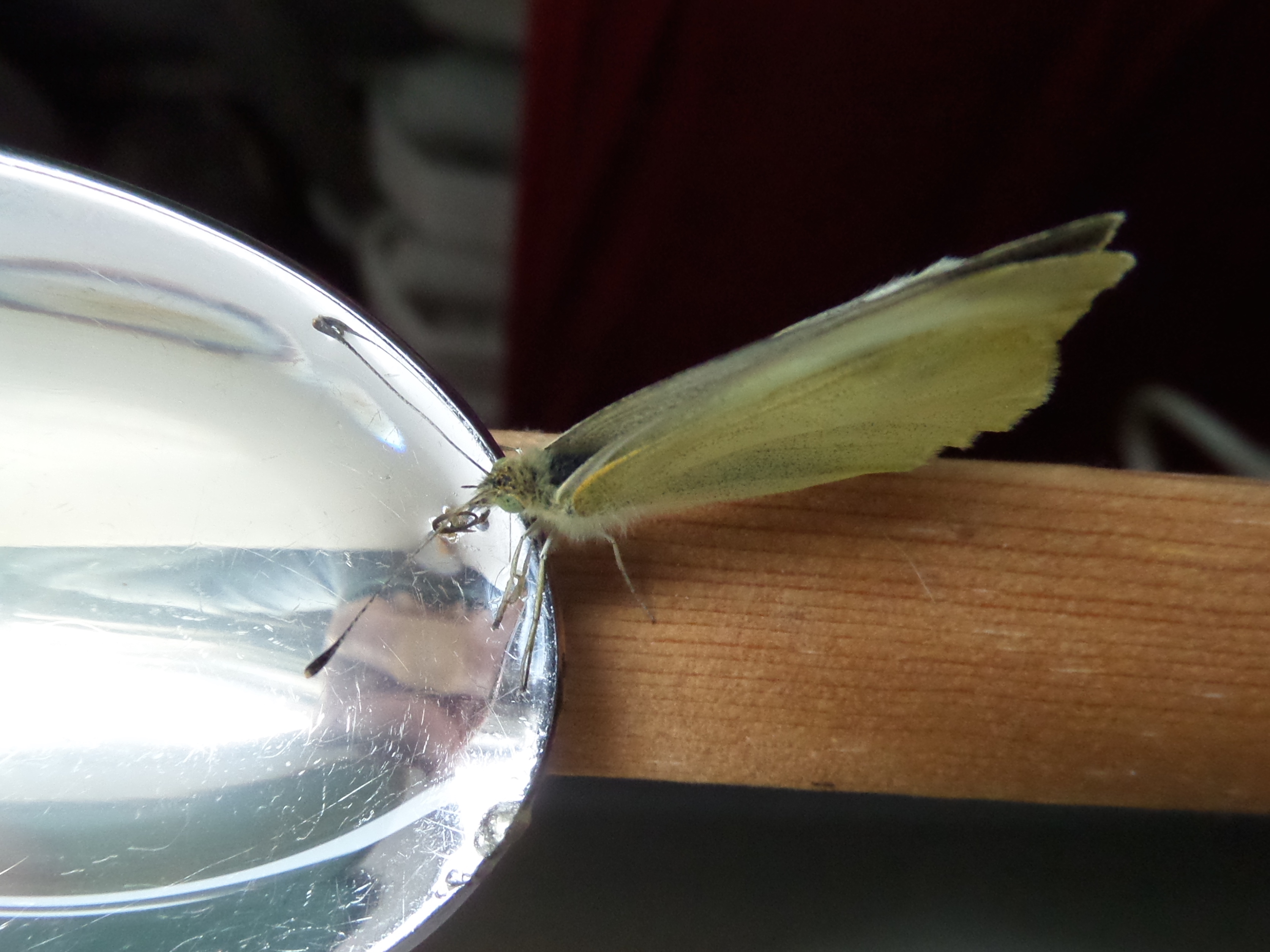
Dainty Sulphur sips from the edge of a spoon. She really is dainty, isn't she?

Dainty Sulphur sips from the edge of a spoon. She really is dainty, isn’t she?

February 13, later in the day. The butterfly fluttered in the kitchen; it had been over by the stove. I made more honey water but I don’t think it’s interested or has to find it on its own. I’d almost been relieved it had been “lost,” that I had no longer felt the pull of keeping track of it.

February 14, 2015.  The butterfly is living its life cycle. I don’t have to save it like some protective “master” who has more power and more intelligence. How about we live our life cycles next to each other, not intending harm, but not fretting unnecessarily about it, like I do about most animals, and most people? To do the kind thing when I can, but not to wear myself away figuring out how to save or fix the situation? What is there to fix, anyway?

Before, I said that here in my apartment and in winter, “it won’t survive.” What does that mean? Of course it will survive—it is a alive, it continues to be alive. But life is not just survival, it is living in and through the moments. We are all NOT going to survive in the end. We all die.

How long would it live in a normal life cycle? Two weeks to a month, the internet tells me.

Another butterfly, this one from summer at Partridge Run: Fritillary.

Another butterfly, this one from summer at Partridge Run: Tiger Swallowtail.

The definition of survive: “continue to live or exist, especially in spite of danger or hardship.” Isn’t living always a bit of an ordeal, under difficult circumstances? Is this life here in my apartment a hardship for her? Maybe, but danger is everywhere for butterflies: frogs, birds, getting trapped, getting smushed, parasites. Survival means getting through some situation—but both of us are not only getting through, but living in, our respective life situations.

I see me looking out the kitchen window, as the butterfly hangs on the glass today looking out as well into deep deep winter. Both drawn to what we are drawn to. I am not doing harm to it, not wanting it out of my life so I don’t have an obligation to it. Yes, I talk to the butterfly, Oh you don’t have to run so madly against the glass! but that is a message for me as well. I don’t have to fight against difficult circumstances, either.

If the tiny butterfly were sentient in the human way, perhaps she would wish things weren’t such a struggle for me, and even wish it could do something for me. As she hangs, rests, it reminds me of my meditation, in which I don’t have to get someplace, I can merely BE. On my yoga mat, feeling what I feel, thoughts wild or calm doesn’t matter, I note them and let them pass; I breathe. Perhaps she is just BE-ing, respiring.

A fritillary of some sort, also at Gore Mountain in the fall.

A fritillary of some sort, also at Gore Mountain in the fall.

We humans like to read meaning into things. For example, I was reading the All Over Albany blog, came across a link to a local writer, Amy Biancolli, and her blog, Figuring Shit Out, went to the blog, read some of it, ordered two of her memoirs from the library and then on a drive across town, happened to hear the beginning of her storytelling on The Moth Radio Hour. Ok, so I am meant to connect somehow with her or her writing. Or maybe she’s just out there, and I’m out there, and we intersect, like this butterfly who just happened to show up in my apartment, and I am learning things from the experience.

I fell in the love with the prologue to Amy’s first memoir, House of Holy Fools, where she writes about Death in her family as “an unwanted guest, oily and shrewd, with a stalker’s bad personal hygiene and pants that gave him a wedgie…”

I am thinking about the feeling of being stalked by death, what survival means, the role of death in our modern lives versus other eras (the 1918 flu epidemic, tuberculosis, recurrences of the plague through history). How unnatural death can seem, and yet it comes to everyone.

So here’s this butterfly to remind me: stop trying so hard; stop banging around. Just BE. It is valuable to JUST BE.

Back at the Chicago Botanic Garden, swans with babies, be-ing.

Back at the Chicago Botanic Garden, swans–symbols of fluidity, intuition, and dreaming–with cygnets, be-ing.

Part the Second: Wherein the Butterfly Drinks, And I Consider the Bugs in My Living Space

Dainty Sulphur, drinking!

Dainty Sulphur, drinking!

I’m still talking to a butterfly, in my kitchen.

February 12, 2015, later that day. Since she would not come to the tiny plastic feeder that I put out, this afternoon I spilled some of the honey water right next to her, onto the top of the air conditioner. She actually came and drank! It was fascinating to watch: antennae started waving once her tarsi (feet)—through which butterflies can “taste”—hit the liquid; her proboscis unfurled, so long it went under her belly, but into the fluid; and then she stepped away and curled the proboscis up again.

See the C-shaped, rolled up proboscis?

See the backwards C-shaped, rolled up proboscis in front of the green compound eye? The feathery looking bits above that are the “palps” which sense what is food and not-food.

Thinking about her survival, I flit between hard-edged City Woman and warm Earth Mother. Well, anyway, I say, there’s your honey water for a couple days. Don’t get stuck in it. Now she’s looking all satisfied, her previously flopped down abdomen—which is the hind end, with the center part actually called the thorax—bent up high.

Am I stupid to put out this sugary fluid for food? Aside from getting stuck in it, her wings might get wet! I blow gently; no, she can pull them up just fine. Nothing like a snack, I think. I could use one myself.

I am playing with anthropomorphism again, I realize, but am really, really clear I know I’m doing it.

****

The Dainty Sulphur is a small crushable creature, one of trillions.

I’ve stepped on, swatted and flattened probably hundreds of bugs its size and much larger: horrifying palmetto bugs and leaping hairy spiders in the Florida of my childhood, and hordes of German roaches in multiple student apartments. Even mice and rats were caught and drowned when they overran other living spaces. My mother always said to invading creatures as she squashed or sprayed them: You can live outside, but I can’t let you stay here. This is MY space.

I don’t mind sharing, but not with things that bite or sting me, or spread disease. I’m really allergic to dust spider bites and mosquitos, but understand that larger spiders and thousand-leggers eat such critters, so yes there is a hierarchy of acceptable and unacceptable bugs in my living space. I can whisk unwanted ones—bees, wasps—out the window but if they don’t go I can become insistent, and murderous—depending on how you define murder.

Luckily butterflies don’t hurt humans, though we can hurt them.

Chicago Botanic Garden.

Late summer Chicago Botanic Garden.

Carolus Linnaeus was the Swedish physician who established “binomial nomenclature,” the multitiered system of scientifically naming plants and animals. I recall the huge bronze statue (which, when my children were small, you could still belly up to and touch) of a kneeling Linnaeus at the Chicago Botanic Garden.  Up close, Linnaeus’ roughly hewn figure was formed of creatures and plants alighted on him, under him, wrapping him; with the collecting bag on his hip and eyes open and curious, his eager hand reached out to touch and identify still more on the ground.

Dainty Sulphur Butterflies, in Linnaeus’ classification are truly Insecta, and moving more specifically down the entomological nomenclature, fall into Lepidoptera (moths & butterflies) and Papilionoidea (non-skipper butterflies; do you see the French word for butterfly “Papillon”?), Pieridae (whites, yellows, sulphurs), Nathalis (sulphurs) and her full name: Nathalis iole.

Like a softie, I’ll leave the sweet water there for a while, probably wipe it up and then put out fresh, for this particular Nathalis iole. (Boy I hope I’m right that it’s a Dainty Sulphur! I would hate to find out I am All-Wrong scientifically.)

I cannot guarantee this butterfly’s survival or quality of life. However, I don’t have to squash this insect either, “put it out of its misery.” She does not harm me, and in fact is a little company, on a cold cold day.

Because bitter wind chills, twenty and thirty below, cause me to hunker down inside, both of us are stuck in my apartment for now. And I am getting to know this creature better.

Sure is snowy and blowy out there, isn't it?

Sure is snowy and blowy out there, isn’t it?

To be continued.

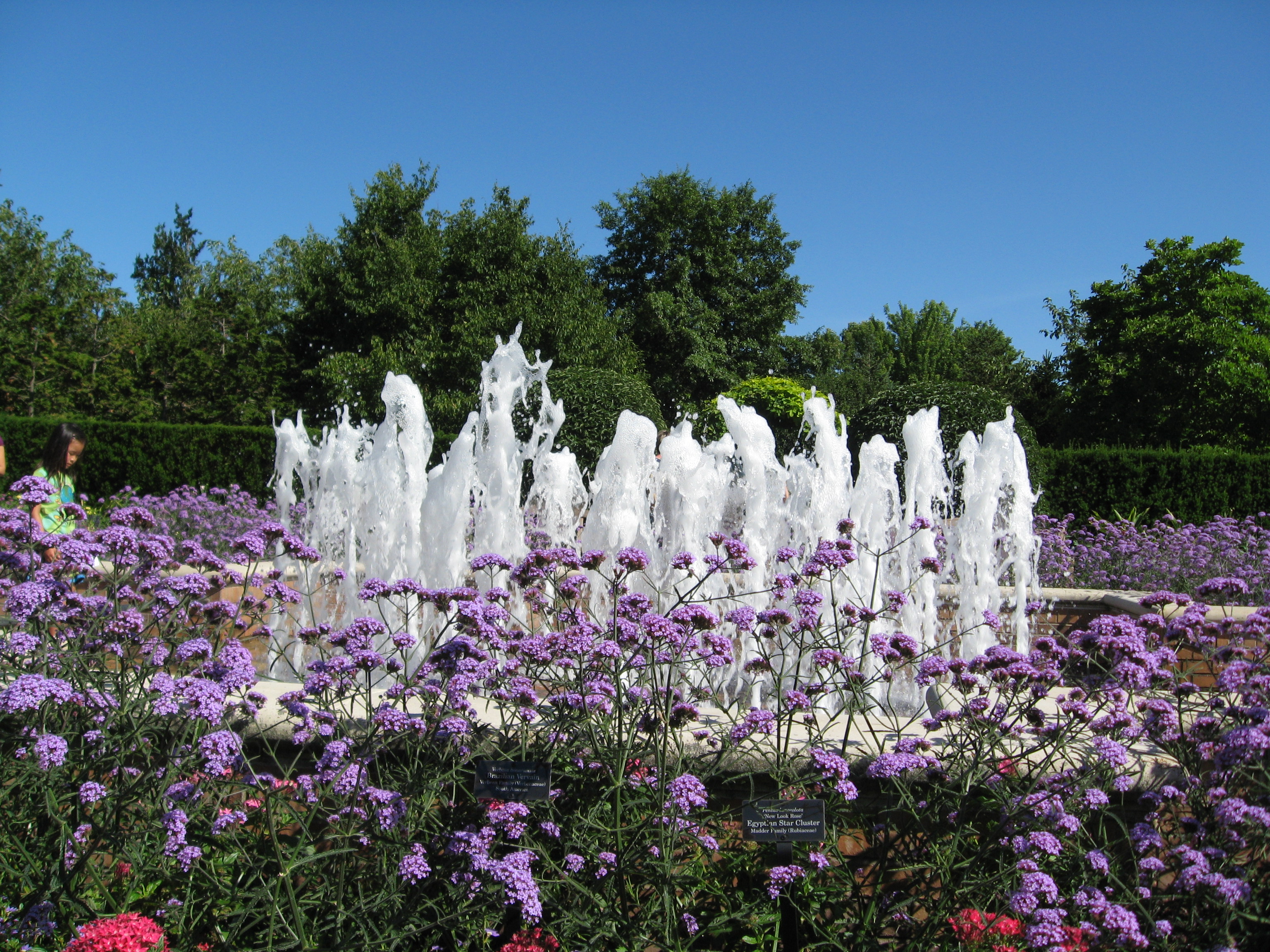
A taste of full summer with fountains: Brazilian vervain (verbena), which butterflies come to visit.

Remember summer? Fountains with Brazilian vervain (verbena), which butterflies come to visit (Chicago Botanic Garden).

Holdfasts

Outside my kitchen window.

Outside my kitchen window.

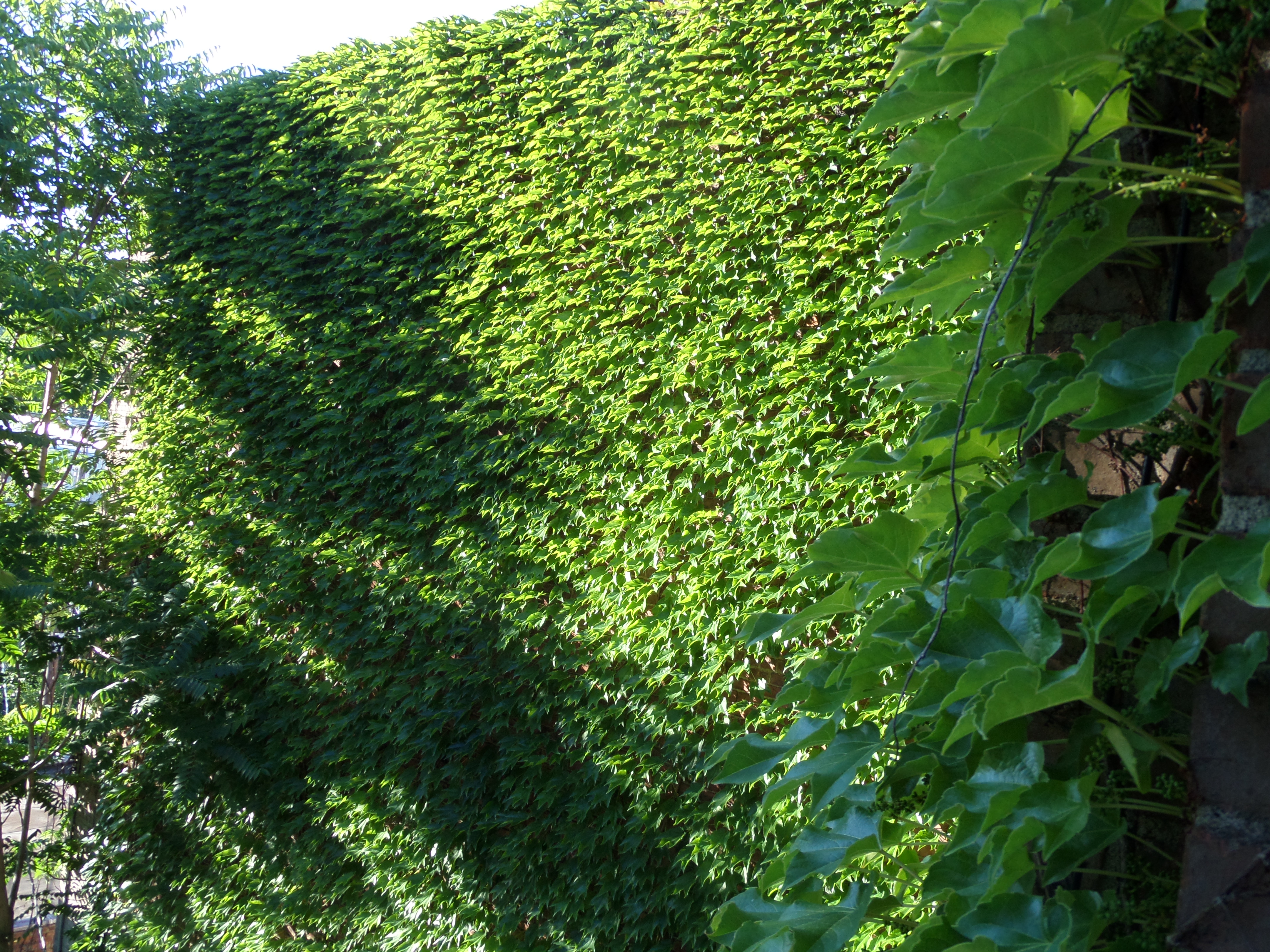
It is September and the Boston Ivy has signaled autumn.
Stems went red in mid-August; now the big green dots of berries that popped out over the summer are deepening to blue. Shiny leaf umbrellas shade this transformation until breezes quiver the ivy and pull it away from the brick, revealing the ripe fruit.

Berries become obvious in the fall.

The part of the ivy that I ponder more deeply belongs to spring.

The building kitty-corner to my kitchen window.

The building kitty-corner to my kitchen window.

For five years—five springs—I have meditated on a brick partition perpendicular to my kitchen window, along with the wall around my window and the next building over.

In March they are all covered with what looks like dried up vines.

First sign of growth.

First sign of growth–see it?

In April, from those ramblers, brown-horned growths issue, then beginnings of leaves, cherry and lime colored. Under the new foliage, tendrils creep that extend the plant’s reach; at the ends of those tendrils are what I can only see as little alien pod-feet.

Leaves and...

Leaves and…what are those?

Squishy wet, secreting calcium carbonate as an adhesive, they venture forward to attach the ivy to the brick, suction cupping step by step to climb the buildings and cover them with more and more leaves.

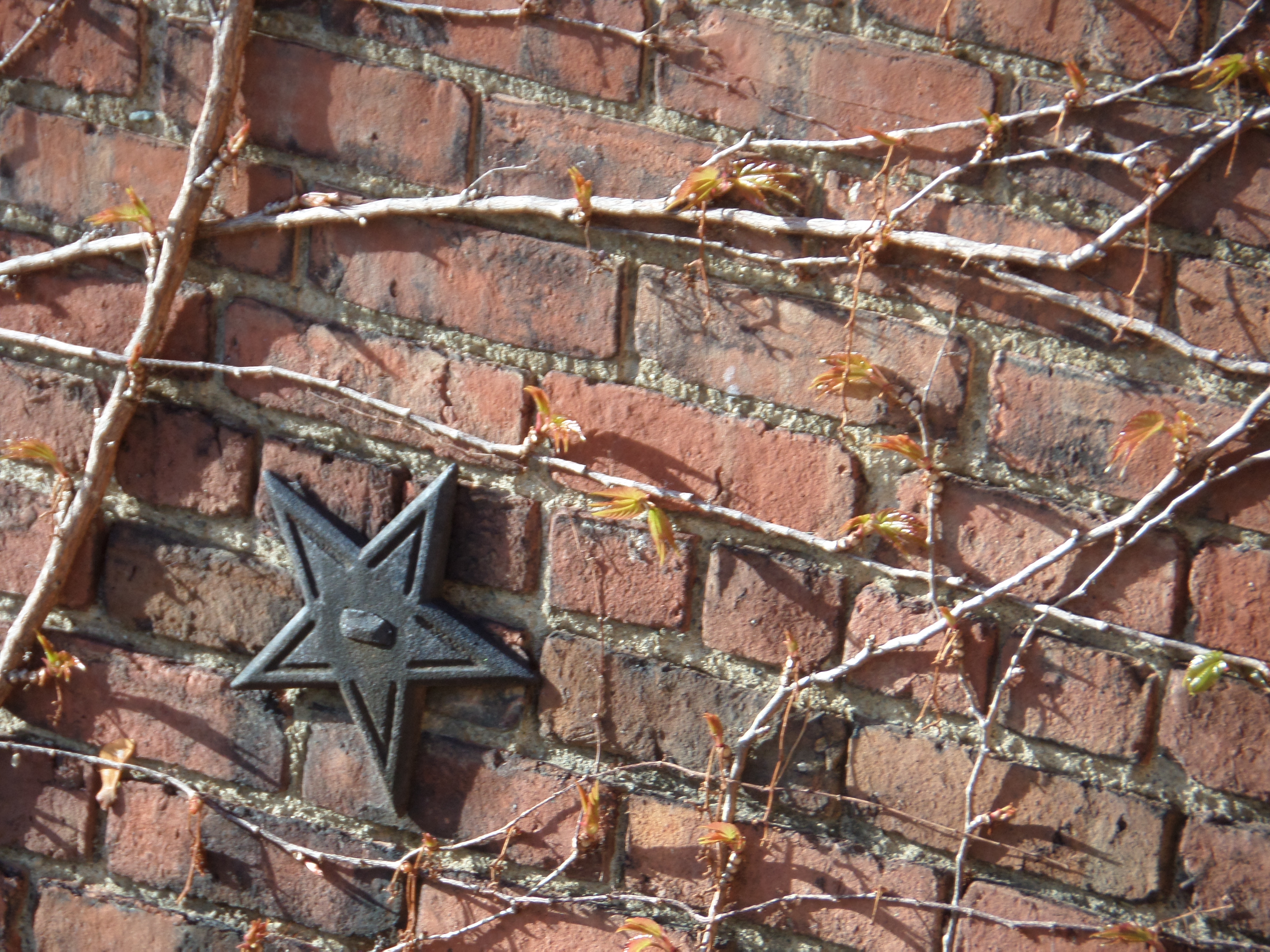
These sticky pads are called holdfasts.

Onto the mortar--

Onto the mortar–holdfasts.

Eentsy-weentsy gummed cushions, the only support for pounds and pounds and pounds of greenery.

Holdfasts.

The wind whips the moist leaves, pulls at the vines, and the holdfasts? They hold.

Walls of ivy

Walls of ivy

Every year, Nature’s prompt: What are the holdfasts in my life?

What are the things that, once I’ve ventured forth, clasp me firm and fast to my true self, keep me from blowing away?

—That don’t seem that strong but really are.

—That form even as I merely think about moving.

—That prepare in advance for the eventual step, wherever it takes me, whichever surface and direction.

—That understand (whether I am willing to acknowledge it or not) there will always be a next step.

hold on!

Wrapped around the old vine, growing new vine.

Whatever those holdfasts are, I need to identify and guard them, because they keep me stable and safe, and are absolutely necessary for growth and expansion, no matter how insignificant or odd they look to the rest of the world.

**

A visitor to the ivy.

A visitor to the ivy.

As summer marches in, bigger leaves follow the small ones, which expand to cover increasing territory; then those green berries appear while I am out in the mountains and going lake swimming and kayaking; next a smell of fall blows before I think it is due–while the petioles blush and glow from the bottom of each leaf to its base–which is right now, here in September. When I start to need a jacket for bike rides, the leaves turn red and brown and yellow-white, like Neapolitan ice cream, sometimes all on the same leaf.

Fall ivy.

Fall ivy.

Finally groups of birds arrive, luckily often on days I am home to watch. They fly at the walls, flapping crazy wings, picking at the berries. Like a scene out of Hitchcock’s The Birds, they attack over and over again, determinedly seeking purple-blue morsels and knocking the already loosened French vanilla, strawberry and chocolate leaves down to the yard below. As that group moves on, some berries are left, to be picked off by the next day’s migrating flock.

The holdfasts darken but remain. Empty brick walls are looped once again only with vines, where small clumps of snow find a precarious perch in January and February. Then the light changes again and signals the slow reaching out of buds and tendrils—and fresh holdfasts to join the others.

Winter light on old vines.

Winter light on old vines.


To Be Human

Pollen frosted close up of roadside chicory flower.

Pollen sparkled stamens of common roadside chicory: delicate and tough together.

I’ve been off the grid for many months, in terms of writing posts, due to some health issues.

It’s been hard to let go of the happy disciplines I crafted over time in favor of other, uninvited ones: from days of writing and hiking and yoga studies and business building, to pain management, miserable medication interactions, diet changes, self-care regimens and (even though it was minor surgery) post surgical rehab.

Unable to sit on the floor and do my yoga in its usual way, I had to figure out what part of my practice “transfers.” Sometimes I couldn’t look ahead into the future, or even the next thirty minutes, so the asana practice simplified into breathing in the moment, then breathing into only-the-very-next moment.

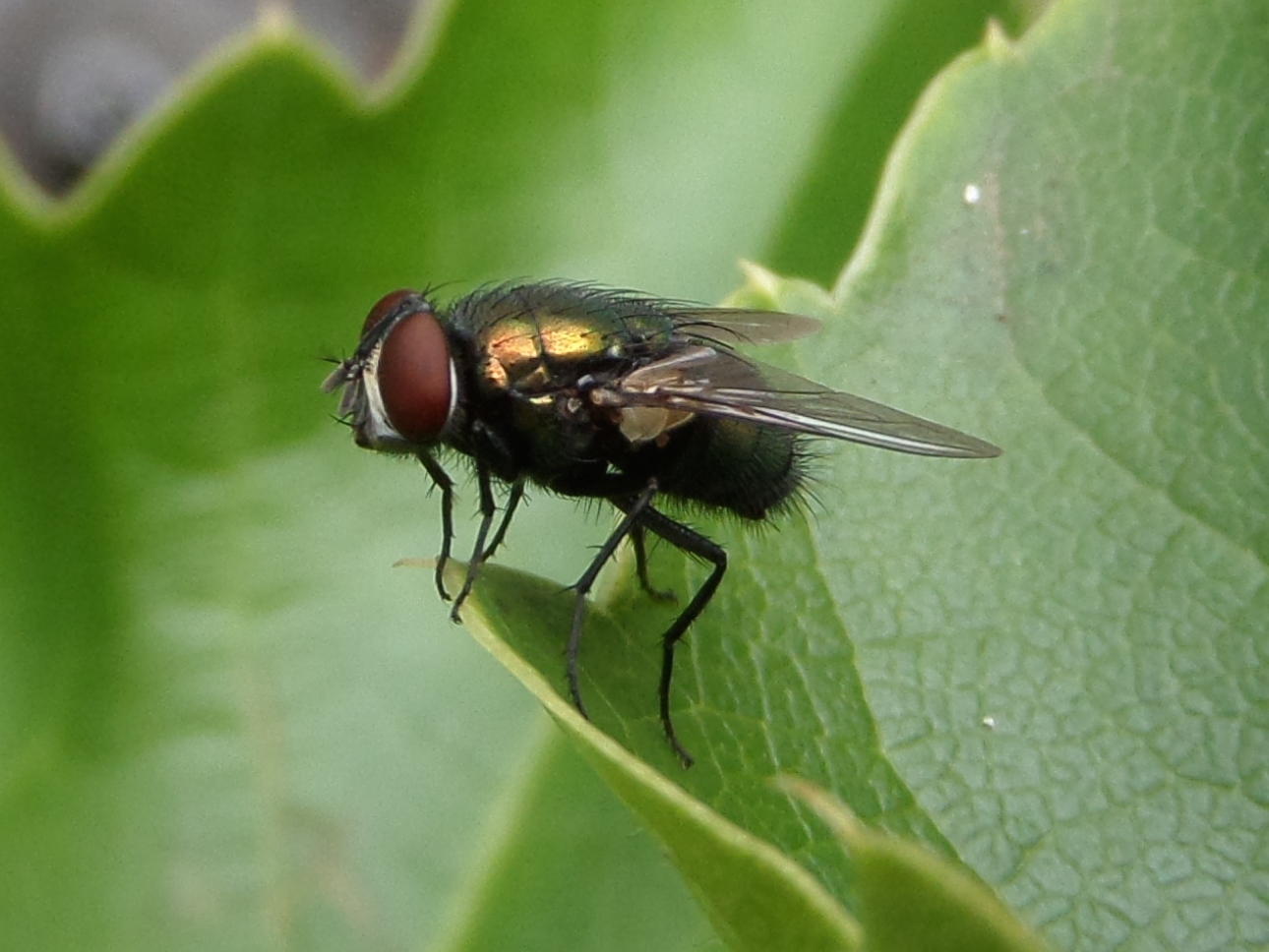
Sometimes I felt like this frog at Partridge Run: barely head out of water, plagued by flies.

Sometimes I felt like this frog at Partridge Run: head barely out of water, plagued by swarms of flies that just wouldn’t leave.

Until I’m consumed by Being-Ill Time, I don’t recognize that my usual experience is Relatively-Healthy (even though I’ve done this being-ill thing before). Since February, I’ve stepped out of ordinary time–like the final months with my friend J. Because it went on for a while, illness became my ordinary time. I had to give up activities I was attached to, like honing essays for this blog.

I stayed with the disappointment, frustration, and unexpected physical weakness. I centered on curiosity, listening to what was actually going on in my body, instead of anticipating procedures with dread or remembering previous ones with trepidation.

I had to bring my self-care tools with me into Being-Ill Time, and develop some new ones. (More on that in later posts.)

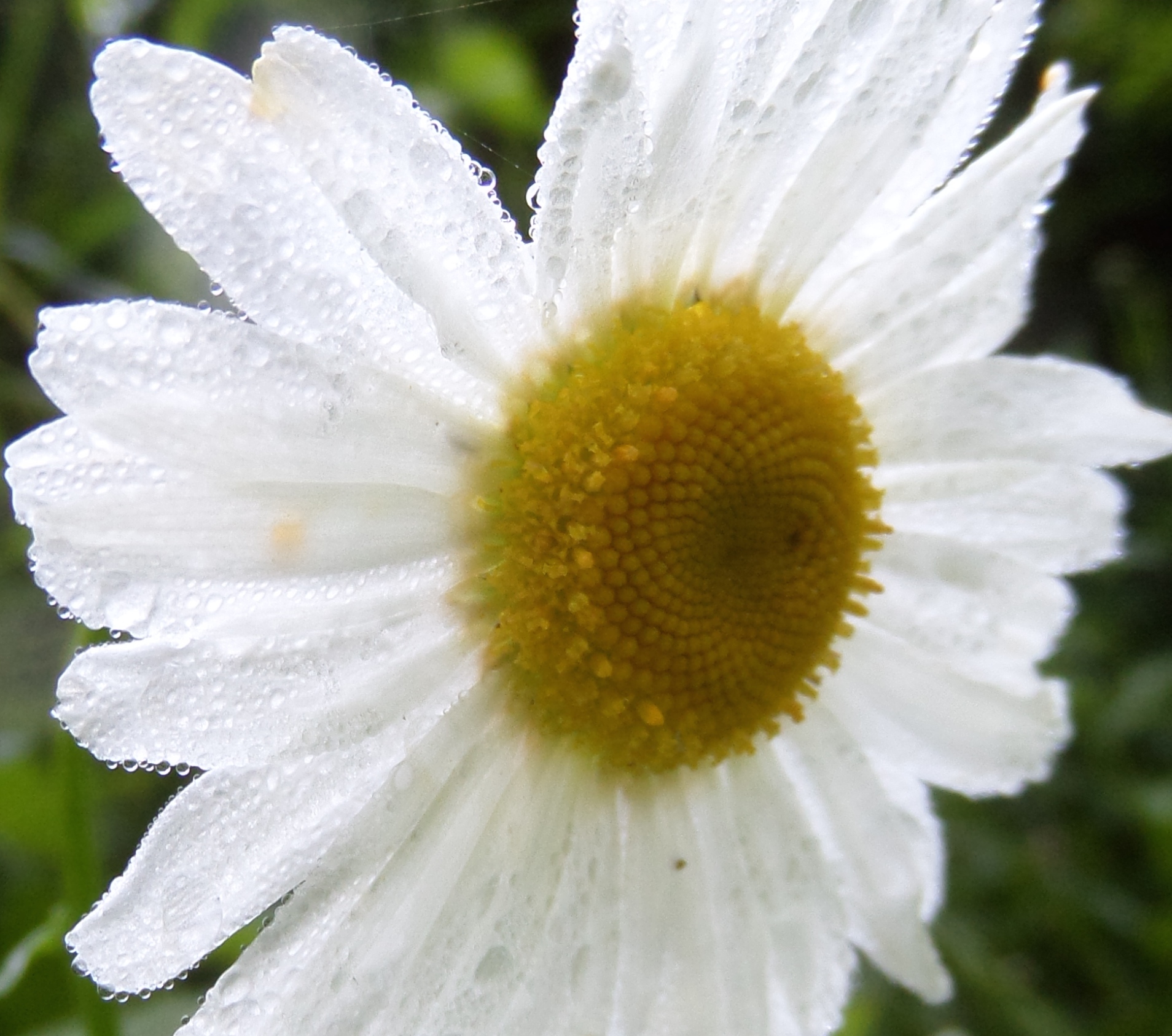
Daisy--closed, preparing for bloom.

Daisy–closed, preparing for bloom.

As humans, we often have to respond to what happens that we don’t choose. To glory in the pain-free moments. To become comfortable in “waiting to see” and not making plans. Here I thought I was moving so much more slowly than in my old perfectionistic, A+ Student self. Now I have been taught to go even slower.

Of course initially my mind went crazy with thoughts: How long will this last? How bad will it get? Am I a wimp?—justifying myself to loads of imaginary detractors.

Then one day on the way to replenish my medical supplies, I ran into an acquaintance who asked about what I was up to.

I’ve been ill lately, but I teach writing and movement workshops—and I’ll be doing yoga with hiking at a local nature area this summer.

But what do you DO?

With my sister, I’m working on a book about meditation and the creative process. Progress continues on the memoir. I’ve been enjoying my nature photography as well.

But what do you DO?

Hearing these persistent questions, I could have become discouraged. No, I’m not working a typical nine-to-five job with a fancy title or perks. I’ve been sick, so certainly my business’s forward movement has been disrupted.

However, for the first time, instead of self-judging, I noticed how her thought patterns and expectations of how I measured my life were upsetting HER. The chosen flexibility and unconventional schedule of my life—which made her uncomfortable—were getting me through some tough times. My response? I didn’t take it personally. I merely wished her well and went on my way.

Daisy, full open in morning dew.

Daisy, full open in morning dew.

It reminds me of what I used to ask my adult literacy students: Not Where do you work? but rather How do you spend your days? The question delved into who they were as people, and acknowledged that personal value is not based on how much money we make or our job descriptions. Some of us raise children, make a community, rest in retirement, volunteer, enjoy our professions or, alternatively, do meaningless repetitive things in order to pay the bills.

The better questions: How do you feel about how you spend your days? What’s important to you? What have you learned about being a human?

I’ve spent my days lately paying attention to what’s happening in my very human (concurrently fragile and powerful) body, researching, breathing, undergoing, recovering. I am living in my moments, honing skills of survival that I also tuck away for when I might need them next.

Dragonfly at Partridge Run seen on a recent come-back hike: symbol of (among other things) renewal after hardship, transformation, adaptability, joy and lightness.

Dragonfly at Partridge Run seen on a recent come-back hike: symbol of (among other things) renewal after hardship, transformation, adaptability, joy and lightness.


Chanting? Really? Yes.

Oscillations of water wash over fall leaves, at Partridge Run, Berne NY.

Oscillation of water, like sound, washes over fall leaves, at Partridge Run, Berne NY.

Most mornings, I chant.

I have always been told I couldn’t sing well; whichever octave sits next to me is where I jump, and I waver when unsure if another note might be closer.  I’ll sing snippets with my CD player or part of a hymn I’ve practiced a hundred times, but only when I am fairly confident I will land correctly.

Still, I wibble and wobble.

But at yoga school, chant began our day. I had to open my mouth and make sound come out. On-target or out-of-key, it didn’t matter; first thing, we intoned “the resonance of the universe,” Om, followed by three Sanskrit stanzas of the Student-Teacher Mantra.

Almost sixty of us perched sit-bones on little black cushions while out the window, sunrise pinked the eastern sky.  The mantra song felt strange to many and made them itch in discomfort and wiggle like little kids.   Mountain fog dissipated into the evergreens while our eyes remained closed, or followed the lines on a large-print poster at the front.  Over twelve days the chant became more familiar.

IMG_4024

Clouded Kripalu morning over the mountain.

During the break between sessions, I committed to continue, using a grainy digital video I’d recorded at Kripalu.

At that point, I needed to be led.

By the third stanza, usually my throat hurt.  I tried again every daybreak to coax energy, with a vocalization some mornings tentative and froggy, other times expansively bouncing off the yoga room walls. Breath slowed and deepened out of necessity, and warmed my throat. Warmed my thoughts toward myself.

This was not just a tune.

Then came even deeper breath and movement, heat, circulation and all the good invited onto my mat with those sensations. Finally, my nauseated frustration flirted with comfort. I recognized unwanted thoughts and let them float away.

When we returned to Kripalu, I heard my morning voice steady and confident.

Tibetan singing bowl with symbol of wisdom eyes.

Tibetan singing bowl with symbol of wisdom eyes.

Now out of school, why do I do it?

One afternoon I sat in a kitchen that reeked of the detritus of cooking, home early because my therapist forgot my appointment–what deep things does THAT say? I asked myself melodramatically. Basil stems and onion ends needed to be taken to the trash, cabbage bits and tea leaves laid sodden in the sink, crumbs sprinkled the table and floor.

Earlier I’d stopped at the used book store and found two 25 cent paperbacks for the lake-vacation planned with my best friend.

But at my table I acknowledged it was a vacation she and I would have to put off–because her brother is sick, so she will instead drive five hours back and forth to him a couple days a week, and then to doctors and hospitals in search of diagnosis, prognosis, the plan, whatever-that-plan-might-be, however long it might take. Because of love.

How can I make my life like a vacation without a trip? Give yourself permission, my therapist might say, like the night before, to stay up and crush the basil into pesto, to cut the watermelon and freeze the grapes for hot afternoon snacking, to wash the lettuce–but also to toss the sprouting sweet potato, feel the sticky floor under my feet, acknowledge I ate maybe one too many pieces of the blueberry buckle baked in the beautiful dark. Feel it all.

Blueberry buckle: crunchy top, tender crumb.

Blueberry buckle: crunchy top, tender crumb.

I had given the therapist some blueberry buckle as we laughed over the scheduling error. I thought, I would send some to my best friend if I could fly it there. In the midst of her pain, she’d mailed me a royal blue Pashmina shawl; the card read: Wrap yourself in this hug from me.

I want to take her to the lake we’d planned to visit, to hear the loons and go on long photo safaris in search of wild flowers and angles of light, to huff the thickly oxygenated Canadian forest air.  Drape myself like a scarf around her sad, sad shoulders. Feed her blueberry buckle and sip Chambord into the evening, watch the hummingbirds and fog dance in over the beach.

That’s why I chant. I chant to create space, to feel distress and delight. I chant, holding my best friend close, and her gravely ill brother. I chant and remember my friend J who died a year ago this month. I chant love gliding out of me for all of my existence.

I chant into the lakes and ponds and rivers and creeks, up the farmland and mountains, through the cumulous and wispy and mackerel skies. I chant into my cells, lungs, intestines, skin and fat and muscle. Into my toes and fingers. Through my navel: center of gravity, center of balance, center of self. Then out again and out again. Stretch, release.  Expand, contract.

Time passes and I am inhaling, vibrating, exhaling, feeling.

Time passes and I am in my breath in my body so time is inconsequential.

Chanting beckons me back to the mat and back to myself.

Chanting opens me with sound.

So most mornings, I chant.

Electric zing of fall color; energy courses through.

The visual zing! of fall; a path of green revealed by seasonal red.

Right Relationship with Food–Lessons from Kripalu

Sweet potato and hazelnuts, black beans, greens: a small window into the cornucopia of food at Kripalu.

Glazed sweet potato with hazelnuts, black beans, greens: a small window into the cornucopia of food at Kripalu.

Two problems:  we were on a schedule (breakfast at 8, lunch at 11:30, dinner at 6:15). And it was a buffet.

Granted, a buffet heavy on vegetables: kale and pepitas–kale and other steamed vegetables at every meal actually!–, saag (spiced spinach), curried cabbage, whipped squash, salsa and guacamole, and so on. Heavy on fresh fruit, too. Some meat if you wanted. Tofu baked and seasoned with sesame seeds, soft chunks in curry, cutlets, diced. Salads and soups at every meal.

Also more carbs than available in my kitchen: banana bread and pappardelle and rice, quinoa and egg rolls and kamut and millet and loaves and loaves of bread. Not to mention my favorite, the maple-nut scones. And the ginger ones. And those scones with the currants. Oh my.

Spanakopita, beans and greens.

At lunch, phyllo covered spanakopita, along with squash, saag, beans and greens.

–All food I didn’t have to research recipes for, shop for, haul up three flights of stairs, chop/slice/dice, sauté/steam/boil, measure then serve. No dishes to wash. No dealing with leftovers.

This was problem number one.

The second one? At home, the meal “schedule” is: wake with the sun, drink water and tea until fruit calls, usually around 10 a.m. Slowly prepare scrumptious dishes on the cooking days, nibble and nosh on them for lunch and dinner, attending closely to hunger and fullness.

At Kripalu we were up way before the sun, on the yoga mat at 6:30 for an hour and a half, followed by the first meal, morning session, lunch then afternoon session followed by afternoon yoga, dinner, then evening session, shower-bedtime-boom.

Cold seaweed salad with toasted sesame oil, fine-chopped broccoli salad, carrot salad too! Must try them all.

Cold seaweed salad with toasted sesame oil, fine-chopped broccoli salad with red onion, carrot salad too! Must try them all.

With these unfamiliar food and time boundaries, desperation set in:

What if I get hungry? 

I am working very hard, after all, pushing myself physically, mentally, and spiritually!  Eating keeps me awake and alert.

I have paid for all these meals. 

Such nifty recipes deserve a taste; then if they’re good I can try them on my own.

What if I don’t like what’s served tomorrow? 

The cafeteria line closes at 7:30, then there are just things to drink. What if I get hungry before bed? In the middle of the night? Before morning yoga?

(Whining) Because I AM pushing myself physically, mentally and spiritually, I want to have fun food!

So I started having three full meals–breakfast just a little vanilla soy yogurt–and some granola and soaked prunes, that’s good for me. Of course the daily egg dish was comforting and warm. Ohhh, better try the scrambled tofu, it looks good. Don’t I need vegetables too?

Almonds with the yogurt and soaked prunes.

Almonds with the yogurt and soaked prunes for breakfast–and then some.

Even though it was Silent Breakfast, I found myself shoveling in big mouthfuls, swallowing before really chewing thoroughly.  We only have an hour before class and I have to do my writing! 

During other meals, I laughed and ate, chatted with one person and ate, got serious with someone else–and ate; at the end, surprised, each time my plate was scraped clean. Already? Is that all?

Comfort food after our first practice teach session: spinach fettucine with mushroom cream sauce.

Comfort food  I gobbled down after our first practice teach session: spinach fettucine with mushroom cream sauce. Yes, I felt comforted. Very.

Feeling bloated the umpteenth day in a row (for some reason, I wonder why?) one breakfast I decided to take a small bite of yogurt-and-seeds, deliberately put the bowl back on the tray, pick up my keyboard and write a while while chewing; then lean over and pick up another spoonful, and so on.

With this slowed-down approach, I could feel tender resistance from the sunflower seeds between my front teeth, spreading sweetness from the soft prune, savory egg on my tongue. Ahh, this is better! Not just flavor but sensation, and a sense of fullness earlier than anticipated. Choosing to leave some on the plate, in the bowl, especially if it didn’t appeal.

Take some, just a little, a few.

Take just a little, some, a few. Space on the plate is OK.

Then to myself–Remember your old habits? YOU put your fork down between bites. YOU pay attention to the texture and flavor. YOU ask: am I full now? am I putting this in my mouth merely because it is on my plate?

Smaller portions each day, I took bowls instead of plates, so the meal wouldn’t look so overwhelmed by empty space around it.  The daily menu board helped: is the  emphasis today on lunch or dinner? Do I want the Thai lunch–or the Mexican dinner instead? 

Can you see how the choice was difficult? Tofu with kale and pea pods here...

Can you see how the choice was difficult? Sesame tofu perfectly crisped with kale and pea pods here…

Indian curry cauliflower and peas, here,

Indian curry cauliflower and peas with chutney here (note the kale)….

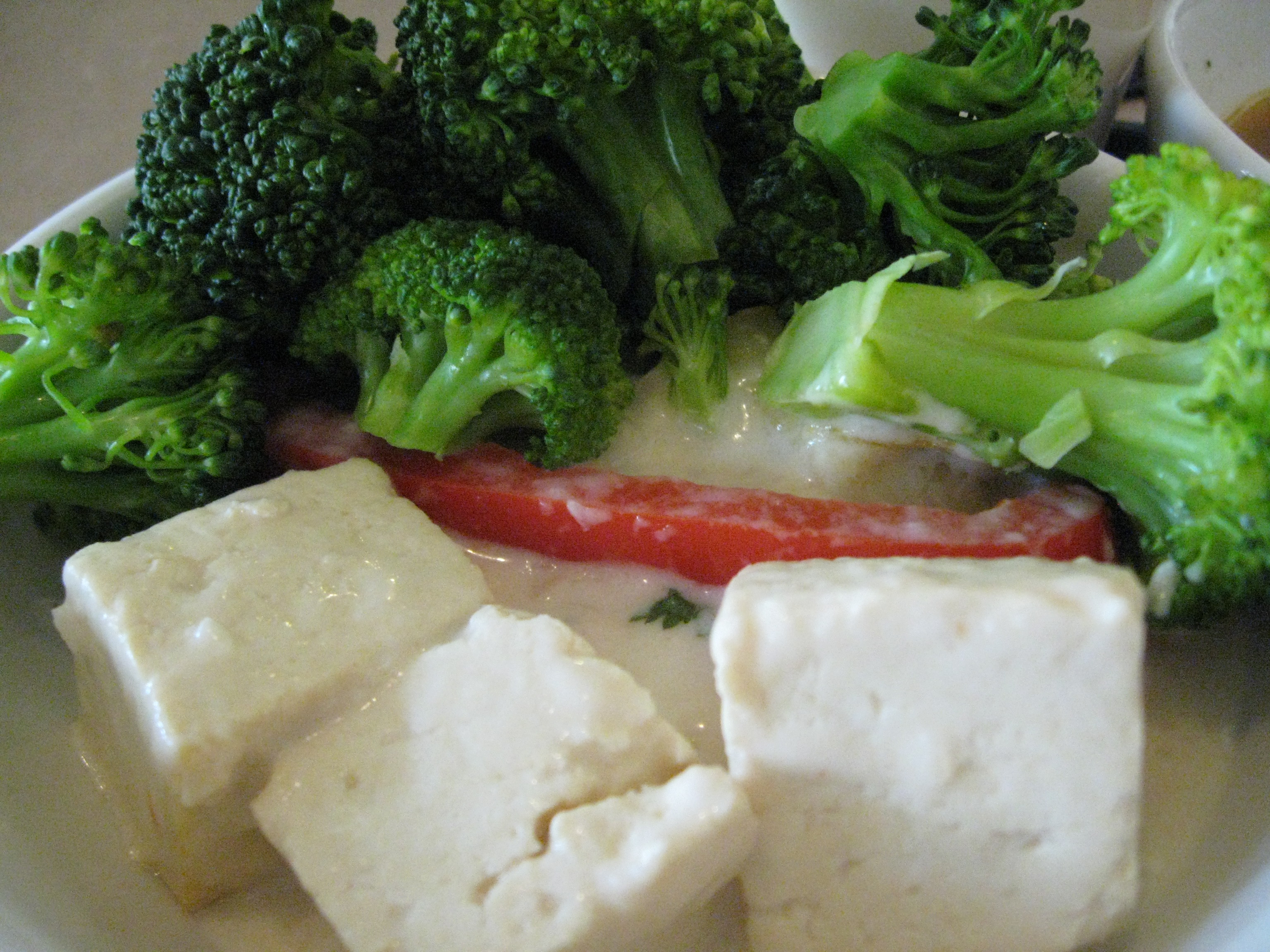
Coconut curry sauce, tofu, broccoli and red pepper.

Coconut curry sauce, tofu, broccoli and red pepper (kale was in the other bowl).

I stopped eating the salads. Usually when dining out, I choose something I wouldn’t or don’t make at home–sudden lightbulb! I make leafy green combinations at home, easily.  So I took the things I don’t do as much on my own: julienned beets. Fresh peas. Risotto. Home-made naan (just one). Chilled cucumber soup.

Beets and a cinnamon apple salad.

Beets and a cinnamon apple salad with raisins and walnuts.

I skipped lunch and took a stroll one day, after “hoarding” a scone from breakfast in case I got hungry. And a banana. Then I didn’t even want them, not until long after the hike, during the mid-afternoon break.

Next longer walks to the pond or around the lake settled my stomach, as I decreased the load of comestibles, helping my sleep as well as digestion. I began to feel more myself.

Then I realized I love interacting with people but actually need quiet and writing and aloneness to feel safe and sane.  Now at some mealtimes I chose a blanket on the grass, a nap in my room. Even photography on my own.

Heavy June rains on peonies outside Swami Kripalu's meditation garden.

Heavy June rain on peonies outside Swami Kripalu’s meditation garden.

Reflections at Monk's Pond

Variations of green at Monk’s Pond

More than half the days gone, to figure out the food piece, and then the personal space piece–I’ve had these revelations before.

But I hadn’t run into these particular challenges before–not for this long, not under these circumstances–with the skills I’d been developing for years.

At a certain point, I paid attention, saw the need for change, and acted on it. I celebrate finally seeing what I was doing, regardless of how long it took me. My knowledge is now reinforced.

But wait, there's more! Garlicky polenta with Italian vegetables....

But wait, there’s more! Garlicky polenta with Italian vegetables and parmesan….

The colors were spectacular!

And a plate of pretty colors! I don’t have to eat them all–but I’m gonna be more aware of color and texture again, when I cook for myself.

School over, I am coming back to a home routine:  doing my own shopping, steaming my garden kale (yes, I still love kale!) and yellow beans, fiddling with local cheese and watermelon and new recipes. Being aware. Thinking about my choices, then making and enjoying them.

Maybe I’ll stop eating after 7:30 pm like at yoga school. Maybe I’ll soak prunes for my mid-morning yogurt.  Maybe–no, for sure–I’ll remember that “problems” are actually wonderfully sacred learning moments.

Clouds over the Mohawk River.

Summer abundance of plants and clouds at the Mohawk River.

**Recipes for many of the dishes here can be found in the series of Kripalu seasonal cookbooks or at http://kripalu.org/article/270/  .

To Be A Student Again: Falling into the Pond, Repeatedly

Monk's Pond, Kripalu Center. Two possible paths in learning, and life: I could worry about stepping perfectly from one broken-down, submerged plank to another, or choose to play, expecting to fall in, enjoying all parts of the exploration of balance.

Monk’s Pond, Kripalu Center. Two possible paths in learning, and life: I could worry about stepping perfectly from one broken-down, submerged plank to another, or choose to play, expecting to fall in, enjoying the exploration of balance. Especially taking in the part I’m most scared of initially: getting wet.

April’s training at Kripalu once more flung me deep into non-ordinary time, like the months of grief around my friend J’s death*; with much to say afterwards, and yet so much unprocessed and unwritten-about.  I’m stymied in the richness of my adventures, and exhausted again, still.

Information, information, poured in for twelve days. From the senses: exotic dishes on the buffet, hiking to jade-green ponds and a blue mountain lake, new faces to learn, voices, expressions, chanting, body movements and stretches and muscles micro-damaged then self-repairing;  loosening of muscles and expectations.

From the emotions: old frustrations hidden in the back and neck, released!, even-older habits of perfectionism popping up and rejected repeatedly.

From the intellect: how to memorize? how to rework language? philosophy to examine and reject or accept, examples to wonder at and incorporate.

We fifty-some students were fed and watered on a regular schedule:  yoga now, eat now, learn now, more yoga now, eat now, learn more, sleep now. Sometimes I opted to sleep instead of eat, as the fifteen hour days wore on.  We studied (or not), absorbed information, wept, breathed in new ways, chattered, practiced asanas, laughed, walked the labyrinth, mused, closed our eyes a lot, danced, practiced teaching, meditated, listened to each other’s life stories.

More to come about the food--but here are the staples of broccoli and kale. I ate kale at every meal some days. Yum.

More to come about the food–but here are the staples of broccoli and kale. I ate kale at every meal some days. Including breakfast. Yum.

I’m groggy coming out of school, as evidenced by my writing:  incomplete phrases dangle, run-on sentences jackrabbit ahead.  Regular life assaults me while I self-challenge not to leap recklessly into the old hurry-hurry. Yet requirements push impatiently through the door as I bring my luggage in:  lists, schedules, topics internal and external: what for dinner? hmm, those piles of unfinished projects, cleaning; oh, and here come other people, can I handle interaction?

Another fact reverberates in this bumpy integration: I return to Kripalu in June for a second round, and preparation is required in the form of teaching practice, absorbing a three inch binder full of materials, memorizing Yamas and Niyamas (Character Building Inquiries of Restraints and Observances), becoming familiar with even more poses (seventeen asanas down, twenty-six more to cover in June).

And most important for me: the internal dialog shift.  Teaching is not giving a performance, it’s having an experience. Breathe and meditate first. Breathe and don’t take yourself so seriously. What do I experience in the moment of teaching? How can I flow with self-awareness along with students’ needs to understand? What about timing the various sections of the class, and whoops! I need to use a new kind of language–not the language of anatomical teaching from my former days in massage therapy but rather directive, guiding phrases to move the participants to internal sensations and lack-of-self-judgment–yes, language cleaner yet more poetic.

Months ago, coming back from Kripalu, I didn’t realize how painful it could be to re-enter regular life.**  So this time I moved back into the world deliberately and slowly.

I let other people take care of me a bit with:

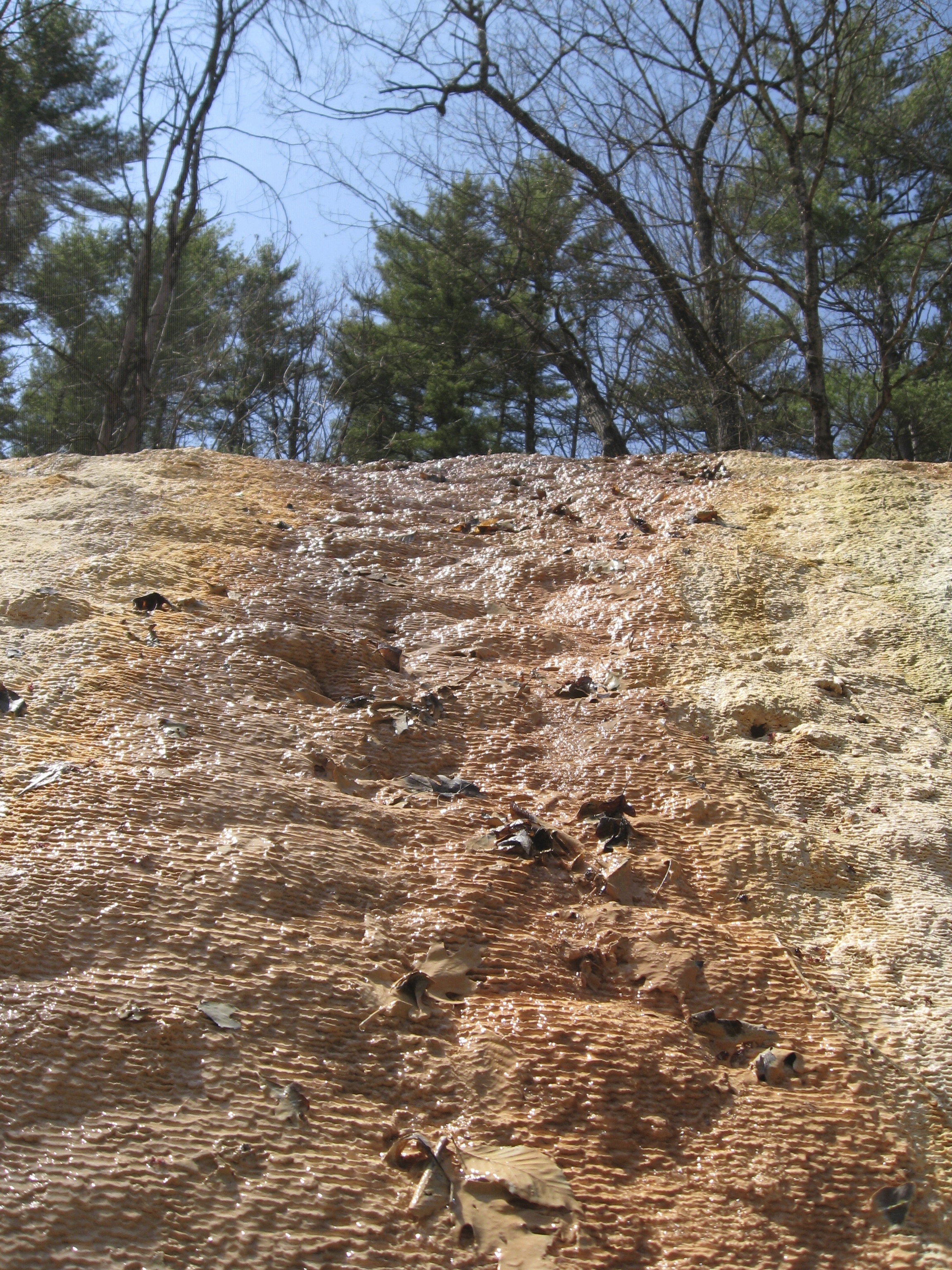
–A zen motorcycle ride to Saratoga Spa State Park; moving meditation different from the yogic variety, world going by but not attached to it:  smells of cut grass, newly manured fields, flowering crabapples and Japanese plum, all cascading inside the helmet, forced up my nostrils; the call to give as little input as possible to the bike’s movement, merely shift with the driver’s body to stay upright or angle to make turns.  Then crunching along gravel, smelling the sulfur-y carbonic acid water when we pulled up to the springs, hearing toddlers in shorts giggle along the paths to the spouters.

Saratoga Spa State Park, Saratoga Springs, NY. Mineral rich waters bubble out and down the rocks.

Saratoga Spa State Park, Saratoga Springs, NY. Mineral rich waters bubble out and down the rocks.

–An hour’s amble to Jumpin Jack’s hamburger shack on the first hot day of the season,  for a cheeseburger topped by coleslaw, finding a long but quick-moving line of post-baseball league families and tattooed Harley Davidson riders, everyone patient but happy-bouncy like little kids because of the warmth.  A measured amble afterwards to settle dinner on the way to Stewart’s for dark chocolate ice cream.

–Another day: the sun was golden at John Boyd Thacher Park where a bald eagle rode troughs of air over the escarpment, along with turkey vultures, red-tailed hawks, ravens circling–and then three rare Blue Karner butterflies indigo’d the path in front of my hiking companions and I.

Rare scarlet trillium, imperfectly framed AND glowing deliciously.

Rare scarlet trillium at Thacher Park, imperfectly framed and yet glowing deliciously from the sun behind.

–Talks on the phone caught me up with family and colleagues as I put in window screens  to catch the cooler night air, then re-stocked the fridge.

Finally I could bring myself to clean out the email queue, a hundred messages at a time (a task not yet complete), unpack the suitcases and put down the new green yoga mat.

And to the garden: Planting has begun in the actual garden plot, in addition to my life plan.***  An entire row of three varieties of carrots!, stringless pole beans, lacinato kale, peas, radishes, and this year sweet pansy-faces smile on the row ends, with bachelor button and cosmos seeds strewn in. The little girl and boy who live in the house next to my community garden begged for seeds when they saw the activity; we tossed a packet of zinnias over the fence.

Dug and double-dug, compost and mulch added in, planted, marked and covered with sphagnum peat, watered. Growing underground where we can't see it. growth occurring that we can't see yet.

Dug and double-dug, compost and mulch added in, planted, marked, rows covered with peat moss, thoroughly watered.  Growth, that we can’t see yet, already occurring.

These May mornings I rise at 5:30 just like at school, loop mala meditation beads around my wrist to remember my sangha (study community) and chant along with the grainy video I took of my instructors singing the Student-Teacher Mantra. I listen to my own body’s needs on the yoga mat, and study how to teach others, giving myself hours a day to learn.

Of course I overextend in studying, and other parts of my returned-to life. Then I remember the Niyama I am practicing of Ishvar-Pranidhana: softening and opening to the play of the universe. I kindly, gently and compassionately, rein myself back in.

April's full moon, called the Awakening Moon in some traditions, certainly appropriate for this period of learning for me.

April’s full moon, called The Awakening Moon in some traditions, over the lake at Kripalu. Awakening, indeed.

*See posts Sep 14 & 28, Oct 8 & 19, 2012; found in the category “Death and Grief”

**See “Confidence that I Know Nothing: The Labyrinth” posted November 2, 2012

***See “To Plant a Garden–And a Life” posted February 1, 2013

Sighing into spring, and school

Golden now, not grainy-gray, the quality and angle of morning light has definitely shifted in the kitchen. Come 5:30 a.m., I hear returning songbirds chipping and chirping outside my urban bedroom. It is spring again–and still–despite the almost-blinding gusts of snow that assaulted my windshield after dark the other night.

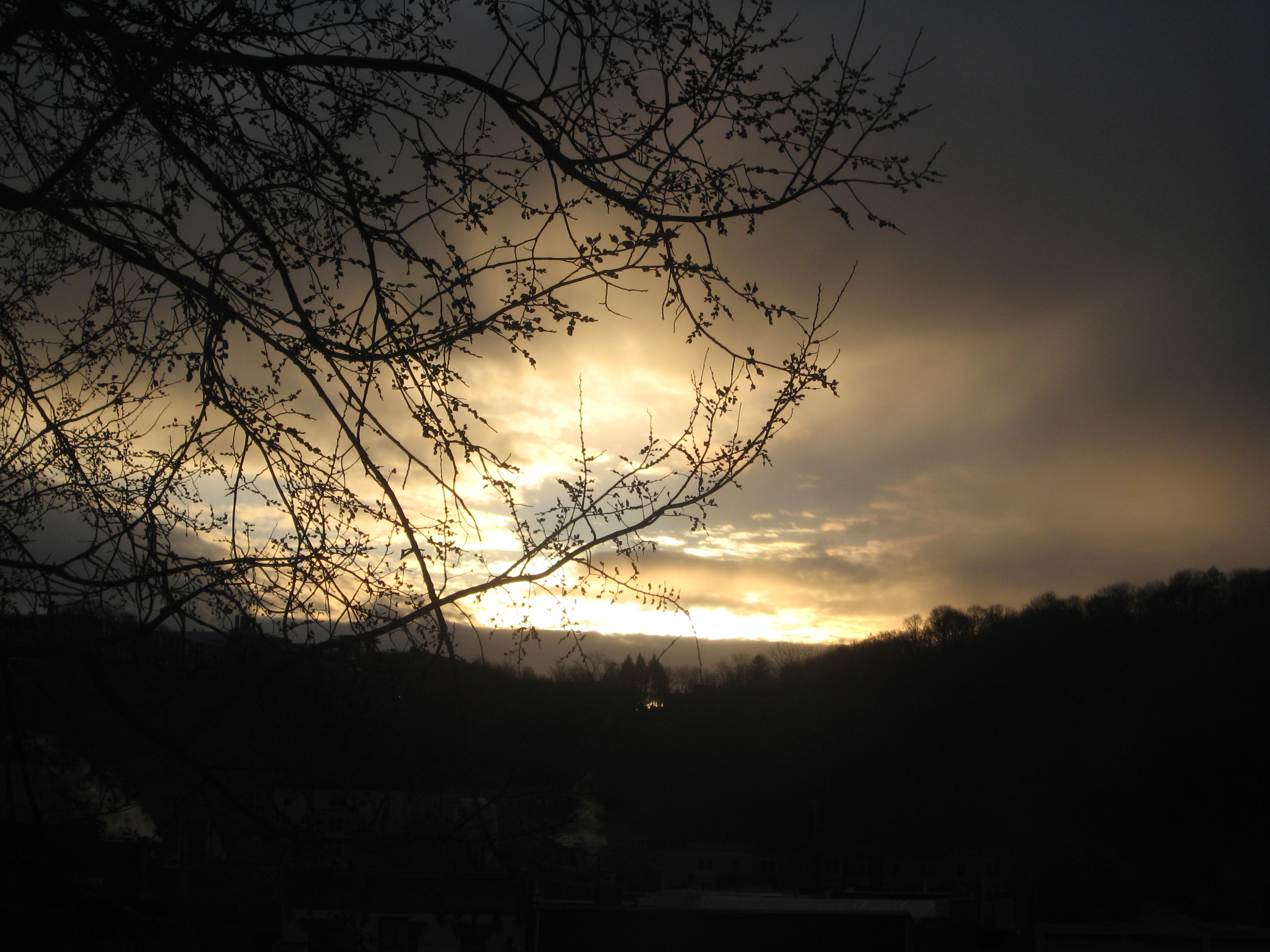
Winter sunrise over the hill

Winter sunrise over the hill

I think about going back to school and sigh, just a little. This will be a challenge. Normally spring is the time students think about freedom! if not the short burst of spring break, then the long open opportunities of summer. Instead, I am picking up books, “screwing on my thinking cap,” as some obnoxious teacher once pantomimed. Ouch.

I am also intrigued, excited, curious. It’s like sleep-away camp–not that I ever attended, just read descriptions in books and heard about it from friends. Supposed to be new kids to meet, a whole lake to swim in, lanyards to twist and knit. In my case, other interesting grownups, a lake to walk around (still too cold for swimming), forest paths and a labyrinth too and a healthy cafeteria: physical and mental growth to be had everywhere.

My problem is that very persistent A+ student who hangs on the edge of my mind, like a bully taunting from the field beyond the playground, Yeah, just try stepping over here. You’ll see what happens! Loser!

She/he interjects comments as I read my Kripalu Yoga textbook. Sometimes I am pulled in by the resonating philosophy, so I forget that voice; sometimes I sigh yet again, frustrated by my more recent midlife difficulties with memorization. Perhaps because I am creating new neural pathways along with the information, undoing old patterns of self-deprecating reaction, my mind has rebelled: This is too hard! I’m not cooperating!

I go into the yoga room and look at the book, the diagrams. Deep breath. I speak the pose names as I stretch out and position myself–

–on the belly, pelvis firmly anchored into the earth, arms and legs lifting up and behind me: I whisper “Nav-asana,” and think Naval, like a boat on the water, floating with waves of breath….

Kneeling, then flowing back over knees-wide-apart, arms reaching forward on the floor, Garbh-asana, Child’s Pose–I am garbed in the freedom and openness of the child-mind and child-body, I take what rest I need, when I need it.

Bala-kik-asana, Crane: a one-legged pose of balance, arms hovering, the staccato Ks remind me of the stick-legs of a bird in water.

Like a boat--or a dock--water softly lapping, the feel of Navasana

Like a boat, or a dock:  water softly lapping, the feel of Navasana

Ah, there, that’s a reason you do yoga. Space for creativity, not pushing and grunting along, not cramming yourself into a place that doesn’t fit. By its very definition, yoga is about expansiveness, room for yourself, who you are, at that moment.

Unwinding my body in Spinal Twist (Matsyendr-asanahow to remember THAT one?) I exhale and think: Snow flies yet spring comes. I can’t remember things, I can remember things.  Just because I suffered last time I learned, doesn’t mean I have to again. In fact, the intention is to do it differently now.

Welcoming carving on the Emma Willard School  "Alumnae Chapel"

Welcoming carved face on the Emma Willard School “Alumnae Chapel”

I enjoyed a marvelous Easter/post-Spring Equinox holiday with a colleague of mine. We tromped through cemeteries overlooking the Poestenkill and around the Emma Willard School campus, deserted on a Sunday; snacked on huge pink slices of watermelon radish with cups of hot tea and maple sugar; worked on individual writing projects while the local whole chicken stuffed with crumbled sausage, butternut squash and kale baked in her oven.

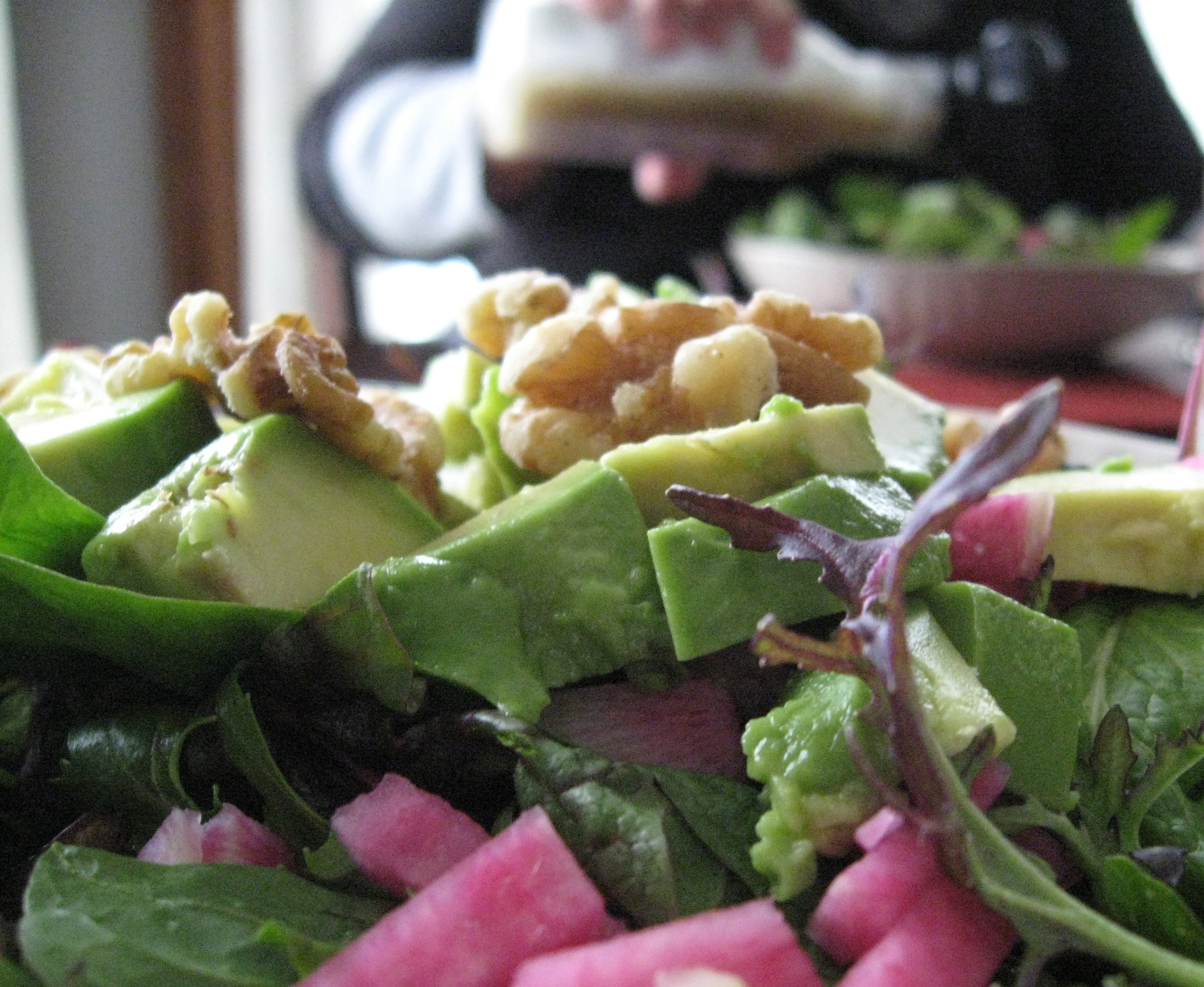
We took a first-course interlude of salad: more radish, avocado, walnut, mesclun and vinaigrette.

Spring salad to tease the appetite

Spring salad to tease the appetite

I sliced sweet potatoes into fries. Her least favorite chore for the day, the knife-work was a job that didn’t feel like drudgery to me at all; I hummed as I chopped along.  That’s something I am watching for in my future earning-a-living, ways of spending my hours that I so enjoy they don’t feel like “work.”

My companion rubbed coconut oil, cinnamon and a little rosemary on the wedges before oven-roasting them. As we tapped our keyboards in the living room, the smells of dinner intermittently tickled our noses and then slammed us lusciously when we re-entered the kitchen in search of more tea.

When all was ready, we ate until satisfied and no more, heaving happy groans nonetheless, and deliberately leaving some food on the plate to wrap up for later.  Sips of tart cherry juice with seltzer served as dessert, accompanied by more writing time.

Paleo stuffing and sweet potato fries

Paleo stuffing and sweet potato fries

Ahhh, we sighed, a holiday that wasn’t (as is typical) about overstuffing our stomachs or our schedule. As the day meandered, so did we; we took seriously our choices but made them only as we went along–Want to walk more? Turn this way or that? Whoops, the chicken isn’t done; oh, I see why it needs more time, ok, we’ll write for twenty more minutes.

She’s a future yoga teacher too, and we’re both applying the lessons on the mat to daily life: sometimes grappling, sometimes serene, knowing serene-plus-grappling is actually desirable.

Yes, I told her, I joke a lot about breaking into a sweat learning to love my life.

But ease is what I aspire to:  ease within challenges, like strength and lightness in a yoga pose, grounded in the earth and yet buoyant, willing to move and respond to the wind, and not let go of connection to who I am in my core.

False starts, shifts in weather, don’t indicate that spring won’t come. How days-off were acknowledged in the past doesn’t define how I celebrate them now.   I will allow myself to be not-so-good in school and not worry.

All of it will be delicious.  Especially the more I stand in each moment, Right Now, swaying and trembling perhaps, but over and over returning to curiosity, determination tempered with compassion, and gentleness toward myself.

Warm spring sunrise

Warm spring sunrise behind budding tree

The Value of Small Things

A droplet frozen as it traveled down the branch tip, bubbles of air and all.

Melting snow refrozen to droplet as it traveled down the branch tip–bubbles of air and all.

Exhausted in my illness, I half-dreamed–swirling textures, miniature scenes:  small things.

I woke at strange hours, blinking in the semi-dark, and dragged myself into consciousness. A few times I flipped on the computer and reviewed my personal visual library of the outdoors.

Photographically, it must be admitted, I often fail to capture The Big Scene. Views to the horizon should encompass not just a grand vista but also multiple items of interest–framing trees, layers of color, initially unnoticed figures–which the eye can move between while simultaneously absorbing the grandness. I usually hazard an attempt or two at digital reproduction, while shrugging at the results.

But when it comes to the diminutive, somehow the camera’s lens recreates what I see, and then some.  These photos lull me out of what otherwise would be a fast hike through the Big Scene of tree-tree-tree, sky and green, sky and brown, up the icy path, down the slippery path, tree-tree-tree.

Lichens galore at Dyken Pond; they loved the damp and cool of December there.

Lichens galore at Dyken Pond; they loved the damp and cool of December there.

Concentrating on the little buds or branches trains me to not just look at what is on the trail ahead–the overall effect–but also the detail that goes into the effect, or surprises hidden within the effect.

More shapes reminiscent of Dr. Seuss: a vehicle, a hairstyle, something from down in Who-ville?

More shapes reminiscent of Dr. Seuss: a vehicle, a hairstyle, something from down in Who-ville?

Flashes of my hiking partner’s cadmium red coat pop up on the computer screen–she and I openly acknowledge that pulling out a camera also acts as an excuse to catch our breath. Look at the little fern! Pant, pant. Oh no, I’m fine, just taking some photos. Wink, wink.

Sometimes I don’t realize I’m tired or in need of a snack of apple-and-cheese or Carrot-Nut Bread until I am enthralled by a leaf’s angle or juxtaposition of shapes in the lichens. Visions of the teensy help me to stop and take care of myself.

No wonder while I was sick I dreamed of the small.

Hints of pussywillows to come, Landis Arboretum, Esperance NY.

Hints of pussywillows to come, in the winter sun of Landis Arboretum, Esperance NY.

like a moth emerging under crystals, velvety/downy leaves like bat ears pressing snow between them, and more leaves unfurling, uncurling, not quite identifiable. Out of a hard stem, hardly able to see that it could create a delicate quivering leaflet

Velvety beech leaves like bat ears or a moth emerge under crystalline snow, Dyken Pond.

In yoga, we do adjustments called “micro-movements”, that make a pose our own, responding to the muscles’ and joints’ needs at the very moment we are holding the body in the defined way that creates the asana. We are in the pose and we are adjusting the pose, all at once–simultaneously ancient/universal and modern/mine.

As part of the adjustments, I am learning to giggle once in a while when I become too serious–How silly to think perfection is required or desired!; to note then let go of worry about the loudness of a knee pop, to feel relief at relaxing a jaw that, unbeknownst to me, became clenched. Micro-movements are responses to the small that call from inside the body, in order to properly choreograph the Big Scene, the vista of Warrior Two or Mountain Pose.

Perhaps my larger views will improve, eventually.

Early crocuses, Landis Arboretum.

Early crocuses, Landis Arboretum.

I saw my first crocus cups of gold this week, two days before the Spring Equinox and one day before a huge snowstorm.

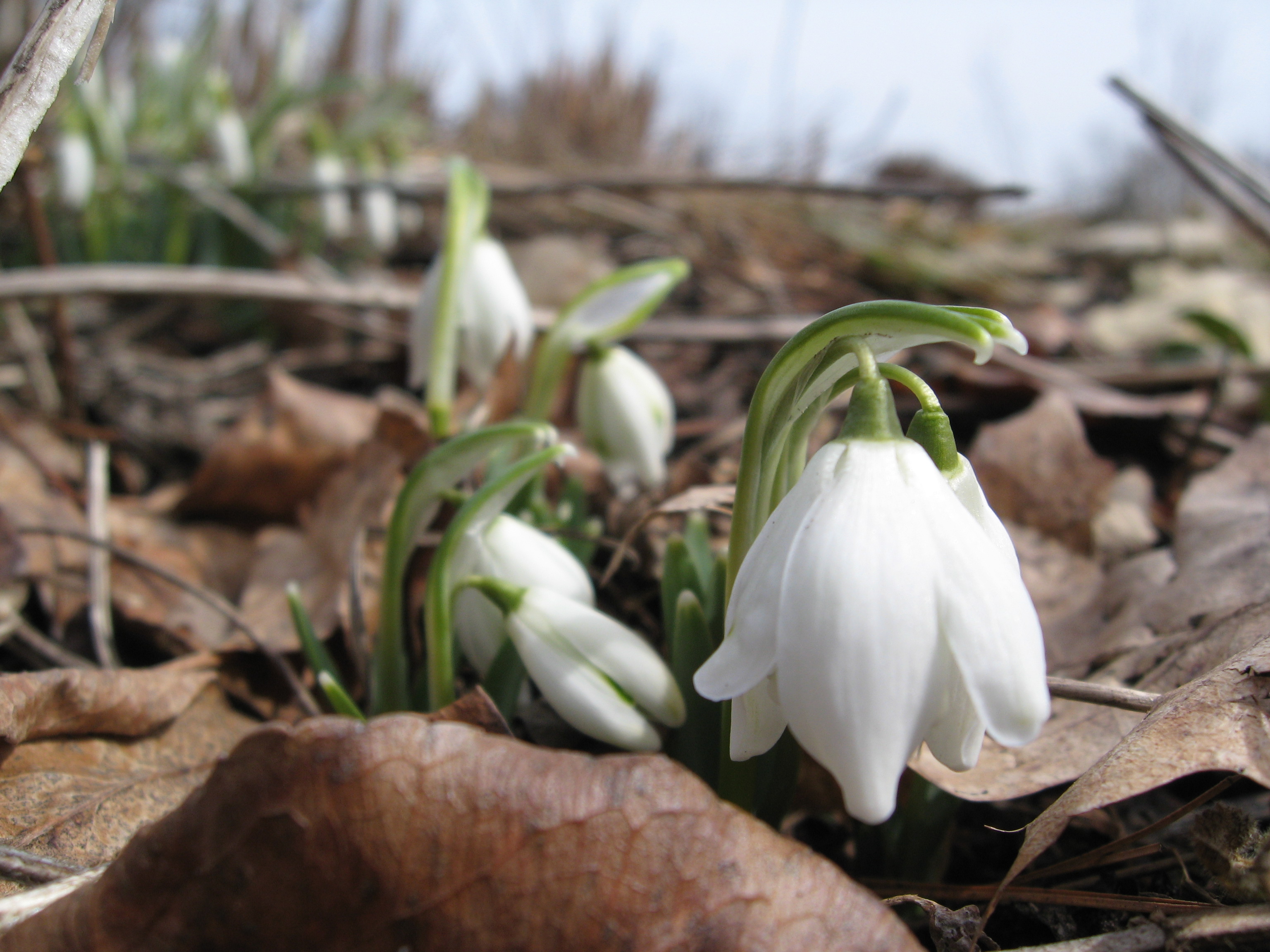
Two seconds after the crocuses, snowdrops. Those squiggles of green, puffs of white, baby plants so clearly claiming their place in the world, popped up out of the snow and mud.

It’s the rhythm of the natural world that’s always there–the natural world that we separate ourselves from too easily, and the rhythm of growth and seasons working like breath; we forget they all continue twenty-four hours a day: in, out, in, out, winter, spring, summer, fall.

What did I take from my middle of the night studies? Exquisite tiny worlds can be seen, if I look. Micro-movements, the small responses in my body, teach me to own my yoga.  And I would do well to practice “micro-movements” in other parts of my life.

Back in the yoga room, the intake and exhale wash away distractions. Small expands to huge. Grains of snow outside the window glisten me into the Now.

Snowdrops, Landis Arboretum.

Snowdrops, Landis Arboretum.