Grief and Green Beans

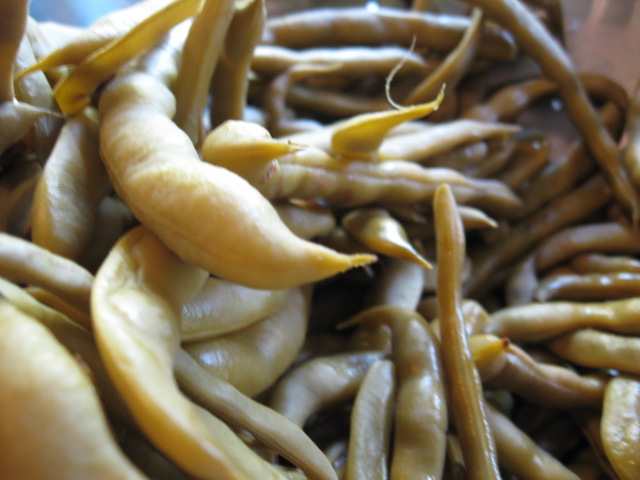
I harvested the last of my pole beans before J went into hospice. The beans are a bit of trouble, since they take forever to steam to softness, and thick strings seam each pod–hence the name “string” beans. A bag kept them fresh in the fridge while I travelled first to say goodbye to J and, two weeks later, to her memorial.

Late one evening after my second flight home, I cooked and cooked the green beans, drained and stuck them in the fridge for later processing.  A friend took me to wander in Vermont, to touch handmade dishes and pause at autumn leaves in the mist. And talk about J.

Home again, there they sit in the fridge, those green beans. De-stringing and freezing loom but I am too tired. I swim through the air as if it were thin syrup, every day or so surprised by forgetting and remembering suddenly, with a sharp inhale, that J is gone.

I don’t even want to open the container, afraid the beans will be moldy, but in a way hoping they will be, because I find myself unable to make decisions. Especially since, after the leaf peeping, the seven year old computer I’d been nursing along just up and died, Zap! screen gone to black. Finally I have to buy the new computer I’ve talked about and put off for months–the money’s in the bank but it will involve more thought, more study, change more change.

On the dead computer I had written three perfect paragraphs to open this week’s post, the only document not backed up to my external hard drive. Now I can’t remember the story. It certainly had nothing to do with string-beans.

I look in the fridge. Just a small bowl of beans, not quarts and quarts, but I hate to waste food, waste all the time planting seeds, watering through drought, harvesting, boiling–yet perhaps it is too late already; maybe the universe and time passing made the decision for me, just like the computer, just like J’s death, can’t put it off, have to face it, I’ve spent my time how I’ve spent it and here I am.

Ghosts of old surgical pain visit in the afternoon: the sore throat memory of intubation and a deep ache under the ribs. Front teeth throb, revealing I’ve been literally gnashing my teeth during sleep. On the yoga mat, tears come up, the ones held in during the expected talking about her death, the rearranging of schedule and inevitable too-soon return to regular life. I am swept along by daily chores and interactions, like currents pulling at me while I stand in a lake, when all I want is to float without effort, study the changing color of the sky and view fluttering fall leaves reflecting in the water’s surface.

We are always asking to be able to slow down and now I feel more stuck than blessed in my slowed-down-ness.

Serendipitously, my best friend comes to visit from out of state, and speaks that language of not-having-to-speak, of long history together. She drives me to the computer store.

I hear the strange notes my speech strikes, mind-on-grief, describing my work to the saleswoman:  The blog’s about living in the moment, has turned out mostly about gardening, gardening as metaphor for life, but lately it is about death; hearing how flat and dark that sounds, my best friend does what I usually do, elaborates for clarity–because a dear friend of hers died recently. The computer has to be special-ordered; I only complete the purchase because the best friend stands next to me.

After she leaves, I think of Thai food delivery but feel guilt over beans already cooked.

What would J have said?

Don’t worry….think of all the food you DID freeze, make into soup, share with others this summer.

We could order pizza; remember last winter when you taught me I could eat it for breakfast?

Have some more tea.  A new laptop, how exciting! Let me tell you a story about–

I toss the smelly green beans and order takeout. I stare at the auburn and gold out my window. I sit and cry over loss–unintended loss, and loss you can’t put off. I borrow a computer to write and post. 

I live in grief-time.

A vista to ponder, Bennington VT


Mind-Out-Of-Time: Writing, and Teapots

My teapot from J, tucked behind an electric kettle, another teapot, and a locally crafted mug,  on my early morning countertop.

I miss talking to J about my writing life.

This afternoon I will concentrate on writing, I’d say.  I’m deliberately ‘concentrating on,’ not ‘working on’–no more of the furrowed brow that ‘work on’ entails.

She’d laugh.  I used to have that furrowed brow, too; hell, look at my wrinkly forehead.  J would talk about the struggle to get to her drawing, even with new chalks and paints around her, how daily chores and her own busy mind pulled her away from something she’d never had time for, yet couldn’t quite get to, even now.  She’d encourage me to keep going, and I’d tell her more.

When I give myself over to writing, or create space for it, then I can relax and play. It’s what I call Mind-Out-Of-Time, what I sometimes think heaven is or would be: you are so involved in something that clock hands move unnoticed, you look up and the afternoon light is bending across your desk and you gasp–how long have I been here?

Mind-Out-Of-Time comes also when I choose to immerse myself in how life looks and feels, tastes, sounds and smells. It comes when I give myself permission to be right where I am, at that very moment, open to pleasure even in the midst of pain.

So I think of J, steeping tea in her beautiful cobalt blue teapot, when I came to visit six months ago. Napkins in hand, she danced oxygen tubing between pieces of furniture as I carried the prepared cups and cookies to the front room. We laughed about how, on our last big trip, she’d pulled her portable oxygenator, nicknamed ‘Fred’ after her father, all over the up-and-down hills of downtown Vancouver.  Fred sure got a workout, didn’t he? Took care of me just like Dad did.  We discussed once again her wish to die at home.  She asked after my teapot, a twin of hers, which she gave me when I moved away. Every time I make tea in it I think of you, I told her.

Two weeks ago, her caregivers still made English Breakfast in her blue teapot; she rested in the home hospital bed, I held the mug, she sipped sweet lukewarm liquid with a straw.  During the moments she was awake, she rolled her eyes sardonically, joking with only a few words about the little yellow curlers in her hair that looked like baby corn; I teased her back about how she finally got us all to wait on her hand and foot, and more seriously, how much we loved doing it.  As she drifted into medicated rest, she murmured about death, it will be pleasant; it will be pleasant. See you on the other side.

After the memorial service last weekend, I wrapped up the cobalt blue teapot in crinkly paper, to deliver it safely to her chaplain, someone who’d shared tea with her every Wednesday for many years, someone whom I suspect also understood mind-out-of-time with her.  I took one of her mugs and packaged one for yet another friend.

This morning, kitchen lights reflect on the curve of my round teapot as rain drips down the apartment windows.  Cars splash black puddles up into the air outside.  J’s goldenrod colored, cartoon-cat covered mug, full of toffee-chocolate-hazelnut tea, sits beside my keyboard.

Guess what.  I’m still talking to J about my writing life.

Living in the Moment: Friendship

Fire tower at Goodnow Mountain

My garden is end-of-season-neglected, but not because all the vegetables have been harvested.

I am not sure what I will find when I return to it, much like I was not sure what I would find when I sat last week in the front room of my friend J, who entered hospice three weeks ago.

Before that visit, she called me.

Hi, it’s Me. I’m really, really sick you know.

J, my dear–sick in the mind or sick in the body? Or sicker in both? Tee hee! Is there a prosecutable offense involved? Or lots of juicy drama?–

–Actually, the pulmonary fibrosis has progressed. A lot.

Oh.  Well, you and I knew that would happen eventually.

At 74, I’m not afraid of dying. I just don’t want to be intubated again.  I don’t want to be poked or prodded or in pain.

Your DNR orders and advance directives—we’ve made sure that won’t happen.

Oh, enough about me! What have you been up to?

J, I hiked a little mountain this weekend, Goodnow, near Santanoni. It took about three hours; the trail was full of tree roots and rocks.  And then I went up the fire tower.

I don’t think I could do it, climb that mountain.

Not with your oxygen tank, no. But perhaps we could get one of those things you sit on, a litter, with the four guys, to carry you up.

Only if they are hunky.

Ok. And fancy tassels will hang off this, waddya call it, palanquin, that’s it! With soft pillows for you to recline on.

And a scarf! I want to wear a white scarf, flowing in the breeze. But wait, what about that dancer, who got strangled by her scarf?  What was her name?

Isadora Duncan! Hmm. I will plan for a fifth guy, who will be there just to make sure the scarf swirls around artistically but doesn’t choke you.

How was it, the mountain?

You could see peaks all around for 360 degrees. The Adirondack lakes below were so cold and clear and blue. My knees were shaking while I climbed and then I was so scared of the heights I was growling like a wild animal to keep myself moving on the stairs! Hanging off the metal fire tower, that was perched on the rock, over those fall colored trees, up on the mountaintop–I was on the edge of the world.

Thanks for taking me there with you. But I’m going to lie down now.

Well, all right….I miss you. I love you.

I love and miss you too.

J, do you want me to come out to see you again?

Yes, please!….It’s been really good talking to you, but my memory is so bad, what if I forget what we said?

Well, are you enjoying yourself right now?

My side hurts from laughing.

All that matters is that we are talking. If you forget, I will remind you what we said. Or if I forget, we’ll do it all over again next time, and just laugh some more.  Wow–I guess that’s what they mean by living in the moment.  See you Tuesday.

Tuesday came, and I went for a week and lived in that space some call Kairos-Time, Meditation-Time, outside of our normal lives, in a place that is exhausting and sad, long and short.  I was glad to be there to say good-bye.

For now, J is at home, and comfortable, resting in her palanquin of quilts. Her bearers,  the many friends and family, come by to visit, waiting in her front room for the moments here and there when she is awake, to share their own memories of the hard climb, glimpses of silk scarves and long views of lakes.

***

While performing final blog-edits, I received word J passed away early this Friday morning.

So my dear friend has finished her own end-of-season harvest.  It may have looked spare and imperfect to outsiders–that’s just the messy way fall in the garden is–but whatever was there had matured and grown somehow perfectly ripe, sweetened even, by the inevitable change of season. I’m grateful that, for eighteen years, we got to hang out together in this part of the garden.

View from Goodnow Mountain fire tower

Woodchucks (Actual and Otherwise), Part II: Woodchucks Otherwise

There are Woodchucks in my writing.

The phrase popped into my head in January, far from the days of warm dirt between my fingers. There are Woodchucks in my writing.

I had become discouraged by a work-in-progress, unhealthily attached to its “success,” and had returned to that old refrain–I’ll never have a piece that is good enough. Undermined by my own thoughts, tempted to give up, give in, to forces that seemed greater than myself–What the heck, my essays will never amount to much, so it would be best to give up now.

Dig-dig. Burrow-burrow.

I began to see how Woodchucks appear in many forms, and got excited about creating a guide–yes! a field guide! isn’t that clever?–Identification and Management of Woodchucks in the Writing.

And then one of those damnable Woodchucks swaggered up and bit me in the butt, before I even got to the garden gate. So let’s begin with that one.

Scratch-scratch. Tunnel-tunnel.

I scribbled down stories almost as soon as my oldest sister taught me to read, when I was four. She also wrote, lush adventure stories and even whole novels.   I studied her fiction—the form, the characters, the movement of the action. In my admiration, I believed I could never be as accomplished. As I aged, prolific and polished and Pulitzer-prize winning authors entered my consciousness, and my Inner Critic, a nasty Woodchuck, emerged–

–to the point where I believed that somebody else could probably pen this essay better, draw out the metaphor with more sophistication and grace; so at first the vision of this non-existent essay stopped me like the sight of my chomped down, messy garden in the midst of everyone else’s blossoms.

But I committed to the task, anyway. (Even though the moment I publish, I will have changes I want to make.)

Yes, we learn from studying how other authors work, but we also just have to write. Yes, we can analyze when other gardeners plant, how they organize their pieces of ground, but our plot is our plot, for us to grow our choices of vegetables, fruits and flowers. Flourish or fail—but not to compare to others’.

Toddle-toddle, shuffle-shuffle.

The big ol’ Papa-Bear of a Woodchuck, previously identified as  A+ Student Syndrome, shows up regularly.  The creatures will come, and they will eat part of the garden. Like the nasty self-deprecating voices in our heads, they can be addressed.  If you let Woodchucks keep you from planting or weeding, you will never get to where you want to be. Or you will have to adjust your expectations. The garden can never be perfect, and in fact is kind of attractive in its messiness, like being a human is imperfect, and a little messy.

During the summer, I called myself the worst garden coordinator, thinking I had to be the best. Why couldn’t I be just-ok, sometimes great, sometimes not?

Peck-peck, bite-bite.

It happened so fast!

The first time the cauliflowers were damaged I had tried to wish away the Woodchucks, but that’s like anticipating the sun to not rise tomorrow: Highly Unlikely. Instead, look at the evidence of sneaky invaders and name them: Yup, those little critters look like groundhogs to me!

What a difference a fence makes—the fence in your mind that says, Whoa! That’s an undermining message!, from the Supposed Expert or Mumsie & Dadsie, or those composition teachers or that nosy neighbor or The Permanent Record, of all our wrongs, mistakes, mis-steps, mis-understandings, pain we have caused others, pain we have caused ourselves—here’s the slippery slope to doing nothing, being stymied by the prospect of not doing so well.

Steel yourself against incursions, gather your resolve. I had these beautiful little cauliflower plants, carefully planned out. Something went wrong and I just wanted to give up, but I didn’t.  Try again.

Nibble-nibble, crunch-crunch.

Sometimes you avoid the feelings: you avoid what you might find (destroyed or not growing or scary) by shunning the garden, by shunning the writing.

Chew-chew. Snack-snack.

My favorite therapist says we are not “bad” at things; we’re just not always skillful. Helpful mantras: I am learning new skills. I have become more skillful. I have options.

With Woodchucks, we learn to face a difficulty and not “fix” it, but discover how to live with it, with patience, becoming more proficient every year.

Crunch-crunch, gulp-gulp.

Sometimes we need a partner in our work; a garden-mate, an encourager.  The garden-mate is about asking for help, knowing you don’t have to do it by yourself.

Enlist the help of others, to do these things. Trade knowledge. Even if the suggestions don’t work, you can commiserate.  The people who choose to be in the garden reinforce my choice to be there, and so it is a circle, a wheel of support, like my writers groups where we read each other’s work, or have writing bouts together, to get the work done.

Munch-munch. Chomp-chomp.

Scamper-scamper. Scurry-scurry.

Because I planted anyway, in spite of my worries/concerns/downheartedness, because I wrote when I didn’t think I had it in me; because I fought back against the Woodchucks of the Mind, eventually I succeeded.

Gulp-gulp, waddle-waddle.

My garden mate thinks woodchucks are cute, even in their destructiveness. I am not so sure about that. And yet, being able to step back and see them as not so large, not so vicious, yeah they are just those fuzzy things, that takes some of the sting and power away; they are just doing what they do, and I just need to do what I need to do. No need for panic or drama.

Gnaw-gnaw, Taste-taste.

Make no mistake, they will still be there, come next year. They will not somehow miraculously mislay the directions to our gardens.  The fencing will have to go up, we will have to be vigilant. The doubts, I have to be vigilant about those too. I tell myself: don’t be caught up in the hurry-hurry of getting it done; instead, relish the moments, second by second, breath by breath.

I write to slow down and look, to figure things out, to show others what I’ve seen so they might enjoy it as well.  I go to the garden not just to reap the squash and basil, but to step into the muddy soil, feel the weeds dripping onto my sandal-exposed toes while I tromp up to my plot, take in the cicadas’ buzz and smell the cilantro in the heat, hear a friendly voice in a fellow gardener, feel a part of a community and be reminded of what I bring to them that is valued.

Scramble-scramble. Clamber-clamber.

Often life intervenes; we make other choices so we don’t make it to the garden or the writing. But growth is still going on, even if we aren’t tending actively. Even the halfheartedly planted seeds.

Run-run! Dive-dive. Under the fence and out.

You rally. Every spring you rally. Every piece you write, you rally. Sometimes like a good gardening day, it flows, and other days you struggle to get there, wrestle to get the tools up the hill, get smacked by the damage you find, find bugs you weren’t expecting—but then those bugs (Old Yeller!) might be found helpful after all.

There’s a whole range of experiences to be delighted in, and we won’t have them if we let the specter of Woodchucks keep us from wandering up to that sun-filled garden.

Things to remember when you encounter real and other woodchucks:

Don’t compare your creation to others’.

Let go of perfectionism.

Anticipate invaders; identify them as the Woodchucks they are.

Don’t look away.

If you “fix” it once, it is not “fixed” forever. This is an ongoing struggle–but your worst attempts are getting better.

Structure and persistence are your friends.

Don’t let fear or doubts keep you from starting or following through on your work.

Live moment by moment, in beauty.

Community is valuable; you don’t have to go it alone.

Don’t take it so damned seriously!

Woodchucks (Actual and Otherwise), Part I: Woodchucks Actual

Our community garden sits on a hill, while another heavily wooded hill continues the rise behind us eastward, toward Vermont.  This picturesque setting quietly belies the insidious population (if not hundreds, at least dozens) of woodchucks. Also known as groundhogs, these waddling, middleweight rodents burrow masterfully. They joyfully excavate their little homes and then tenaciously tunnel their way right under any and all barriers to early spring vegetation. Which, while waiting for the wild plants to sprout, includes a delicious twenty-item salad bar conveniently located right in their own neighborhood, a snacking opportunity otherwise known as my community garden.

For three summers I have battled woodchucks. “Battle” is not the most accurate word, since I tend toward nonviolence—so I haven’t engaged in hand-to-claw combat, or even met them up close–but fear not, their presence is clear.

My plot adjoins the first groundhog-hole-under-the-fence that the locals dug my beginning year, when the voracious critters rapidly decimated my early-planted oak leaf and bibb lettuces.

Even as I joked with my fellow gardeners when we discovered the damage, I was heartbroken, and dispirited.  Emails flew back and forth about how difficult these invaders are:

“Woodchucks?—might as well give up now.”

“J only plants corn and tomatoes, ‘cuz groundhogs don’t like ‘em.”

“They WILL destroy your plants, and are impossible to get rid of.”

I wondered what I had gotten myself into. Would this Community Garden thing really be worth it?

At some point that initial summer the gardeners rallied and plugged the holes, making the woodchucks reroute their speedy access over and over again; some folks fenced their individual sections, though I didn’t get quite that far.  Finally, the groundhogs found enough tasty morsels outside of our chain link, and we breathed easier.

Last year, my second year, I planted spring greens and then had to go out of town; I returned to nibbled-away spinach and the weeds that replaced it—It’s too late, anything I do will be destroyed; these nuisances are too numerous to deal with… If I weed now, isn’t that just a big “Come munch me” sign to the woodchucks?  Finally, I volunteered to be the Garden Coordinator and now have the worst looking plot in the place!

I became very sporadic in my garden visits.

But one day I discovered that later seeds, half-heartedly tossed into the soil, had sprouted into sturdy, sprawling, bristle-legged plants, some with orange blossoms promising vegetables to come. The arugula I had allowed to overtake my lettuces seemed to have repulsed the woodchucks, as tender pale frisee revealed itself, barely alive under the weight of now-overly-spicy leaves.

That second year I harvested more salad than the first, and went on to reap more than enough cherry tomatoes to pop into salads and put up for the winter. My belief in Community Gardening was strengthened.

With memories of the previous summer’s bounty dancing in my head, this year I started in promptly on planting.

During the first official workday in April, while I coordinated Perimeter Litter Cleanup and Getting To Know Your Weed-Wacker sessions, my newly recruited garden-mate cleared weeds in our plot; then I joined him to add the peat and compost, form mounds, plant seeds in double rows, and even put in a row of little cauliflower seedlings, carefully selected from the store for healthy stalks and lack of yellow leaves and well-developed but not overgrown root systems.

I came back two days later and saw the plants chomped down to the ground, just one half-eaten cauliflower leaf to identify what had been there. Once again I felt discouragement in my gut as I surveyed the other, untouched-as-yet plots, and sighed.

So, you thought perhaps the woodchucks weren’t around yet this spring? Or that they’d become stupid over the winter? Well, wrong on both counts!

After a phone consultation and determined trip to the hardware store, my garden-partner and I returned to erect an orange plastic fence around our plot, digging slit trenches to bury the bottom edge underground. We sweated, we dug, and rather like Bill Murray in Caddyshack, we cursed the little buggers while giggling at our own nefarious devices.

We still worried they’d get in—one vision involved finding woodchucks on their backs crunching carrots like babies sucking bottles; instead on the next few visits, we found the protected plot lavish with young basil and parsley, nasturtiums and acorn squash, and even volunteer tomato plants sprouting up!

As May turned into June and then July, the whole garden community worked to block the outer fence holes, continuously looking for new holes and filling them. Emails chimed in, this time encouraging each other:

“S has extra fencing if anyone needs it.”

“We just have to wait them out, til the hillside plants give them enough to eat.”

“Stick your weeds into containers with some water and let them rot; then pour the decaying smelly stuff all along the fence-line.”(That one was fun.)

The survivor from that initial vegetable holocaust come back from its gnawed state to inch by inch grow some stunted leaves, and then larger ones, and it finally produced a single creamy-bumpy head of cauliflower–which I harvested this third week of August.

the “White Cloud” Cauliflower that pulled through…

Yes, it’s beautiful.

But I have received more out of interactions with woodchucks than just, well, the skills of dealing with insistently burrowing rodents.

More on that, next week.

Eating Out: A Light-Hearted Post

Since I am on my way out of town once again, here are some meals to sink your eyes into, from local non-chain restaurants.

OUTDOOR FARE

Ok, seriously fried food: crab cakes and onion rings, outdoors at The Boardwalk, Lake George NY. The view of the water and people para-sailing was more fun than the food; washing lunch down with local brews helped.

I ended up taking most of this home, and reheating it in the toaster oven over several days. Also had to make big piles of vegetables to eat with it, as I am just not used to the oil.

P.S. Never reheat crispy/fried/texture-driven food in the microwave; it’s such a disappointment.

Next, cheeseburgers with slaw on top at Jumpin Jack’s Drive-In, Scotia NY, with a side of excellent onion rings; rode up hungry on bicycles for the first summer visit and on a motorcycle for the second. A large sweating cup of icy unsweetened tea rounded out the meal.

Last summer we saw television pictures of Jumpin Jack’s under water from Hurricane Irene. Apparently they are all dried out now and back to long but quick-moving lines of customers again.

I don’t eat that much red meat, so when I do it has to be worth it.  Even then, I usually split a burger with other people, and nibble on two or three onion rings. Ok, maybe four. I really, really enjoy the zesty crunch of the coleslaw as my teeth sink into the salty cheese and meat.  All right, maybe five onion rings, you know, if I’m really hungry.

BREAKFASTS

Oh my heavens, mascarpone-stuffed French toast topped by fruit compote at The Parkside House, Buffalo NY.  The Parkside is a B&B three blocks from Frank Lloyd Wright’s Darwin Martin House (note the FLW inspired china).

This meal kept me going for absorbing architecture in the morning, followed by three hours of hiking Niagara Gorge at Whirlpool State Park. Thanks, Chris and Jonny–breakfast was delightful.

Home-made waffle and broccoli rabe (aka rapini, a brassica related to turnips of all things!) & mushroom omelet, with some of the least greasy breakfast potatoes I have ever eaten. Someone was bringing in fresh local bunches of chard, for lunch I presume, as I sat drinking tea.  Skyport Diner, Schenectady NY

DINNERS

Crab cake with–get this!–lemon & vanilla-bean aioli (kept thinking there was something “chocolatey” about it ’til I double-checked the menu) over mango coleslaw, at Waters Edge Lighthouse  Restaurant, Glenville NY.

I suspect most people who dine out have a food they just must sample and compare to previous versions whenever they see it. Mine used to be chicken fried steak with sausage gravy (known in Yankee country as “southern” or “country” fried steak), but since I spend most of my time in the north now, I eat much less meat and fried food–oh, and I’ve eaten more than enough chicken fried steak for several lifetimes—I am now a crab cake taster. This exquisite cake proved one of the best ever, not too bread-y or fried-tasting, accompanied by such exotic flavors! What’s your “search out food”?

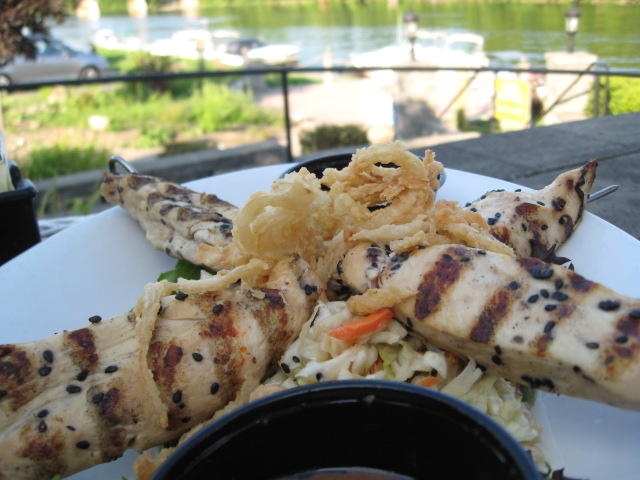
The chicken satay appetizer (big enough for a meal), again at Waters Edge Lighthouse. Note the Mohawk River flowing by behind the food, and yes, boats are bobbing there with the sun reflecting on them. Eating on the water is wonderful—especially when Hurricane Irene is not overflowing the banks; this was another restaurant that flooded last summer.

Vegetable samosa nestled behind a bowl of shrimp masala at Shalimar in Delmar NY. The creamy masala sauce with its peppers and onions is best eaten by dipping garlic naan (bread) into it, though you can eat an awful lot of naan in the process. I am also partial to the bund gobi aloo (cabbage and potatoes) all golden and yummy.

NOT DESSERT—INSTEAD, PRETTY COLORS TO FINISH WITH.

The beer flight at Madison Brewery, Bennington VT. The color, just look at the color and the varying opacities!—so many shades of red, amber, gold. Included in this sampler were Crowtown Pale Ale, Sucker Pond Blonde, Wassick’s White Wall (the cloudy one), Buck’s Honey Wheat, Willoughby’s Scottish Ale, and Old 76 Strong Ale.

Cheers, summer!

Squash Beetles and Old Yeller (not the dog)

Summer squash in July–that survived the dreaded squash beetle.

Last year R, who gardens in a nearby plot, caught me early one morning: Have you found any squash beetles yet?

Squash beetles? The last moment of my baby-gardener innocence…

Yeah, I read about them on the website; here, let me show you what they look like….as he flipped over a big hairy leaf, to reveal even rows of orange eggs along the thick plant veins.

You can control the beetles by squishing them with your fingers before they hatch.

Ewwww, I thought.  But I saw the damage already present in his plants.

Ok, I can do that, I said out loud as I dutifully smushed the few eggs in my own territory. And mashed the increasing masses of eggs on the next visit, and the next few visits after that. My flowers developed into zucchini, acorn and butternut squashes by end of summer, as I researched the critters online, saw the destruction they were capable of, and stayed vigilant in their pursuit.

This year I am a squash beetle pro.

The nymphs are particularly icky—those orderly rows hatch into black-legged, white-bodied reminiscences of the robot spiders of Stargate SG-1; they rapidly swarm the leaf undersides, and stir up an ancient human response: Run away! Run away! As adults, they grow grey shells and crawl around as recognizable beetles, and so don’t engender quite the same gut reaction.

In fact, I haven’t taken pictures of the adults or the lines of eggs, figuring people could just look that up if they were so inclined. Shudder. And the little spider-like stage, well, they skittle away too fast to take pictures. Double shudder.

I have a dear friend who works my plot with me. Because the squash beetles in all their forms (but especially the alien-invader nymphs) horrified my garden-mate when he first observed them, I take it on myself each time we weed to quietly dispatch the egg masses without comment, rubbing them to annihilation between my gloved fingers, sometimes even taking the whole leaf off and boot-grinding the nasty things into the afterlife.

This morning we went to the garden to weed and harvest again, and my garden-partner shivered as he noted, Yup, there are more of those creepy beetles.  I moved in to take care of them.  Later we pulled out a non-producing squash, found a gigantic zucchini hiding under another plant, plucked some sweet sun-colored summer squash, and then he jumped back—Ahh! There’s a g-d spider in here and it’s huge. I haven’t seen anything that big outside of the Adirondack woods!  He caught his breath: Whew! It reminds me of the tarantulas back in Oklahoma that were so large they’d bounce their way across the highway. Literally. Boing, boing, as the cars went by.

Well, this one wasn’t quite that sizable, but was enormous compared to what we’d seen previously in the garden.

Very quickly, the initial startle was overcome by admiration for the arachnid, as we snuck in closely but carefully to observe it.

Bright yellow markings on its back led us to the nickname Old Yeller. It wasn’t a stray like the loyal dog from the book, but rather a creature that belonged right where it was.  Neither did it embody the “ugly” of the original character, but instead stretched out lithe chestnut legs onto a beautifully crafted web in the corner of the pole beans.

Our final thrilling discovery– it was chomping away on a silk-wrapped adult squash beetle!  Tasty I suppose, if one were a spider (a bug-burrito, a calzone of creepy-crawlies) but who cares about gastronomic preferences when your nemesis is being destroyed? Not me.

As we harvested the pole beans very cautiously around its bug-catching lattice, we cheered the helpful spider on: You go, Old Yeller! You’re a pal! Git those squash beetles!

Of course, I don’t know what kind of spider it is. (Arachnologists out there, any ideas?)

We worry a little it’s something poisonous that we’ll have to steer clear of, but, as I was musing afterwards, There’s lots of “dangerous” out there in the world--mosquitoes carrying West Nile Virus, ticks with Lyme Disease, and heck, even humans who will T-bone you with their truck because they are too busy texting.

So I can live with “dangerous.” Especially if it’s swallowing those horrid squash beetles.

Unidentified spider we’ve nicknamed Old Yeller, who dines on nasty ol’ squash beetles

Peas! Beautiful Peas!

Peas and where they come from

I planted the seeds in May, thinking of slim pea-pods stir-fried with rice, but then the plants bleached in the July sun while I was home sick. Finally working in the garden, I thought, Damn, they are done, I left them on the vine too long! but harvested anyway. Maybe there will be some that are still tender….

Back in my kitchen, the pale, bumpy, now-inedible pods surprised me with actually-edible peas hidden inside! This gardener didn’t realize they’d continue on and make something different, like green bell peppers ripening into red.

The big pile of Pisum Sativum pods yielded four ounces of fresh peas—they are sugar snap peas; that’s what I planted, and now I know the difference.  For stir-fry alone, I could have planted snow peas. And if I’d gotten to these sugar snaps sooner, the pods (considered a fruit) would have been edible along with the green vegetable globes. Of course if I had just wanted plain ol’ peas, “shell” would have been the variety for me.

I discovered all this in my favorite educational cookbook: From Asparagus to Zucchini: A Guide to Cooking Farm-Fresh Seasonal Produce 3rd edition by the Madison Wisconsin Area Community Supported Agriculture Coalition, 2004. (You can check out MACSAC here.)

My other lesson for the day–Some of the peapods made just one pea. The thick skin cupped and protected a single perfectly shaped emerald ball.

I used to be like one of the pods that made five, six, seven of these beauties, boom-boom-boom, lemme make some more! —  I believed I had to be the pod that constructed the most and the most exquisite peas!

But look–here is a capsule, so cute, so delightful, that curls around just one pea. Or maybe two, as in my photo, both well formed.  What does that say about production schedules, quantity and quality of what we make?

Sheepishly, I admit now that I don’t have to make “more”, “most”, “better” all the time. Just one pea can be enough.

Some of the pods, bulky and hard to open, reveal withered peas, a few undeveloped blips, little nubs of pre-pea. The cases looked good, but the contents are not as promised.  I don’t want that, either, to half-heartedly construct a life, the outside looking good but the inside empty.

Or, if I see these as unborn creations, ones I didn’t have time or attention for, I could mourn, but not fret too much over them.

Because there are plenty of seeds and soil and water, if I just keep returning to the garden. And thus, plenty of pods to come.

***

Here’s what I made with the peas, again adapted from a favorite Moosewood Cookbook recipe; the original Sri Wasano’s Indonesian Rice Salad involves among other things pineapple and peanuts which, as you may imagine, is a whole different taste sensation.

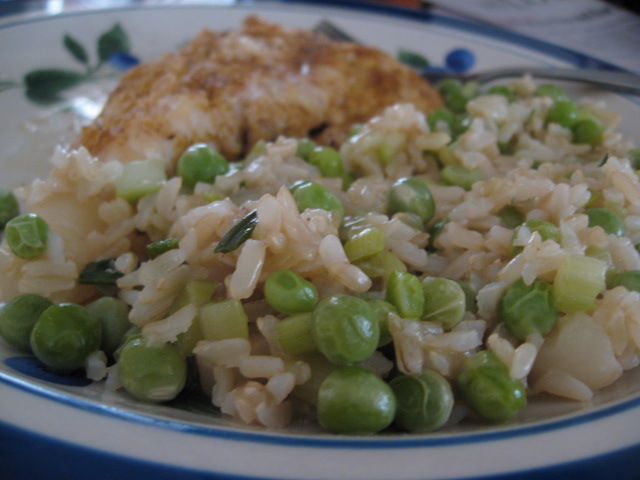
This is not the originally fantasized stir-fry, but satisfied my craving for savory rice with veggies. I served it with a butter-and-olive oil broiled, seasoned whitefish.

Smoky Honey Rice, showcasing my fresh community garden peas.

Smoky Honey Rice

1 ½ cups of (organic) basmati brown rice, cooked in 3 cups of water–while still hot, mix with 4 oz of fresh peas steamed for about 8-10 minutes or until soft, 6 TB of toasted sesame oil, 6 TB of honey, a couple stalks of chopped celery, ½ bunch of chopped scallion (green and white parts), a can of chopped water chestnuts, 1/8 to ¾ tsp of cayenne pepper depending on how spicy you like it, salt or soy sauce & fresh ground pepper to taste.

A+ Student Syndrome, Part Two

The A+ student had a goal.  Or rather, the Artist Formerly Known To Participate in A+ Student Syndrome, who still liked to get things done–that person had a goal.

It was a set of little deadlines, leading to one blog post per week, on Fridays.

In fact, that exceptionally smart person was going to get a few posts ahead, “in the can” as they say, ready to automatically publish–so she wouldn’t have to worry about producing every single week; she could take a little time away if needed, or work on something for longer if it was, you know, Not Quite Ready But Almost.  She luxuriated in thinking and writing, felt cured of the perfectionism.

But then…you might have noticed Of-the-Essence-Blog started on a Wednesday, followed by two Friday posts in a row and…silence until today.

Yes, life intervened before she could get the next piece finished, without that comfortable backlog of essays. Life intervened when she lost a filling on Thursday–Thursday before the Friday when the blog needed updating.

~~~

Just a filling, but really, when you are breakfasting on delicious pastries, and you think, Wow this muffin must have been made with stone-ground corn, and then you see it’s not a misplaced part of the grinding mill, it’s a big hunk of silver which until moments ago fit nicely into a back molar and you’ve never had trouble with fillings before and the jagged tooth then shreds the side of your tongue and egad this needs to be fixed very, very soon and you berate yourself in good A+ student manner for not finding a dentist right away when you moved here and then you think about all the awful life crises that happened to prevent you from finding said dentist and in addition you realize you now can’t eat all the crunchy healthy food in your fridge, thus undermining your campaign to get the clothes you bought last summer to fit more loosely again, and oh my gosh you still haven’t chosen which short piece to edit and put up on your blog–well of course you are going to be emotionally and physically exhausted and incapable of writing about anything for days and days.

~~~

Friday and Saturday went by with no post. Dammit. Behind already.

The list of self-imposed deadlines grew from “little” to “little and belated” to “really overdue and huge and monstrous”; the writer berated herself and returned to strict requirements for things to be Just So.

Aside from not being on time, she saw she hadn’t prettied up her site to her own exacting internal specifications, so she avoided what now felt like drudgery instead of delight, with hours of television episodes on Netflix on Sunday and cleaning out the email queue on Monday and Tuesday, all the while eating too much soft white bread and honey-butter.

The voices returned.

I can’t do this writing thing, I am letting my few readers down, I am letting myself down, I am failing already and I just started.

An unexpected interruption had collapsed the proverbial dromedary’s spine; the pack animal wasn’t as strong as she thought.

Then the former A-plus-er realized that being tired or in pain can turn up the whispers of doubt, which don’t ever go away fully anyhow.  You just get better at identification and quicker at banishment. After seeing them for the untruths they are, no worries linger about straw and burdens–because you are just out enjoying the day’s walk.

Hey! I am not letting anyone down; so I didn’t get to do what I planned.  What’s the big deal? There’s no failure here, just falling down and getting up.

You are a writer. Only fear makes it logical to pulverize your creative children before they are even born. So, write already!

After the new dentist put in a temporary crown and chewing was no longer painful, she took a deep breath. I will try to publish this next Friday. I will.  Then she smiled and shook her head.

In the first post, I said I would be continuing my description of A Plus Student Syndrome. Just didn’t think it would be quite so soon.


First harvest in my community garden plot

As someone who cooks a lot, for myself and others, I use fair trade, seasonal and local, and/or organic ingredients, whenever possible.   Call me crazy but I just believe in these defining attributes strongly, try hard to find them, and encourage others to prefer them over imported, old, pesticide-covered & water-polluting, factory-farm, long-distance food.

Having said all this, I don’t flog myself when I can’t find them. (Striving for perfection, not necessarily reaching it, right?)

As a city dweller without yard access, my fresh veggies with those descriptors come from the farmers’ market, the local grocery, and in the summer, my community garden plot. “Community garden” just means I grew it myself, or a friend did, in a local shared garden; in the Albany & Schenectady area, that would be part of Capital District Community Gardens.

So for me the literal ground-work of April and planting of May have now yielded July’s bounty—

Basil. Many poetic words have been waxed about its delicious properties, its pungent, fruity addition to dishes. But look how gosh darned pretty it is, coming out of the dark earth, growing hard in the night and day! I can taste the sun in it, taste other seashores and countries. As long as I pinch off the tops to keep it from bolting (flowering), it will continue to give me pesto and Thai-spiced vegetables and lime & basil vinaigrettes all summer.

And nothing like the morning light streaming through red chard….Yes, it got a bit old and spotted before I got to it, so I picked leaf after leaf, and tossed it all into green bags in the fridge until it could be washed properly; yes, I used the fancy salad spinner, rinsed it again and again to get the grit off, spin-spin-spin, and then finally cooked it all down. Mild and wonderful to float in soup or drop into stir-fry, it’s one of the “top ten vegetables” for nutrition. Go chard, you subtle thing, you.

Can I tell you what happens when you plant radish seeds in the ground, water them and then leave town without thinning them? You get a lot of radishes. I ended up with piles and piles of mildly spicy roots popping up out of the ground, mostly red but many pink, and a few exciting purple ones. You’ll see the basil here in the sink too, and a little parsley:  clean flavors to go into my salads.

Finally, this is a picture of my bush beans, before they were beans, back when they were just beautiful pinky-purple flowers. I watered, weeded some, went out of town (see above), came back, and almost missed the long stems of bean, hanging hidden behind leaves. They would have been spotty themselves and over-ripe the next time I came to my plot, if another gardener hadn’t pointed them out to me while I was frantically weeding the nasturtiums and watermelons. The former-flowers now-beans have been turned into Five Bean Salad, complete with parsley picked the same day.

Marinated Five Bean Salad Adapted from  Moosewood Cookbook by Mollie Katzen, Ten Speed Press, 1977:

¼ cup raw apple cider vinegar and ¼ cup fair trade olive oil

2 tsp salt and some fresh ground pepper

½ tsp oregano and 1-1 ½ tsp basil

1-2 heaping teaspoons of minced garlic

zest (the yellow part of the peel, taken off with a tool handily called a zester) and juice from half a lemon

1 can each of well-rinsed dark kidneys, black beans, great northern beans, garbanzo beans—or whatever else you’ve got. Mollie recommends freshly cooked beans, but it was just too hot this week!

2 heaping handfuls of fresh community garden bush beans, washed and trimmed

½ bunch of community garden parsley, chopped

1 finely minced red onion; maybe 1 1/2 if you like more onion

Mix all the sauce ingredients together. Cook the green beans in a bit of water (1/2 cup to a cup) until tender (5-10 minutes depending on their age and your definition of “tender”; some people like a crunch to beans; others desire complete abdication).  Mix green beans with canned beans and other ingredients in a big bowl.

This version is much lower fat than the original; I wanted to be able to taste the lemon and the different beans’ nuttiness more than just taste and feel the oil; a cup measures roughly 225 calories. Yummy cold or room temperature.